

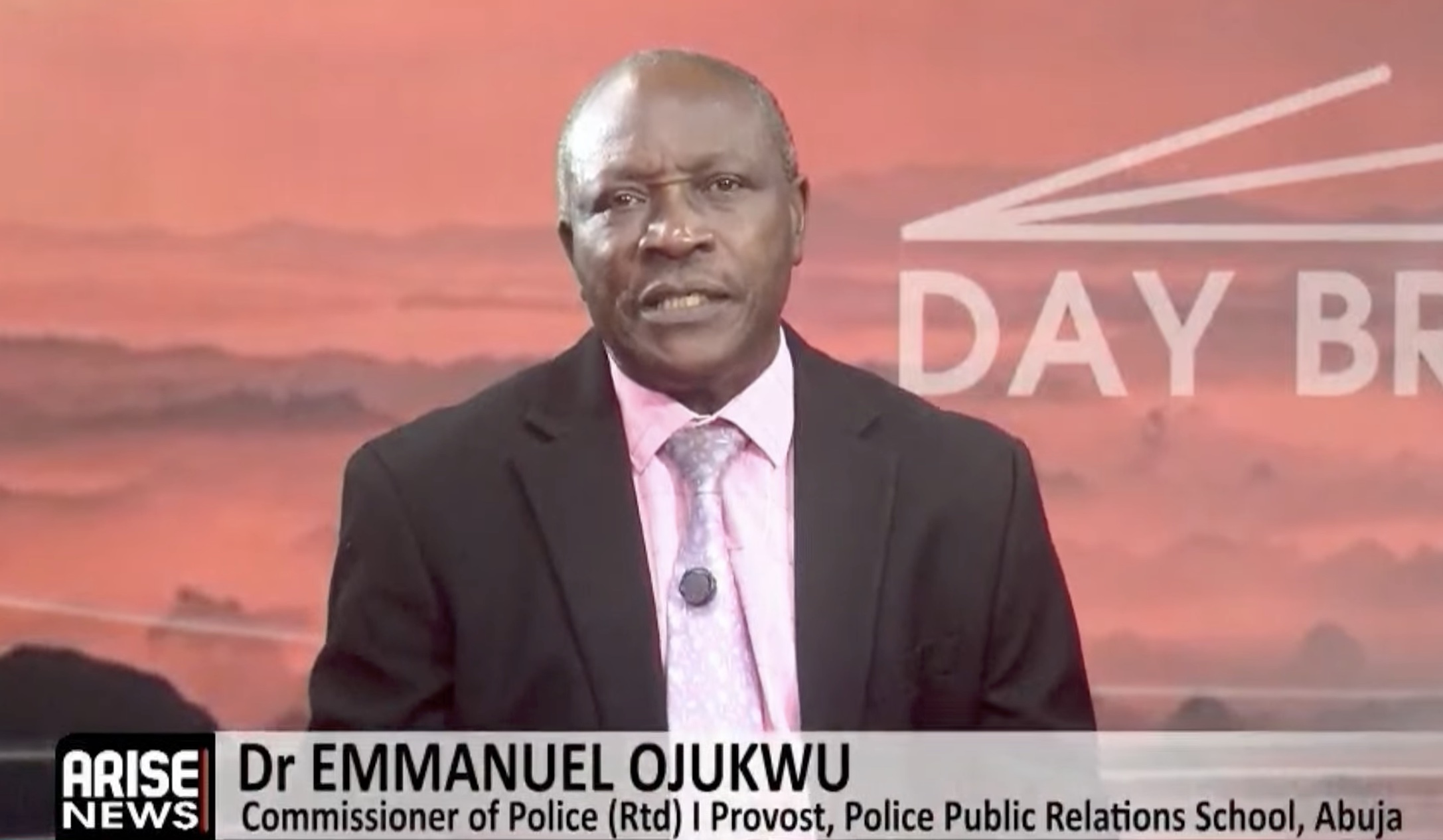
Retired Commissioner of Police, former Public Relations Officer, Nigeria Police Force and Provost 1, Police Public Relations School, Abuja, Dr Emmanuel Ojukwu, has said Nigeria has finally come to terms with the need for state policing, stressing that the proposed reform must not repeat the shortcomings of the federal police.
Speaking on ARISE NEWS on Friday, Dr Ojukwu identified inadequate funding, poor motivation, insufficient equipment and a lack of public trust as key challenges that must be addressed to ensure an effective and accountable state policing system.
“It is good Nigeria has come to terms as regards the need for state policing. It has been brewing over the years, but now we are putting our money where our mouth is.
“For you to have good police services within the various states of the Federation, we need to do a scanning and a proper understanding of why the current federal police, the Nigeria Police so to speak, has not functioned effectively. One of which we know is lack of funding, another one is poor motivation, next is very poor equipment—police are not properly mobilized to do their job—and then, of course, the issue of public trust. If all these factors are properly dissected and analyzed, then we can proffer solutions to them, so that what befell the mother elephant will not behold the younger ones”, he advised.
He also called for greater public participation in the implementation of the proposed State Policing Bill, saying there ought to be broader citizen engagement to allow Nigerians shape the kind of policing they want. According to him, policing belongs to the people and not the government alone, stressing that the public must be carried along and given the opportunity to make meaningful inputs as the bill goes through the states.
“The bill was introduced, and before you could say, ‘How are you?’ the whole thing was passed. There ought to be public engagement, as you rightly mentioned. The public need to make inputs as to what they desire of their police. This police is not for them; it is police with them. It belongs to the people, so they must have an input. It has been said elsewhere that if you want to develop a people—if development is an end, and the people are the end of development—then the people must participate in that development. They must play a role. We must carry people along. But I do believe that now that the bill is going round the states for assent, acclamation, or whatever they call it, maybe the public will make their input as to what they want as police in their various states,” he said.
Acknowledging concerns over the timing of the proposed reform ahead of the 2027 general elections, Dr Ojukwu warned that state police could be manipulated by political actors if adequate safeguards are not put in place.
“I do agree that the rush—we have an election coming, and the tension is there already. There are so many issues that don’t seem to agree with democracy. And so, the fear is that these people who may form state police personnel are going to be lackeys, agents, and foot soldiers in the hands of political actors. We cannot rule it out. The police are always being manipulated by those who call the shots, who pay the piper and call the tunes. So, it may happen this way, but we need to have guidelines and safeguards,” he underscored.
While noting that such fears cannot be ruled out, he stressed that each state must enact clear laws defining the powers, operational limits and accountability of its police, insisting that state police must never become agents or private militias of governors.
“Every state should legislate on its own state police and give them parameters on how to operate and the limits of their powers. The state police are not to be agents or private militia of governors. Another thing is because, many a time, Nigerians who are in politics or who have reins of power want to be prebendalistic. They acquire everything that belongs to the state as if it is personal. If they personalize the police, we may have problems in the 2027 elections,” he warned.
On broader criminal justice reforms, Dr Ojukwu said police reform must be accompanied by reforms across the entire criminal justice system, describing policing, the judiciary and correctional services as interconnected components.
“There are many players in the criminal justice sector in this country and elsewhere. The police is the doorway. It is what the police brings to the court that the court will adjudicate upon, and then whoever they find guilty is sent to the prisons. So, these three elements—the police, the judiciary (and the process of criminal investigation, execution, and prosecution), and the prisons—have to be involved. It has to be a holistic exercise, not doing one aspect and leaving the other.”
He welcomed the proposed review of the Administration of Criminal Justice Act (ACJA), saying existing fault lines must be addressed, while stressing that reforms to policing, the law, legal practice and correctional services should progress together to strengthen the administration of justice.
“So, if the ACJA is being reviewed, that is okay, because there are so many errors and fault lines there that have to be reviewed. Look at how we have removed prisons from the exclusive list; we now have states having correctional services to operate on, but they have not built their own. These things have to be in tandem. As you are reforming the police, which has been very slow, you also reform our laws, the way our lawyers operate, and all the obstacles we face in the course of criminal justice execution in this country,” he stressed.
On the funding of state police, the former Police PRO said there should be no uniform formula for financing state police, arguing that funding should be determined by the specific needs, objectives and security realities of each state, adding that while funding could come from government allocations, grants and donations, state legislatures and their Police Service Commissions should determine the resources required to effectively run their police forces.
“The funding of any establishment or body is based on need. What job specification have you given to this assignment? What are the objectives of state police? How many personnel do we need to effectively implement state police? What are the equipments we need? What is the infrastructure that should be there? All of these things will determine funding. You source funds for them. Funding can come from donations, from grants, as you rightly said, and from normal government allocations. These are parameters that determine it.
“Nobody can give any formula to any state because state police is local police based on the particular needs of the state, their peculiarities, and idiosyncrasies. A police force in Lagos may have 10,000 men, while Bayelsa State may have 5,000 or 2,000. It is according to need. So, the need now determines the key success factors in terms of what you need—the men, the material, and the rest of them—to fund it. Those are the areas the states have to legislate upon, and then the Police Service Commission of various states will help them to determine how much money they need to run their state police,” he explained.
Speaking on the training of state police personnel, Ojukwu said policing across the country must remain uniform and standardised despite the varying security challenges facing different states.
He proposed that existing police training institutions be used to train officers from neighbouring states to ensure consistent standards, while calling for improved funding, better motivation for instructors and greater intervention through the Police Trust Fund to strengthen training institutions.
“As we said earlier on, there are peculiarities according to various states, but policing has to be uniform and standardized. The way policing is done in Adamawa should not be different from the way it is done in Anambra State.
“How do we make it happen? There are about 40 police training institutions approved by law in this country, and the states are members of this country. So, these police facilities, I propose, may be used to train all police officers from the contiguous states. They will go to the one very close to them and get trained, so that there will be a standard. The way you investigate murder or homicide in Kogi State will not be different from the way you investigate murder in Anambra State, for example. There must be standards.
“For these institutions to work, they need proper funding and a proper reorientation of the personnel who are working there, because a good number of them are not happy working there as there is no motivation. That is why I believe the Police Trust Fund has to make serious interventions to make sure police training institutions are up and running and up to standard, so that they can be able to give proper training to officers who attend their institutions,” Dr Ojukwu said.
Favour Odima
Follow us on: