

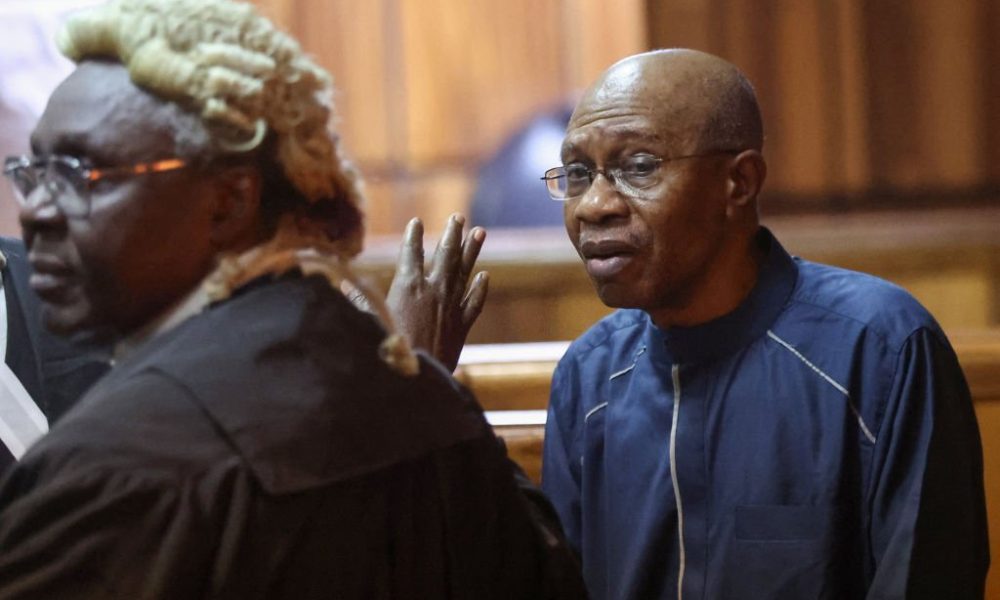
Fresh revelations have emerged in the ongoing trial involving former Governor of the Central Bank of Nigeria (CBN), Godwin Emefiele, as the Special Investigator appointed by the Federal Government alleged that global audit firms Ernst & Young (EY) and KPMG failed to disclose a controversial $6.23 million payment in the apex bank’s 2022 audited financial statements.
Testifying before Justice Hamza Muazu of the Abuja High Court, the Special Investigator, Jim Obazee, accused the two international accounting firms of complicity in what he described as financial irregularities that allegedly occurred during Emefiele’s tenure as CBN governor.
Obazee, who was appointed by President Bola Tinubu in July 2023 to investigate alleged misconduct within the Central Bank of Nigeria and other government agencies, told the court that his investigation uncovered an unauthorized payment of $6.23 million allegedly approved by Emefiele without the necessary supporting documentation.
According to him, the transaction resulted in significant financial losses to the apex bank but was omitted from both the external auditors’ reports and the CBN’s 2022 audited financial statements.
He alleged that EY and KPMG failed to classify the payment as a material “event after the reporting period,” despite the transaction occurring before the bank’s 2022 financial statements were signed.
“The CBN’s financial statement omitted a $6.23 million withdrawal from the ‘Event after the Reporting Period’ (December 2022 to the signing of the 2022 account), which, under Section 50 of the CBN Act 2007, ought to have been disclosed in the audited financial statements presented to the President,” Obazee told the court.
READ ALSO; Appeal Court nullifies Emefiele’s asset forfeiture, Orders retrial
He explained that Section 50(1) of the CBN Act requires the apex bank to submit its certified annual accounts to both the President and the National Assembly within two months after the end of each financial year.
Obazee further pointed out that although the statutory deadline for the submission of the 2022 financial statements was February 28, 2023, the accounts were not signed until May 2023.
According to him, the delay became significant because the disputed $6.23 million withdrawal allegedly took place on February 8, 2023—well before the accounts were signed—and therefore should have been disclosed as a post-reporting event.
He also alleged that the transaction failed to appear in both the domestic report prepared by the external auditors and the internal audit report submitted to the CBN.
“Secondly, the withdrawal of the $6.23 million and the resulting negative balance should have appeared in the domestic report from the external auditors to the apex bank, but it was missing. It also does not appear in the domestic report from the internal auditor to the defendant,” he testified.
Obazee maintained that a review of Note 35 of the CBN’s Consolidated and Separate Financial Statements for the year ended December 31, 2022, supported his findings.
The note, titled “Events after the Reporting Date,” stated that no significant event occurred between the reporting date and the date the accounts were signed that required disclosure or adjustment in the financial statements.
According to Obazee, that declaration was inconsistent with the alleged $6.23 million payment.
During his testimony, the Special Investigator also referred to the international regulatory history of both EY and KPMG, noting that the firms have previously faced sanctions, suspensions and disciplinary actions in several countries over audit failures.
He told the court that KPMG had been sanctioned in jurisdictions including Oman, South Africa, Nigeria, the United Kingdom, the United States, Chile and the United Arab Emirates over various audit-related lapses.
Similarly, he said EY had faced regulatory actions in Germany, Japan, the United Kingdom, the United States and Canada, including sanctions arising from major corporate accounting scandals.
Obazee cited examples such as Germany’s sanctions against EY following the Wirecard scandal and KPMG’s regulatory actions linked to financial reporting controversies in several countries.
The allegations formed part of the prosecution’s evidence in the ongoing proceedings against the former CBN governor.
The trial continues as the court hears further evidence relating to the alleged financial misconduct during Emefiele’s administration at the apex bank.