


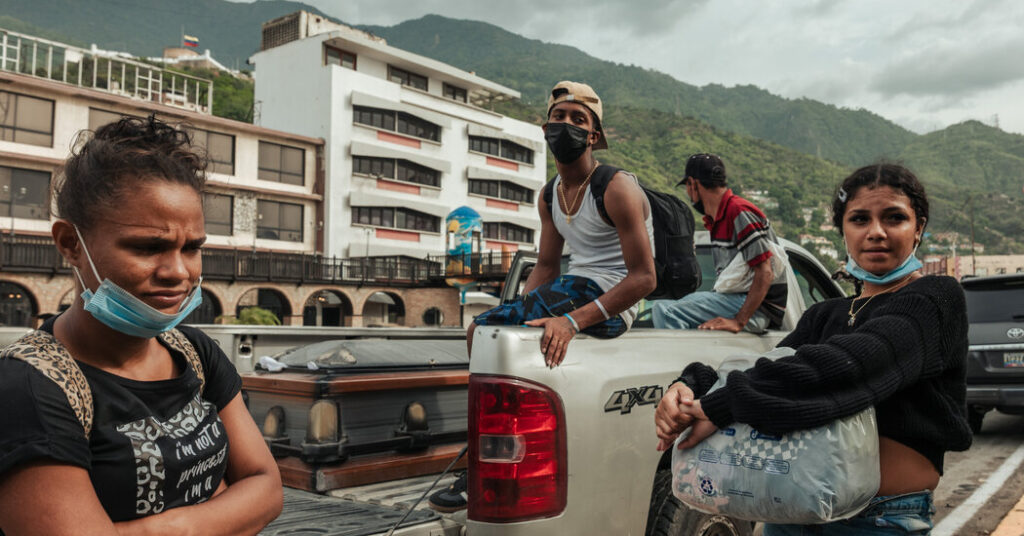
The teenager sat in the passenger’s seat of a pickup truck beside her mother’s coffin and merged into traffic along a coastal road in Venezuela. Michell Mendoza, 16, had escaped the wreckage of one of the many high-rise public housing complexes that collapsed during last month’s catastrophic earthquakes in the state of La Guaira. Her parents and her older brother, however, were killed.
But when Michell and her other family members — mostly children and teenagers — arrived at the hillside graveyard in her town of Caraballeda, the caretaker sent them away. The family did not own a gravesite, he said, and because they could not afford one, Michell could not bury her mother there.
“I didn’t know even graveyards could be private,” said Alexandra Romero, 18, Michell’s sister-in-law, who is six months pregnant, her legs dangling from the pick up in front of the cemetery.
The rejection started a long, painful ordeal for Michell’s family, but it also illustrated the bleak fate that can follow the less privileged even after death.
The back-to-back earthquakes that ravaged northern Venezuela tore through social classes, leveling upscale high-rises and neglected housing blocks alike. Luxury towers and public housing complexes now look identical — both reduced to piles of rubble. Wealthy young women from Caracas and local fishermen from La Guaira spent days sifting through the debris with the same anguish and the same desperate prayers that their loved ones would emerge alive.
But there were differences within this shared horror.
With heavy machinery in short supply, wealthier Venezuelans were able to rent private equipment to aid their search. Many were also able to bury their dead in private family plots, while poorer Venezuelans were forced to cremate their loved ones because of a lack of affordable burial options nearby.
Cremation in Venezuela, as in other Latin American nations, is not historically customary, and in many cases was not what victims, or their relatives, would have wanted.
When Michell, who had kept a calm and gentle attitude for much of the day, returned to the morgue to hand over her mother’s body for cremation, she looked distraught. She said she wanted her mother to be buried in a grave she could visit, not turned into ashes.
“I would have liked to bring her flowers,” she said.
The deep-seated inequalities that are prevalent across Latin America loomed large amid the devastation in Venezuela, prevailing over the grimly equalizing force of a natural disaster and setting even the dead apart.
“We all have the same need” said Victor Calderón Castillo, explaining that over 20 of his family members who lived in the same apartment complex were killed in the earthquakes. For four days, he was forced to stop digging for the last bodies because he had no tools and could not afford to buy them. “But the rich come first.”
Sitting on top of the rubble that had buried his family, he looked at a tall crane operating at a nearby private building. “If you don’t own anything, you are nobody,” he said. “It’s always been like that.”
Cranes and excavators became the most coveted objects in La Guaira — a town now covered in ruins where everything people cared about is trapped beneath collapsed columns and contorted steel.
It is unclear how Venezuela’s government was allocating its stock of heavy machinery, but many victims complained that too little arrived too late.
Some private companies and donors stepped in to operate cranes for free. But several people said that they paid for machines, showing that financial privilege could dictate access to the equipment needed to recover bodies.
Paola Alessandra Peñaloza Gómez, 30, said she was paying a private company $650 a day to search for the body of her father, who had lived in an upscale building along the waterfront in La Guaira.
She said she was grateful that her family could afford it, but acknowledged that “there are buildings that have no machines, buildings that have no money.”
“We have many things that most people don’t have,” she added, and asked: “How do they manage, those who have nothing?”
Many do not.
“Please, I need a machine, I can’t wait any longer,” Vladimir Peña, 29, cried as he ran toward two men operating a piece of machinery at a private apartment complex that had collapsed.
He was looking for his wife, Pribeth Peña, 26, who had lived in a public housing complex reduced to rubble nearby. It had already been two weeks since she was trapped, but he still had hopes of finding her alive. “I don’t want her to die for a lack of help.”
A few blocks away, two excavators, rented privately for about $400 a day, sifted through the rubble of a townhouse to remove a pickup truck buried underneath. Days earlier, the same man had rented the same machines to pull out the bodies of his two children.
Venezuelans turned to crowdfunding or asked friends and relatives abroad for financial help to rent cranes. But even with heavy machinery on site, there was no guarantee that bodies would be recovered.
Ms. Peñalosa Gómez’s father was found after about three weeks of searching. Another family said they had spent $11,500 on a large crane for four days of digging at a destroyed building in Catia la Mar and could not find the bodies of relatives buried under the debris.
Still, having the resources to rent heavy machinery helped some people fight a sense of helplessness that overwhelmed many of those who did not have access to such equipment.
“We had to pull out our relatives with our own hands,” said María Calderón, 52, Mr. Calderón’s sister. Her son, Robert Adrian Hernández Calderón, 30, as well as 17 other family members died in the quakes. When relatives recovered Robert’s body, there was no car to take him to the morgue, she said. So the body sat on the side of the street for five hours until they found a ride.
The only free options to bury him in the ground, she said, were faraway cemeteries, so she had to cremate her son, even though it was not what she wanted.
“There were no other options,” she said.
Venezuelan authorities offered some options to bury the dead for free. They included a mausoleum in a Caracas cemetery, a mass grave in another cemetery and a gravesite the government had dug on a mountain west of La Guaira.
All these options were about an hour’s drive from many of the large housing projects destroyed in the quakes. For residents, many of whom do not own a car, the locations were simply too far.
At nearby cemeteries, burial plots had to be paid for.
“I don’t have 900 dollars to bury the three of them,” said Amarilis Rada, 31, watching rescuers pull a body from rubble, straining to see if it was her 7-year-old son, Adrian. The bodies of her husband and 2-year-old son, Vicneth Elian, had been recovered earlier that day.
Ms. Rada said a cemetery in La Guaira had wanted her to pay $300 to bury each of them. So she cremated the two bodies she had already found while continuing the search for her older son.
“I don’t have money to look,” said Ms. Rada, who used to sell snacks on the beach.
“I didn’t have money to hold a wake for him,” she added, talking about her youngest child. “If I could have held a wake, I would have a place to visit him, a place to go for his birthday.”
Sheyla Urdaneta contributed reporting from Buenos Aires, and Isayen Herrera from La Guaira.