

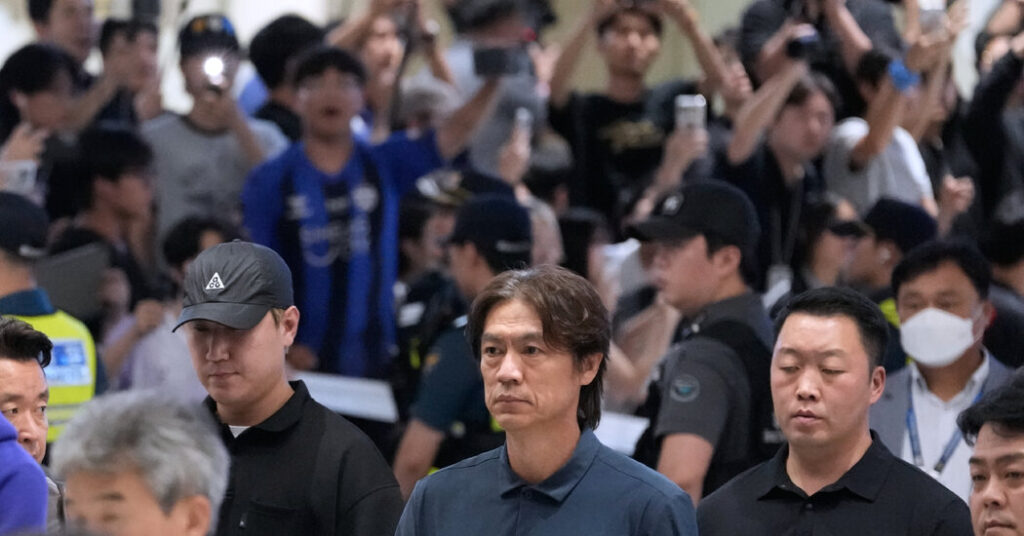
When South Korea crashed out of the World Cup, its fans weren’t just sad and disappointed. Many were furious.
Dozens lined an airport arrivals hall this week to boo and shout insults at Hong Myung-bo, the team’s coach, who had just resigned. A death threat was posted online against Hong, the South Korean news media reported, and police officers were deployed at the airport near Seoul to maintain order when he returned.
Such anger among supporters after a team’s disappointing run in the World Cup is not unique. Here’s a look at some extreme reactions:
The Demonization of David Beckham
David Beckham was among England’s rising stars at the 1998 World Cup. The 23-year-old had already made his mark on the tournament with a spectacular goal against Colombia in the group stage. England then faced a longtime rival, Argentina, in the first knockout round.
Early in the second half, Beckham clashed with Diego Simeone and got a red card for kicking at the Argentine player. A man down, England hung on but lost on penalties. With their World Cup dreams ruined, many fans — and the British tabloids — blamed Beckham.
He faced a torrent of abuse and threats for months. Some demonized him for years. One pub in London hung an effigy of him with a noose around its neck. The Mirror, a tabloid, published a dart board with his face in the center.
When he resumed the domestic English soccer season with Manchester United, he was mercilessly booed and jeered by people at rival stadiums.
Beckham said he was spat at and received death threats. It took a toll on his mental health and he said he did not feel safe for years. “I find it hard to talk through what I went through because it was so extreme,” he said in a 2023 Netflix documentary. “The whole country hated me.”
Racist Abuse
FIFA, the governing body of global soccer, has highlighted a rise in racist attacks online and set up a service to track abusive posts. The service found that racist attacks made up the biggest single category of abusive comments and posts.
It said there has been “a significant increase in the objectively worst, most offensive material” compared with the same stage of the last men’s World Cup, in 2022.
This monitoring service also provides evidence to law enforcement agencies, and FIFA said that it had identified more than 100 cases of abuse during this World Cup’s group stage that met the threshold for pursuing legal action.
Violence
Law enforcement agencies around the world have grappled with violence around soccer matches and tournaments for decades.
During the 2022 World Cup in Qatar, there were reports of confrontations between groups of fans and the police in several European cities after France defeated Morocco in the semifinal. In the French city of Montpelier, a man who was driving a car with a French flag hanging from it was confronted by a group of Morocco supporters. As he drove away, he struck a boy, who later died, the French news media reported.
Deadly violence has sometimes followed losses by national teams. In 1990, two people died in rioting in England after its team lost to West Germany. In 1998, Mexico’s defeat by Germany set off violence in Mexico City that left a man dead and dozens of other people injured.
Sometimes unrest has involved fans of victorious teams. After Morocco knocked out the Netherlands this week, celebrations erupted in several European cities. The police clashed with some Morocco fans in The Hague, and the authorities said officers were targeted with stones and fireworks. The police said 13 people were arrested.