

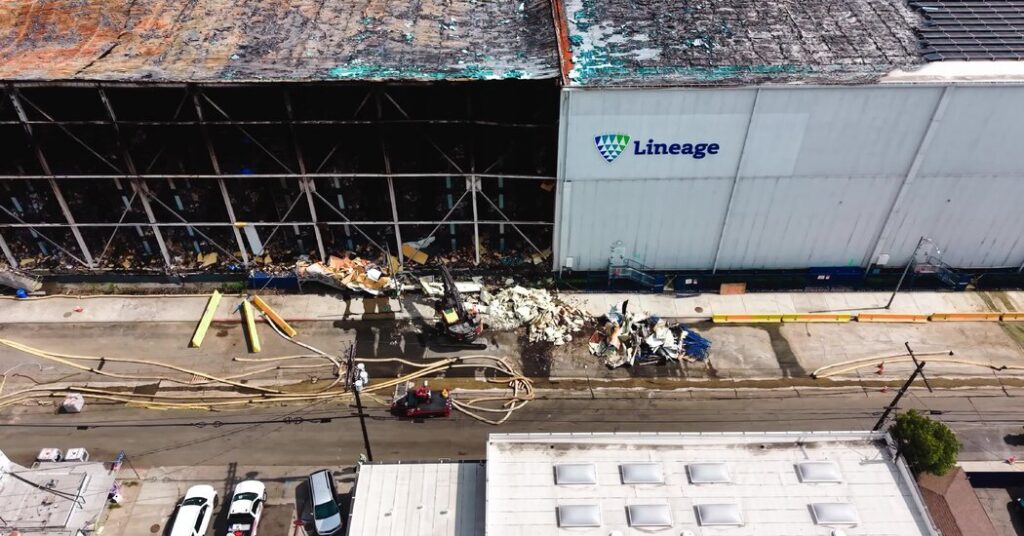
Residents who live near a massive industrial fire east of downtown Los Angeles had to first deal with days of thick smoke overhead.
The fire at a cold-storage warehouse has been out for more than a week, but now people in the working-class Latino communities of Boyle Heights and East Los Angeles are struggling to survive another nuisance: the smell.
The warehouse stored 85 million pounds of food. Weeks after the fire broke out on June 17, that food — beef, pork, poultry, seafood — is now rotting, filling parts of the residential streets nearby with a distinct stench. Workers have been hauling out spoiled food and debris, but residents say the cleanup hasn’t been fast enough.
The complaints of odor and fears of rodents add new concerns to an industrial disaster that had already worried officials about the health effects of toxic smoke, the elevated levels of air pollution and the environmental impact along the nearby Los Angeles River.
Some residents said the stench sticks to their masks and clothes. Others said they had stayed indoors for days because of the smoke, and now they limit their time outdoors because of the smell. Their complaints about the odor come on top of their deeper concerns about headaches, breathing problems and burning eyes.
On Tuesday afternoon, cleanup crews used trucks and heavy equipment inside and outside the site, but the streets surrounding the warehouse were largely quiet. The smell of rotten food varied in intensity depending on the wind and a person’s proximity to the building, which takes up an entire city block. If the scent could be bottled into a perfume, it would have hints of mold with traces of that gag-inducing dead-animal smell.
Rene Lopez, 55, who lives two doors from the warehouse, had been looking forward to firing up the grill to celebrate the Fourth of July this weekend. Not anymore.
“I cannot do carne asada because of the smell,” Mr. Lopez said. “I’m going to be throwing up.”
Blocks from the warehouse in East Los Angeles, Remedios Reyes Ruelas, 68, said she has had persistent headaches and chest pains, and is worried her house might be contaminated by smoke.
“We’re tired of having our doors and windows shut,” Ms. Reyes said. “We’re tired.”
Ms. Reyes said she was angry that the authorities seemed unprepared to respond to an industrial fire so close to people’s homes and that no officials had come to her door the day the fire broke out to tell her to evacuate.
She emerged from her small yellow house on Tuesday and stood on her driveway. A brief moment provided a snapshot of life in East Los Angeles now: Ms. Reyes pulled her shirt over nose and mouth, a man fixing her gate covered his face with a bandanna and a neighbor walking by wore a blue surgical-style mask. All three questioned officials’ preparedness and response to the fire.
Ms. Reyes’s masked neighbor, who did not want to be identified, said officials didn’t pay attention to them because they were poor and Latino, and the worker fixing Ms. Reyes’s gate, Frank Morelos, agreed.
“If this were a white neighborhood, they would have evacuated everyone,” Mr. Morelos said.
Mayor Karen Bass and other officials said they had taken steps to help residents through the crisis but that their work was ongoing.
Officials distributed respirators and air purifiers to residents and set up free mobile health clinics. Ms. Bass ordered Lineage, the logistics company that operates the warehouse, to remove all rotting food from the site within 45 days. As of Wednesday, 75 truckloads of food waste had been removed since work began on Sunday, officials said. The food waste was being doused with a deodorizer before transport, and misters were being used to try to contain the smell, according to the mayor’s office.
“Warehouses like this do not exist in affluent neighborhoods — they exist in low-income communities of color,” Ms. Bass said in a statement. “As mayor, my responsibility is to ensure this community is safer moving forward than it was before the fire began.”
In a statement, Lineage said its crews were working around the clock to clear the site, and that the company had donated $2 million to local organizations to assist residents.
The Los Angeles County Public Health Department said there was a significant uptick in patients who reported smoke- and fire-related symptoms in emergency rooms within a 10-mile radius of the building in the week after the fire began.
One of those patients was the sister of Mr. Lopez, who changed his Fourth of July plans.
He said his sister has emphysema, a lung disease, and went to the emergency room in the early days of the fire. She is doing better now, he said, but when she comes home from work, she struggles to breathe and has to use her inhaler and oxygen tank more frequently.
“She wants to leave, but where can she go?” Mr. Lopez said. “We don’t have any place to go.”
Shawn Hubler contributed reporting.