

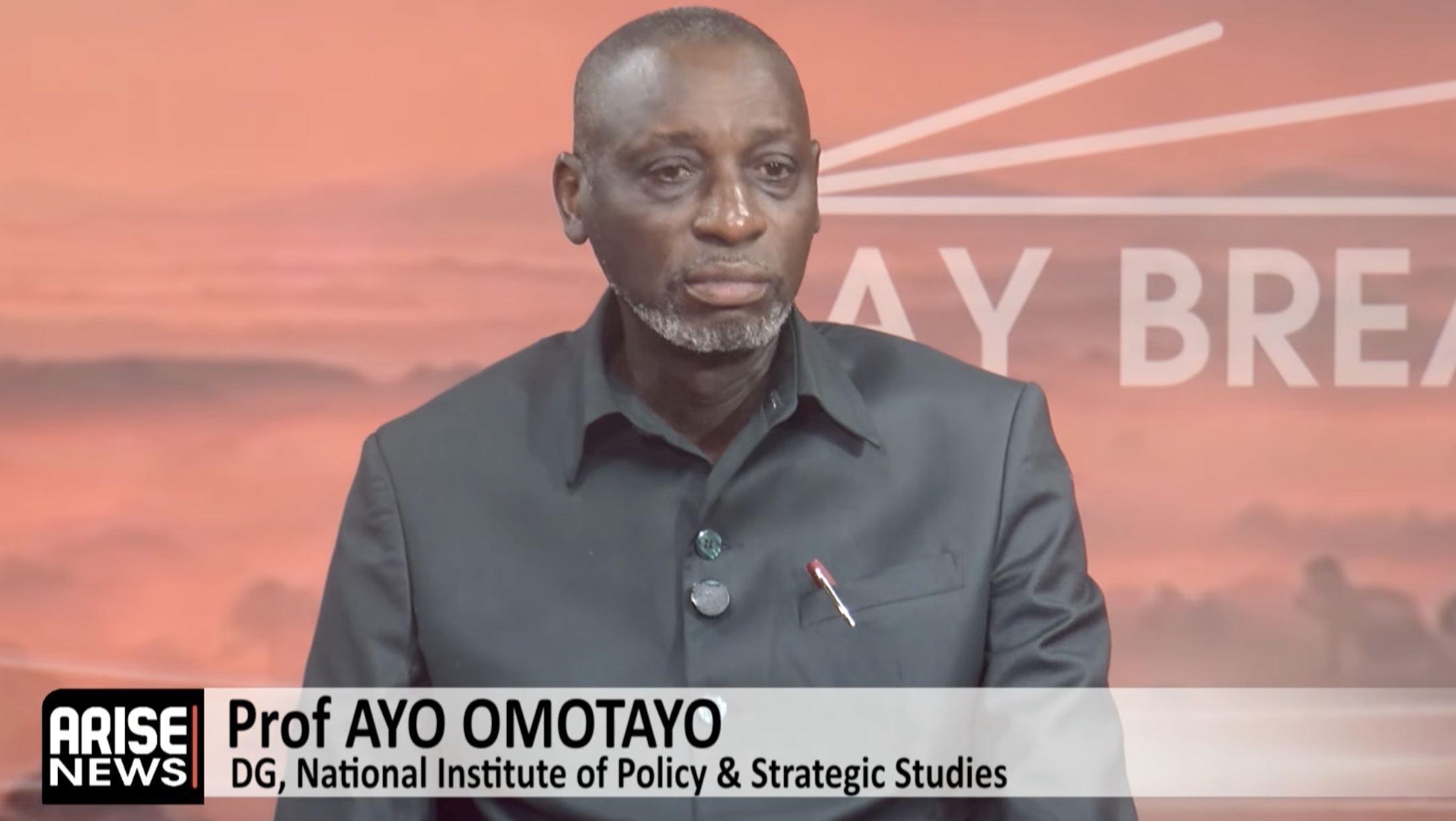
The Director General of the National Institute of Policy and Strategic Studies, Professor Ayo Omotayo, has said security agencies are still investigating the recent attack on the institute and have yet to identify those responsible.
Recall that armed men on 15, June, attempted to breach the perimeter of the National Institute for Policy and Strategic Studies (NIPSS) in Kuru, Plateau State. Security personnel engaged the attackers in a gun battle, preventing them from gaining access to the facility. The attack claimed the lives of three security operatives — reportedly two soldiers and a police officer — prompting the deployment of additional security personnel and intensified patrols around the institute.
Speaking during an interview on ARISE NEWS on Friday, Prof. Omotayo said authorities had advised the institute’s management to exercise caution in commenting on the incident until investigations are concluded.
“For those responsible, at this time, we are not too sure. The security agencies are carrying out their investigations, and we have been asked to be careful about what we say until they conclude those investigations,” he said.
Prof. Omotayo however said while investigations are ongoing, several groups could have an interest in destabilising the institute, including local militias aggrieved over alleged unpaid compensation for land occupied by NIPSS and herders who frequently operate around its perimeter.
“However, it could be a number of groups who could be behind it. We have the local militia who have always been bothered about the National Institute not paying compensation for the land that we occupy. Of course, we also have the herdsmen who are always hanging around the perimeter of the institute. A whole lot of other people could have an interest in disturbing the peace of the National Institute.”
He added that the attack, which claimed the lives of three security officers, has prompted a review of the institute’s security protocols, with authorities abandoning the use of warning shots in favour of a more robust response to future threats.
“As you know, we believe the National Institute has a very tough perimeter and that we are like a fortress that nobody can try. Of course, they tried, and unfortunately, they killed three security officers. The normal procedure in the past was to deter people from trying to come into our perimeter by shooting into the air so that they would know they are warned. On that particular occasion on June 16th, they decided to fully attack. Because of this, we have now changed the rules of engagement. We are not going to fire deterrent shots anymore. Anyone that comes close to the perimeter will face the full consequences of trying to disturb the peace of the National Institute,” he revealed.
The NIPSS Director-General further noted that it was not impossible that the attack was aimed at disrupting the institute’s strategic role as Nigeria’s foremost policy think tank. According to him, individuals or groups opposed to national unity and progress could seek to embarrass the government by targeting the institute and hindering its operations.
“Well, it’s not impossible. Bad guys are always there, and those who have interests different from promoting unity and progress in Nigeria might think, ‘Oh, because of the role the National Institute plays, let us embarrass the government by trying to stop that place from functioning properly.’
“In the past few years, everybody has seen what the National Institute has been doing—pushing the government’s agenda, ensuring that we execute our mandates to the maximum level possible, and training manpower to run the bureaucracy and our economic system to ensure Nigerians get the dividends of democracy. People might think too much is coming out from here, so let us try to disturb the peace of this place. A whole lot of things are in the mix,” he noted.
On the Federal Government’s policy of reintegrating repentant terrorists and bandits, Omotayo said the strategy should not be regarded as a complete failure, noting that a similar approach adopted during the Niger Delta crisis yielded positive results.
“First, you must know that we have tried this strategy in the past. When we had problems in the Niger Delta, we used this same technique to calm that particular space, and it worked. If something has worked elsewhere, the tendency is for you to want to also try it in some other spaces,” he said.
He argued that rehabilitation and reintegration provide an opportunity for offenders to reform and reconnect with society, although he acknowledged the need to continually review and improve the process where necessary. According to him, extending an “olive branch” to those willing to abandon violence remains an important first step before more drastic measures are considered against those who refuse to change.
“As it stands, we are still evaluating whether there is a wholesale failure in trying to reintegrate these people into society. Don’t forget that they are Nigerians, and when someone does something wrong, they often have their own protestations. You must give room for reform, give room for re-educating the people, and give room for them to relearn what they didn’t know or correct what they have been doing wrongly.
“I do not feel that it is a wholesale failure. We need to watch the situation and maybe rejig the way we are doing this reintegration. For us at the National Institute, we believe that efforts being made by the government to reform Boko Haram jihadists are not in themselves wrong. The first thing is to throw out the olive branch and ask people to come talk. For me, I think that is how to start. It is only when they refuse to get refined that we have to do something drastic,” the NIPSS DG said.
Acknowledging that the Niger Delta crisis and insurgency in northern Nigeria are different challenges, Prof. Omotayo said governments often adapt solutions that have worked elsewhere but must be willing to review and adjust them if they prove ineffective.
“Like I mentioned, these are different spaces. If you have a problem and you use a solution that works in a particular space, the tendency is to want to use that same solution in a different space. But once you try it and you see that it is not working as intended, there is nothing wrong in rejigging what you need to do to solve the problem.”
On the debate over the future of Nigeria’s refineries, Prof. Omotayo maintained that government must weigh the costs and benefits of rehabilitation against disposal while assessing the country’s long-term energy needs.
“The refineries, as we have them, may still have hope. They will have hope because there have been Nigerians working there for so many years. Taking a decision on whether to sell or not to sell has to be deeply looked at. On the face value of it, the first tendency is to ask the hard questions: Can we make this work? What exactly is wrong?
“Having spent so much money in the past does not mean that the refineries cannot work. They probably didn’t work because of other systemic matters, but this is a different government that believes it can deliver to the people. If you sell the refineries as they are, you have to ask yourself: at what cost? If we diligently look at these refineries, bring in experts, and truthfully and honestly re-engineer what is there, can we still get some value? Those are the issues we have to look at,” he explained.
Comparing the state-owned refineries with the Dangote Refinery, Prof. Omotayo said the two operate under different models, noting that the privately funded refinery was built from scratch without the legacy challenges facing government-owned facilities. He argued that previous failures do not mean the refineries cannot work again if properly managed and restructured.
“The amount of money spent by Dangote was spent by a private sector entity. When a refinery is owned by the government, you know that there is going to be a different approach to how things are managed. I told you a whole lot of legacy issues troubled those refineries. Dangote started anew, learning from what had failed previously, so it certainly would not go down that same route.
“I don’t think I can sit here and say definitively whether it is good to sell or good not to sell unless all the parameters are laid out on the table. But what I am saying is that the fact that past governments spent money and nothing happened does not mean that the refineries can actually never work again,” he insisted.
Speaking on the rising hunger crisis in northern Nigeria, Omotayo rejected claims that the administration was failing the region, questioning the methodology behind reports indicating worsening food insecurity and calling for local data to validate such findings.
“That would certainly not be a true assertion. Number one, I do not always believe blindly in these statistics. I am not saying they don’t do their work, but when somebody comes up and says 2 million people have been made poorer or 2 million people are now hungry, we have to ask how they arrived at these figures. To ask if Northerners have become poorer—we cannot simply say they have become poorer without carrying out comprehensive studies to verify it. I am not going to just allow an external report to tell me this is happening when we do not have the localized statistics to prove it,” he stressd.
Omotayo acknowledged that insecurity and flooding have posed challenges to food production in parts of northern Nigeria but maintained that agricultural output has improved as more farmers return to their farms.
“The North is challenged because of the fact that we have had floodings and we have had security issues, just like we have in other parts of the country. However, if food production increases and food prices come down, then you can say that it means production is actively taking place. I can tell you for free that where we were two years ago is not where we are today. Food production has gone up, and that is because farmers have been able to return to the farms. The major problem we had in the Northeast last year was the massive flooding that affected the bean plantations.”
He added that studies conducted by NIPSS do not support claims that poverty in the region has worsened under the current administration.
“ We have carried out studies, and we do not have the figures to support the claim that the North has become progressively poorer since we started this administration,” he stated.
Speaking more on data from NIPSS on hunger and poverty in northern Nigeria, the DG said the institute’s findings do not support claims that an additional two million people have fallen into extreme hunger, arguing that increased food production and lower prices point to improving conditions.
“We do not have that same data claiming an additional 2 million Northerners are plunged into hunger,” he maintained.
“Our own data reflects patterns, and this is how you interpret them. Two years ago when the president came into office, the insecurity issue was very high and food prices were extremely high because farmers could not go to the markets or fields safely. Now, we see that food prices have dropped in several areas as a result of production increases. Does it make logical sense to now say that people have become poorer? It is clear that if you are producing more, prices will drop, and that is exactly why prices have stabilized or dropped in key sectors—it means a whole lot of people have been able to go back to their farms and do their jobs. What other data do I need? It is clear,” he insisted.
Commenting on the proposed state policing bill, Professor Omotayo expressed support for the initiative, saying the framework draws from principles of community policing previously studied by NIPSS and should be given an opportunity to prove effective, with adjustments made where necessary.
“For us at the National Institute, I think it was in 2018 that we did a whole lot of studies on community policing. We believe that the same basic strategy for running community policing is what has largely been adopted in the framework for state policing.
“I have seen what is proposed out there, and I believe that we need to give it a trial. I feel that getting states directly involved in policing is the right thing to do, and the way it has been structurally set up is going to make it work. We have done a whole lot of work and carried out extensive studies on this, and I believe we have to give the new structure a chance. There will be a need to tweak and fine-tune it at some point, but right now, we need to give it a chance,” he urged.
Favour Odima
Follow us on: