


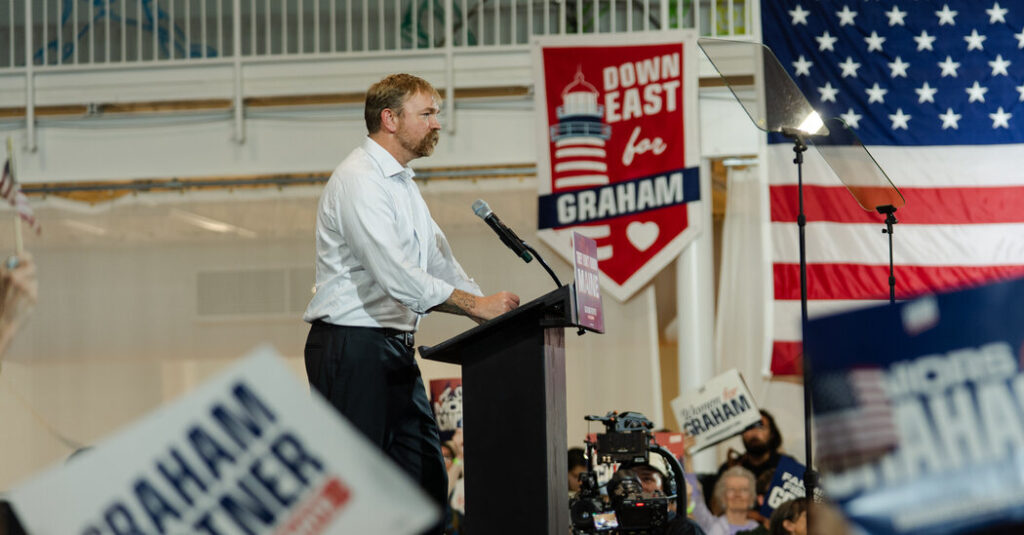
They told him that he was “the guy.”
Last July, in a small town in coastal Maine, three progressive, self-styled recruiters of economic populists showed up at the blue-shingled house of Graham Platner, a little-known oyster farmer and Marine veteran who lived largely off government benefits.
They knew his name from local labor organizers and activists, and they had watched a video on the internet of him talking about oysters. Struck by his left-leaning ideology, his working-class affect and his gravelly voice, they became convinced that he could win a Senate seat in Maine — and quickly persuaded Mr. Platner of the same.
The recruiters — Dan Moraff, Leanne Fan and Morris Katz — told Mr. Platner he was “the one,” a “hero of the movement,” “a historical figure” who could be “leading a revolution,” according to half a dozen people with knowledge of their conversations.
But a clutch of people who cared about Mr. Platner were telling him something else. They worried about his mental health, amid his ongoing efforts to heal from post-traumatic stress disorder after tours in Iraq and Afghanistan. They feared this trio of out-of-state operatives was a dangerous combination of inexperienced and overconfident. The worst-case scenario, they thought, wasn’t running for Senate and losing — it was destroying the life he worked hard to build.
Until recently, Mr. Platner had seemed to prove the worriers wrong. His campaign was pumping out viral videos and broadcasting scenes from crowded town halls. He easily pushed a sitting governor out of the Democratic primary as voters embraced his message of economic populism and overlooked his checkered past. Progressives across the country heralded him as a new left-wing hero and saw him as their best opportunity to defeat Senator Susan Collins, a Republican, in a race that could decide control of the Senate.
But behind the scenes, his campaign was messy, disorganized and haphazardly run. Mr. Platner did not disclose explosive, politically damaging secrets to key members of his team. And he was guarded by an insular and zealously protective inner circle of advisers who did not always seem to grasp the seriousness — or strangeness — of what quickly became a steady drip of scandal, according to party strategists, Democratic officials and former staff members.
Repeatedly, Mr. Platner promised there was nothing else damaging from his past to come. And each time, he was wrong.
Mr. Platner, said Ronald Holmes III, his former national finance director, was “seriously flawed.” But he faulted Mr. Platner’s team for failing to “ask the right questions and get honest answers.”
In a statement, the campaign disputed the idea that there was a lack of planning or infrastructure as “simply false,” and said that the team “built the operation, strategy, and organization needed to create one of the strongest grass-roots campaigns Maine has ever seen.”
This report is based on interviews with more than 30 people who interacted with the campaign or Mr. Platner, many of whom were granted anonymity to discuss sensitive matters.
In June, as rumors swirled about a damaging story coming from The New York Times featuring several of Mr. Platner’s ex-girlfriends, Mr. Katz called a top national Democratic strategist, insisting that there were no issues in Mr. Platner’s past concerning his treatment of women, according to a person with direct knowledge of the conversation.
Mr. Katz said he had asked Mr. Platner directly and repeatedly whether anyone had made sexual assault allegations against him and the candidate had said no, according to two people familiar with the discussion who described it on the condition of anonymity.
“It’s been a slow-rolling disaster instead of all happening at once — it’s been really drawn out and painful and difficult to watch,” added Mr. Holmes, who resigned last fall after raising concerns about the professionalism of the campaign’s senior leadership. “It’s like we’ve been watching a mile-long train derail at four miles an hour.”
That train finally crashed this week, when a woman who had dated Mr. Platner accused him of rape. He denied the allegation, but released a video saying he was taking time to “reflect” on his path forward.
Within roughly 24 hours, Democrats at every level had called for him to withdraw, and the Maine Democratic Party was on a war footing with its own nominee. Ambitious politicians were taking steps to try to succeed him on the ticket. And Democrats across the country wondered how one of their best chances to flip a Senate seat had imploded.
A ‘Totenkopf’ tattoo
Before Mr. Platner became the Democrats’ biggest headache, his most ardent supporters spoke about him in strikingly lofty terms.
As his campaign was getting off the ground, Mr. Moraff likened him to Barack Obama in conversations with senior Democratic officials, according to two people with knowledge of the private conversations.
But there were early signs that Mr. Platner had serious political liabilities. Less than two weeks after he announced his bid, his wife, Amy Gertner, approached a top campaign aide. She wanted to disclose that Mr. Platner had been exchanging sexual messages with multiple women.
Mr. Platner was about to hold a campaign event with Senator Bernie Sanders, his first major endorser and a personal hero. Ms. Gertner told Genevieve McDonald, then the campaign’s political director, that she worried Mr. Sanders would think less of her husband if he later found out about the exchanges with other women, Ms. McDonald recalled.
Was that the extent of the controversy in Mr. Platner’s personal life or was there more to worry about? Campaign officials appeared not to know.
A top Platner adviser had promised a national Democratic strategist that they would not launch a campaign without completing a full investigation of Mr. Platner’s background. But, according to two people familiar with the campaign’s operations, no extensive effort was undertaken in one of the marquee races of the midterm cycle.
Instead, they conducted an expedited review, resulting in a short risk-assessment memo.
Mr. Platner’s campaign said that a research firm produced a vetting memo of nearly 50 pages that included searches of news reports, social media posts and public documents. They did not do exhaustive interviews with Mr. Platner.
“I said, ‘None of this will or should stop him from becoming a U.S. senator,’” Mr. Moraff told The Wall Street Journal.
But others had access to significantly more damaging information about Mr. Platner’s past.
In Northern Virginia, Lyndsey Fifield, a former girlfriend of Mr. Platner’s, texted a private group chat of friends last summer about a tattoo on his chest widely recognized as a Nazi symbol. He had gotten it while serving in the military and referred to it, she has said, as “my Totenkopf.”
The “Nazi tattoo on his chest,” Ms. Fifield suggested, was going to be a problem.
The existence of the tattoo, however, did not immediately become public. In the meantime, Mr. Platner’s campaign began to find an audience. He drew bigger and bigger crowds, crisscrossing the state for events and spending hours gabbing on podcasts.
Yet controversies kept arising. In October, CNN and other news outlets uncovered a trove of incendiary online posts that Mr. Platner had written between 2009 and 2021, which included dismissive comments about rape and sexual assault in the military.
Mr. Platner apologized, and has urged the public not to judge him for his worst moments on the internet.
The lack of disclosure about his past made Ms. McDonald, a former state legislator and lobbyist, uncomfortable. She quit the campaign in October.
Around the same time, photos of Mr. Platner’s tattoo from his wife’s Facebook account began leaking to news organizations.
The Platner team, hoping to defuse the potential damage, released video footage of a shirtless Mr. Platner with the tattoo visible to Pod Save America, a liberal podcast that supported his bid.
In a friendly interview, Mr. Platner dismissed the issue as little more than pearl-clutching by his opponents. “I am not a secret Nazi,” he said. “Lifelong opponent.”
At the time, Mr. Platner said in a statement that he did not know that his tattoo resembled a Nazi symbol until it became a campaign issue.
More staffers, including Mr. Holmes, left the campaign.
“It’s not that complicated”
For months, there was little indication that any of the controversy was seriously hurting his candidacy.
As Mr. Platner’s star rose through the winter and early spring, Mr. Katz was privately promoting him as a future presidential candidate for as soon as 2028, if he won his Senate bid.
When Janet Mills, his chief Democratic primary opponent, produced tough ads featuring his comments about women and rape, it did little to change the trajectory of the race. Poll after poll showed Mr. Platner leading Ms. Mills, a two-term governor who was supported by national Democratic leaders, by double-digits.
Mr. Platner built a movement-like following, emerging as one of his party’s most powerful online fund-raisers. His campaign constructed an image of a working-class combat veteran who had returned to Maine to rebuild his life, who spoke movingly about the failings of American foreign policy and rallied voters with his promises to take on a political system dominated by corporations and billionaires. Democrats flocked to his town hall meetings.
Publicly, at least, the candidate expressed nothing but bravado.
In an April interview, he dismissed any jitters about going up against Ms. Mills — a former prosecutor — in a series of planned public debates.
Mr. Platner had debated before, he said, in college classes. His preparations, he said, were “standard run-of-the mill debate prep.”
“Honestly, I’ve seen enough and read enough about politics that it looks and sounds very much like what debate prep usually looks like,” he said.
He added: “Standing up and talking about the things you believe in, it’s not that complicated.”
Mr. Platner’s theory about debating would never be tested. The next morning, Ms. Mills dropped out the race, saying she lacked the funds to compete.
But by June, Mr. Platner was trailing far behind Ms. Collins in campaign funds. Mr. Platner’s campaign had just $1.3 million in the bank when he exited the race, a fraction of Ms. Collins’s $9.7 million war chest as of late May. A person familiar with the campaign’s finances said the amount of cash available to spend was even lower — under $100,000.
The campaign raised nearly $9 million last quarter, said a campaign official, more than doubling the previous quarter’s haul. While the campaign successfully focused on attracting small-dollar donations, it struggled to recruit and retain big-dollar donors.
Campaign aides told top Democratic strategists that donors kept raising concerns about the tattoo and his other controversies. Their requests for help assuaging donors’ concerns were met with silence from the national committee, according to three people familiar with discussions.
Last week, Mr. Platner kicked off a call with a new national finance committee — a first, if belated, step to bundle checks from wealthy donors, according to an invitation seen by The Times. And the campaign took its worries about money public, warning on a call with reporters that he was being swamped on the airwaves.
Estimates showed they were set to be outspent by 2 to 1 on advertising by Ms. Collins and her allies through Election Day, according to data from the media tracking firm AdImpact.
“I was training with my jujitsu buddies at my kids’ class yesterday,” Ben Chin, Mr. Platner’s campaign manager, told reporters. “There were these radio ads that were coming on as we were listening, and people were starting to give me a hard time, like, ‘Oh, where are your radio ads?’”
A campaign in crisis
The campaign’s money troubles were exacerbated by a series of even more damaging revelations about his personal conduct and treatment of women. In May, The Wall Street Journal and The New York Times published stories detailing sexual text exchanges with women that had worried Ms. McDonald and Ms. Gertner nearly 10 months earlier.
In early June, Mr. Platner found himself in a private meeting in Washington facing questions from senators about whether more damaging revelations were yet to come. He promised that there was nothing else, according to a person familiar with the discussion.
But it became clear that Mr. Platner and his team were in crisis mode. He flew home to Maine, and frantically dialed ex-girlfriends to find people who would testify to his good character.
He called Representative Ro Khanna, an early supporter from California, to warn him that The Times was going to publish a story that would detail his “toxic relationships.” He was a “terrible boyfriend” and made misogynistic comments, he said, according to someone familiar with the discussion, but nothing worse.
Days later, The Times published accounts from three women who had been in romantic relationships with Mr. Platner for years. They said he could be demeaning to women and, in at least one case, even physically threatening.
In the immediate aftermath, many activists and politicians went to their partisan corners.
“There are no saints in the United States Senate,” Mr. Sanders said.
But other prominent Democrats started speaking out more bluntly. In private meetings, even strong supporters began raising concerns.
“I look forward to the day where I am not answering every single week a question about bad behavior by another dude,” said an exasperated Senator Elissa Slotkin, a Michigan Democrat, in an interview on MS Now.
By late June, Mr. Platner found what he hoped would be a powerful answer to critics: an endorsement by Planned Parenthood Action Fund at a splashy rally, portraying him as a champion of abortion rights.
Planned Parenthood officials knew their endorsement was a political risk, according to someone familiar with internal discussions. But they desperately wanted to defeat Ms. Collins.
Before they offered their endorsement, Alexis McGill Johnson, the chief executive of the group’s political arm, had posed to Mr. Platner the question that so many others had asked: Was there anything else that would come out about him?
Again, he said no. She responded with an ultimatum. If anything worse were to come out about him, he should not expect the women’s groups to clean up after him.
On Monday evening, as news that he had been accused of rape ricocheted across the country, the group quickly withdrew its support.
By midweek, as Democratic officials pushed for Mr. Platner to rapidly exit the race, the besieged candidate and a handful of aides, including Mr. Katz, hunkered down in his blue-shingled house and tried to challenge establishment politics one last time. Journalists trailed them to the local convenience store, where “The Graham,” a roast beef and pepper-jack sub, has been a popular deli counter order.
On Wednesday night, his campaign released a video in which Mr. Platner suspended his campaign and blamed his loss on the “corporate media system” and “political establishment.”
“We did it the right way,” he said. “And we won and now they are not going to let us have it. Not if it’s me.”