

Tehran and Washington are doubling down on their standoff over the Strait of Hormuz, as a Red Sea blockade risks shutting another key shipping route amid an expanding war.
Days of U.S. strikes have not loosened Tehran’s chokehold over the Strait of Hormuz, a vital corridor for the world’s oil supply, while tit-for-tat strikes have taken the place of a collapsed ceasefire.
A tanker came under attack in the strait early Tuesday, near Oman, forcing the crew to abandon the ship on a lifeboat, the British navy’s maritime trade operations center said. Iran said fires broke out on two tankers that passed through an unauthorized route.
“As long as American hostilities in the region continue, the Strait of Hormuz will remain closed,” Iran’s Islamic Revolutionary Guard Corps said in remarks carried by the semiofficial Tasnim News Agency.
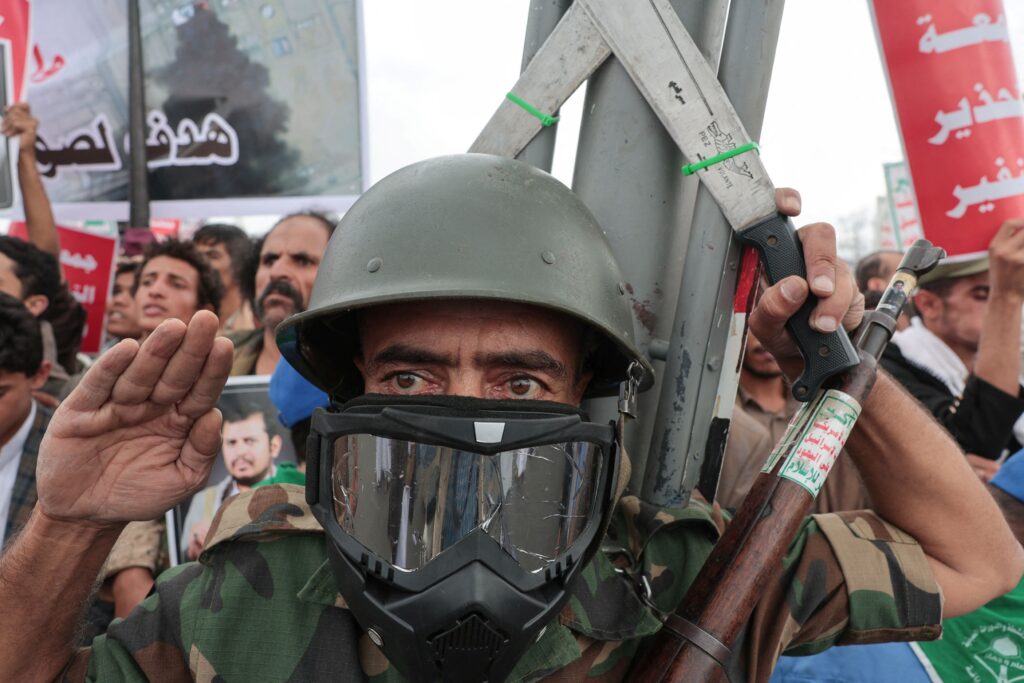
Threatening to widen the conflict roiling the Middle East, the Iran-backed Houthis in Yemen announced Monday a blockade on Saudi Arabia’s shipments through the Red Sea’s Bab al-Mandeb Strait.
If successful, the move could choke off one of the Gulf’s few viable alternatives for oil exports and reduce global supply by an estimated 7 percent. Already, 10 percent of global oil shipments are halted by disruptions in the Strait of Hormuz, which has been largely shut by Iranian threats and mines since the U.S. and Israel launched the war five months ago.
The U.S.-Iran ceasefire announced in June, which included a 60-day negotiation period, had raised hopes that traffic could flow again.
The price of a barrel of Brent crude oil, the international benchmark, fell on Monday to around $88 a barrel as investors weighed hopes of a resolution with renewed fighting. But the benchmark oil price has risen sharply since the $70 seen in early July as some shipments began to resume transiting the Strait of Hormuz. In the United States, the national average gas price rose above $4 per gallon this week, following an average of $3.85 one week ago.
Saudi Arabia has sought to circumvent the deadlock in the Persian Gulf by routing oil to its Red Sea ports. Those tankers then mostly sail through Bab al-Mandeb.
Saudi Arabia, which leads a coalition against Yemen’s Houthis, said it would respond “firmly and forcefully” to the Houthi threats.
On Tuesday, Tehran claimed fresh attacks on U.S. military assets in Jordan and Bahrain, after a 10th consecutive night of U.S. bombardment in Iran. U.S. Central Command said overnight that its strikes hit Iranian command centers, missile and drone launch sites and air defense systems.
The U.S. strikes followed a pledge from President Donald Trump to make Iran pay “many times over” for the killing of U.S. forces in the region in recent days.
Iran’s forces also launched attack drones at U.S. military hubs and installations in Kuwait. Iranian media said Tuesday that the drones targeted Camp Arifjan in Kuwait, along with a helicopter parking station at Camp Udairi and U.S. military housing at Ahmad al-Jaber Air Base.
The Pentagon has disclosed that nearly 100 U.S. troops have been injured in the U.S. war with Iran over the last two weeks, underscoring the extent of Tehran’s retaliation against U.S. military sites in the region as negotiations faltered.
The State Department has reissued a warning to Americans living and traveling abroad about increased threats on U.S. embassies, citing “heightened tensions in the Middle East.”
Even as the U.S. and Iran appear to dig in, Iran’s Interior Minister Eskandar Momeni is on a visit to neighboring Pakistan, which helped mediate the ceasefire.
Suzan Haidamous contributed to this report.