

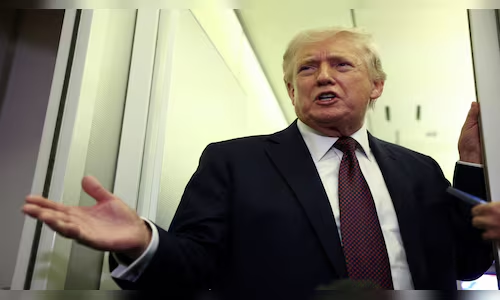
Speaking alongside French President Emmanuel Macron in Evian-les-Bains, Trump described the document as “a very powerful document” and contrasted it with the Obama-era Iran agreement, which he called “a terrible document”.
On sanctions relief tied to the framework, Trump said its implementation would depend on Iran’s compliance.
“It’s really a behavioural thing. If they do what they’re supposed to do, that starts taking effect,” he said.
Addressing developments around maritime traffic, Trump claimed the Strait of Hormuz is already beginning to reopen, with shipping activity resuming.
“Ships are starting to go out now. On Friday, it will be completely opened,” he said, without providing further operational details.
Earlier, in a post on Truth Social, Trump said ships carrying oil were beginning to move through the Strait of Hormuz, signalling the resumption of traffic through one of the world’s most important energy chokepoints.
He said many vessels loaded with oil were “starting to move” out of the strait and were travelling along the southern shipping route, which he described as “totally safe, secure, and pristine”.
In a separate development, Iranian President Masoud Pezeshkian said the draft memorandum of understanding was the result of months of dialogue and sustained diplomatic efforts. He said that if all its provisions were properly implemented, it could be considered “a document of pride” for Iran.
He also thanked Iranian officials involved in the negotiations, including Parliament Speaker Mohammad Bagher Ghalibaf, Foreign Minister Abbas Araghchi and members of parliament.
Separately, Reuters reported that the memorandum of understanding has been signed by President Donald Trump, Vice President JD Vance and Iranian Parliament Speaker Mohammad Bagher Ghalibaf, citing a US official.
According to the report, the proposed MoU is expected to establish a framework for future US-Iran relations.
The official, who spoke on condition of anonymity, said any benefits for Iran — including sanctions relief and the release of frozen assets — would be strictly conditional on Tehran’s cooperation with Washington on its nuclear programme and its commitment not to support what the United States described as “radicalism” in the region.