

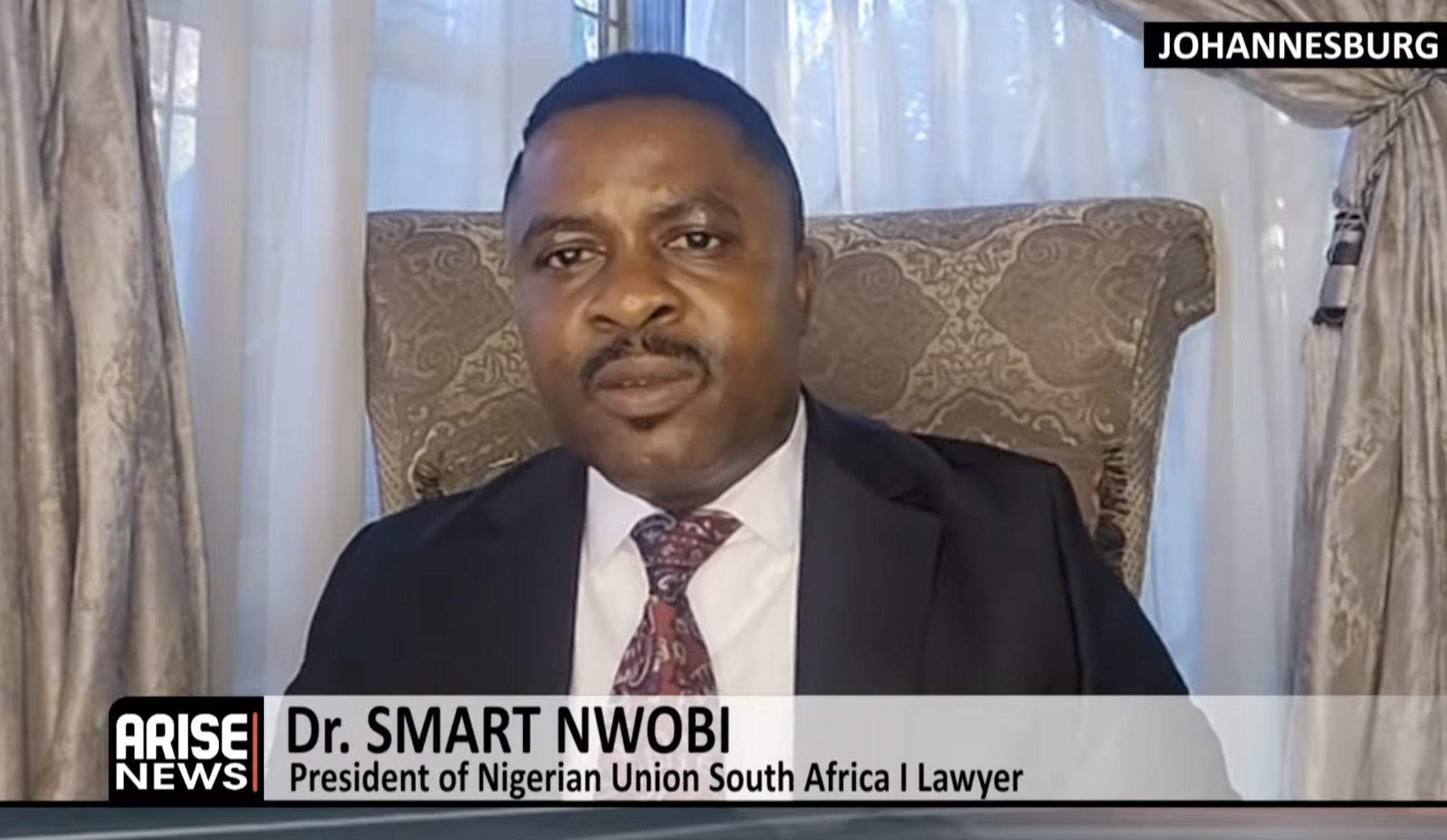
The President of the Nigerian Union, South Africa, and a lawyer, Dr. Smart Nwobi, has bemoaned the plight of more than 1,000 Nigerians awaiting evacuation from South Africa, saying many are stranded, displaced and without shelter following delays in the evacuation process.
He said this while speaking with ARISE NEWS on Monday, as the deadline for evacuation of foreigners from South Africa draws near.
“The challenges that many Nigerians face currently are issues of displacement. Most of them are sleeping on the street. As you know, more than a thousand have been screened, and they are currently stranded, they are currently displaced. In fact, they are being made worse off as a result of the delay of this evacuation,” he lamented.
He said the union had made several attempts to engage the Nigerian Acting High Commission, to ensure proper communication with affected Nigerians, but complained that promised evacuation flights were cancelled without prior notice, leaving many stranded after they had already given up their homes and livelihoods in preparation for departure.
“We as a union, the apex organization—I represent the Nigerian Union in South Africa that has all the Nigerians’ geopolitical organizations affiliated with this union—have on different occasions tried to engage the Nigerian Acting High Commission, in the person of AJ Itebitope, to at least carry the unions along in order for us to give proper feedback to these stranded Nigerians.
“We did heed to this call because this is a call from the federal government that five planes will be made available to evacuate our people. Dates—specific dates—were given to our nationals. The second flight was supposed to leave on the 15th of June, and they had to rock up to the Nigerian embassy and be told in the morning that the flights were canceled, and the reasons were not communicated to the union members. We have tried to write to the Nigerian Acting High Commission to always carry the unions along. That is the issue we’ve been facing,” he shared.
Nwobi, however, noted that he was informed that two flights would be deployed to evacuate stranded Nigerians, while calling for timely communication from authorities.
“I was being informed yesterday that a flight will be made available this morning that will evacuate our people. In fact, two flights will be made available. What we are seeking is timeless communication, timeless engagement with union members, so that our people who are stranded can at least know where to go and how they should prepare to be evacuated,” he urged.
Arguing that anti-foreigner rhetoric had emboldened attacks on Nigerians, Dr. Nwobi insisted that incitement could indirectly lead to violence.
“As a human rights lawyer who has been on the ground, what you will note is that the crime of incitement will not necessarily be instantaneous at the exact moment of the incitement. Once there’s an incitement, the feeling—for example, if someone incites in Johannesburg that foreigners should go and that they should be dealt with—immediately, someone might not be killed in Johannesburg. Someone will be killed in Pretoria because they have been emboldened that nothing will happen, that they’ve got the backings of the marchers. That’s why I disagree with that analogy that it is not as a result of the marches. Yes, while they are marching, maybe someone will not be killed right there. But what we should note in law and otherwise is that the crime of incitement is not necessarily perpetrated directly by the inciters; rather, this is an indirect criminal offense that another person perpetrates on behalf of the inciter,” he said.
Speaking on the deaths of two Nigerians reported to have occurred on Sunday, Dr. Nwobi alleged that one was killed by metro officers while another trader was shot outside his shop in Witbank.
“I could conclude that the two deaths that occurred—one of the deaths yesterday was a result of the authorities, metro officers, that actually hacked a Nigerian person to death. In fact, we received this news yesterday. This happened because the previous police brutalities were not dealt with accurately by the host authority as well as our Nigerian government. The other death was a Nigerian national in Witbank who sells gold and diamonds. He has a shop, and he was shot down in front of his shop by locals for the fact that he opened his shop,” he recounted.
On the response by Nigerian authorities, Dr. Nwobi commended the Federal Government’s initial efforts, saying plans for evacuation were underway before delays disrupted the process.
“I would say that I appreciate the effort of our Federal Government because we had a series of meetings in March, even prior to March when these anti-xenophobic sentiments reoccurred. At a point, we had a joint meeting with the two missions, and they reassured us of the Federal Government’s readiness to evacuate Nigerians.
“I could say that on the part of our Nigerian government, initially things were on track up until the second batch of the evacuation was suspended. As leaders, we did not get reasons; we were only informed there is a technical delay. We tried to get what this technical delay was on the part of our government. We have been informed of different reasons: that the President of South Africa is engaging our President not to evacuate our people, and that it might not look well in the eyes of the international community. We’ve been informed of different things,” he explained.
He, however, faulted the South African authorities’ response, arguing that anti-foreigner attacks had been allowed to escalate despite earlier warning signs.
“But the issue here is the South African Police Services on different occasions have told our people that they cannot really control this issue because of the number of South African locals that are part of these anti-xenophobic sentiments. Then the issue is, has the South African government done enough to nip this in the bud at the beginning? Have they tried anything? They left it up until it matured to a greater number before they started putting measures in place, whereas things have overgrown to a stage where lives have been lost in some instances,” he noted.
Highlighting the hotspots for the xenophobic attacks on Nigerians, Dr. Nwobi identified Johannesburg, Durban, East London and Bloemfontein as the most affected areas.
“One of the hotspots is Johannesburg, then Durban, East London, and Bloemfontein.”
Favour Odima
Follow us on: