
Ship-to-ship transfer, two locations, armed drones: How US smuggled 90 million barrels of oil using Iran's technique

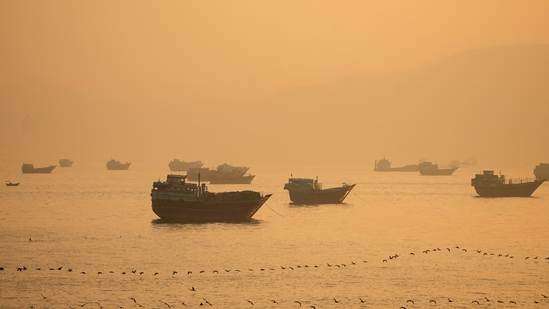
The United States has been using a technique from Iran’s playbook to transfer oil out of the Gulf evading attacks from Tehran even as the Strait of Hormuz remained shut during the West Asia crisis.
The secretive technique involves using ship-to-ship oil transfers, aerial and water drones as guards and a shuttling technique to transport oil – a method that has long been used by Iran to escape sanctions, news agency Reuters reported.
The transfer of oil using the technique started in early May and so far at least 92 ships have been involved in the transfers, according to shipping data and satellite imagery reviewed by news agency.
Also Read: US-Iran peace deal to be signed soon: All you need to know about the MoU
The report said that the US military oversaw the transfers out of the Gulf region to keep the energy export flowing, despite the Iranian blockade.
How the oil transfer happened?
The Strait of Hormuz, through which roughly a fifth of global oil consumption normally passes, was largely shut to the global oil traffic ever since the conflict started between the US and Israel on one side, and Iran on the other.
Even as the strait remained shut, the US military went ahead with the transfer as recently as this week. According to Reuters, 17 pairs of ships were seen carrying out simultaneous oil transfers at two sites on June 11, satellite imagery showed.
- The transport involved two crucial spots, staggered departure, and other methods to lie low. The entire operation was fully controlled by the US military, with the Americans “obviously watching you all the time,” one of the sources told Reuters.
- During the entire shipping transfer, two locations mattered the most: the coast of Fujairah in the UAE and the another coast off Oman’s post of Sohar.
- The two spots, where the oil transfers took place, were close to the boundaries drawn by the Persian Gulf Strait Authority, an Iranian body responsible for managing the Strait of Hormuz.
- During the transfer, the tankers would sail to a meeting point before reaching the strait. Then the vessels would stagger their departures, maintaining a distance of around 3-4 kms apart.
Also Read: Designed in one weekend, deployed for 70 years: The ‘BUFF’ B-52 US Air Force bomber that crashed
- At the crucial stretch near the Hormuz, the transponders were shut and the lights of the ship dimmed. A series of waypoints would then allow the US military to monitor the progress of the designated tankers.
- While passing through the strait, just beyond a zone claimed by Iran under its control, the tankers pull alongside the recipient ships, which are Very Large Crude Carriers, or VLCCs, to begin the oil transfers.
- The transfer from the tankers to the VLCCs would take between 24 to 40 hours, following which the empty tankers would then shuttle back through the strait and the newly loaded VLCCs sail onward.
According to the report, what makes the ship-to-ship operation possible is the willingness of a few shippers to sail through the strait despite threat of Iranian attack.
The ship-to-ship technique has been used by Iran for years to bypass sanctions as it masks the source of the oil. The Iranians would operate one pair of ships at a time, to avoid detection and because the quantity of exports were small. However, the mass transfer provided the US-led operation better protection from retaliatory strikes so that more crude and petroleum products can be sent to international buyers.
Apache crash linked to oil transfer?
A US Army Apache helicopter that was shot down over the Strait of Hormuz on June 9 was reportedly linked to the US oil transfer.
After the crash last week, US President Trump blamed Iran for shooting down the American chopper. Tehran said the attack was not deliberate and may have happened unintentionally because of the tense military situation in the area.
The Reuters report said that the Apache helicopter was involved in the mission, putting a spotlight at the role of choppers in the oil transfer.
Also Read: Ease on Rupee, oil prices: What US-Iran peace deal means for India
The Apache crash and its link to the oil transfer was confirmed to Reuters by four sources, including a former US official aware of the matter.
Though the role of the chopper was not confirmed, the satellite imagery showed six pairs of tanker ships clustered together in a small area off the port of Sohar in Oman on the day the helicopter was shot down.
As per Reuters estimates, at least 90 million barrels of crude oil and petroleum products have moved through the offshore network since May.
However, the volumes remains relatively small compared to the the pre-war average of about 20 million barrels that passed through the strait daily.
Trump has now said that the Strait of Hormuz will reopen to global oil trade from Friday, after the US and Iran agreed to framework peace deal.