

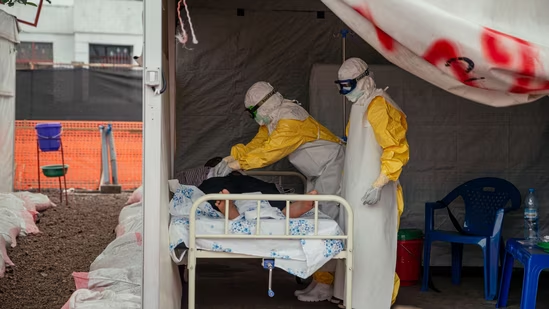
The Democratic Republic of Congo’s Ebola outbreak has climbed to 782 confirmed cases and 181 deaths, health authorities said on Sunday, as the virus spread to new health zones in the country’s conflict-hit east and crossed into neighbouring Uganda.
According to Congo’s Ministry of Health, the outbreak has now affected two additional health zones, Nia-Nia in Ituri province and Mabalako in North Kivu — raising concerns about further transmission as authorities race to contain the virus.
The outbreak was declared on May 15, though health officials have said the virus had likely been circulating undetected for weeks before it was identified.
The current outbreak is being driven by the Bundibugyo strain of the Ebola virus, a rare variant for which there is currently no approved vaccine or specific treatment. This distinguishes it from the Zaire strain, which caused most of Congo’s previous Ebola outbreaks and for which vaccines and treatments are available.
Health authorities said 56 people have recovered from the disease so far, while the outbreak’s fatality rate currently stands at 23 per cent.
Also Read: Ebola outbreak continues to evolve rapidly; deaths top 100 in Congo
Outbreak concentrated in eastern Congo
More than 90 per cent of all confirmed infections have been recorded in Ituri province, making it the epicentre of the outbreak. Cases have also been reported in the neighbouring provinces of North Kivu and South Kivu, while infections linked to the outbreak have spread across the border into Uganda.
The outbreak has become one of Congo’s largest Ebola epidemics on record, with health officials warning that ongoing transmission in remote areas could further complicate containment efforts.
Efforts to trace contacts and isolate infections have been complicated by the humanitarian crisis in eastern Congo. According to the United Nations humanitarian office, nearly one million people have been displaced by conflict in Ituri province, forcing many residents to move frequently across remote and hard-to-reach areas.
Dense forests, poor road infrastructure and isolated villages have made surveillance operations difficult, while the movement of thousands of artisanal miners between remote mining sites has added another layer of complexity to tracing potential exposures.
Authorities have also faced attacks on health workers, community skepticism and insecurity linked to armed groups operating in outbreak hotspots, all of which have hampered response efforts.
Also Read: Ebola outbreak: WHO chief Tedros warns response is still behind as cases rise in Congo and Uganda
The outbreak has also prompted concerns beyond Congo’s borders. Last month, US officials announced plans to send Americans exposed to Ebola while abroad to a quarantine facility in Kenya rather than transporting them back to the United States.
The proposed centre at Laikipia Air Base was expected to accommodate up to 50 quarantine beds. However, the plan triggered protests in Kenya and was subsequently halted after a court intervened.
(With agency inputs)