

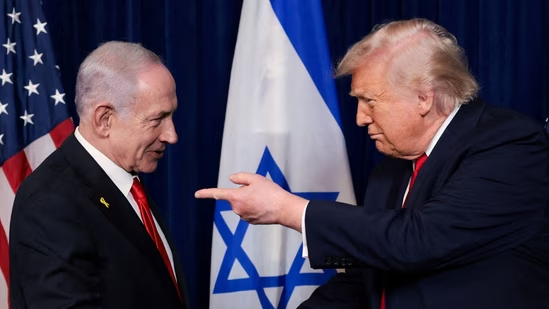
There would be no Israel without the United States, Donald Trump has said. The US President didn’t hold back on Israeli Prime Minister Benjamin Netanyahu during a meeting with Qatar’s Emir at the G7 summit in France on Tuesday. Track the G7 summit live here
With the US-Iran peace deal expected to be formally signed sometime this week, Trump now demands that Israel stop bombing Lebanon.
“Without the United States, there would be no Israel. Without me, there would be no Israel because no other president was willing to do what I did,” Trump said at G7. “I had a great relationship with Bibi, but now Bibi has to be more responsible with respect to Lebanon.”
ALSO READ | Ship-to-ship transfer, two locations, armed drones: How US smuggled 90 million barrels of oil using Iran’s technique
Israel’s pushback
The comments came during a meeting between Trump and Qatari Emir Sheikh Tamim Bin Hamad Al-Thani in Evian-les-Bains. The two leaders met to talk about West Asian security and the new major diplomatic agreement with Iran. Earlier, Israel reportedly bombed Beirut only two hours before the deal was supposed to be finalised.
One of Iran’s conditions for the ceasefire was a complete halt to all Israeli attacks in Lebanon. Netanyahu was, and still is, furious about how this was handled. The standard line out of Jerusalem has been a hard “no.”
In a presser on Monday, Netanyahu said the threat to Israel remained, not only from Iran but also from its regional allies. “We established deep security zones around the State of Israel. We did this in Gaza, in Lebanon, and in Syria,” he said. “And I want to make it clear: we will remain in these security zones for as long as necessary to protect our country.”
Trump frustrated with Netanyahu
Trump on Tuesday made his frustration very clear. He said he “didn’t like” the timing or the scale of the strike. “I let them know that. I didn’t like that, not at all,” Trump said at the G7 summit. He later also said the bombing was “vicious” and “too much.”
Trump also reportedly asked the Israeli PM “what the f**k are you doing?” after the weekend strikes, Fox News reported.
ALSO READ | After years of Netanyahu crying ‘bomb’, hostage crises and assassinations, the US and Iran are moving towards a peace deal
Trump remains confident the diplomatic pact will survive. Asked if the US-Iran deal could withstand further Israeli attacks in Lebanon, he replied, “It can.”
He said Israel’s missile strikes in Lebanon, over the course of several months, was a “minor war” and a “little pinprick” compared to the US-Israeli assault on Iran since February 28.
At least 3,756 people have been killed and 11,632 injured in Israeli attacks in Lebanon since March 2, according to the country’s health ministry.
Trump mentioned that Israel’s long-running fight against Hezbollah has gone on too long and killed too many civilians. “You don’t have to knock down an apartment house every time you’re looking for somebody because there’s a lot of people in those apartment houses and they’re not all Hezbollah, that I can tell you,” Trump said.
A new role for Syria?
Trump, at G7, suggested a different strategy for handling Hezbollah: letting Syria take the lead.
“If Israel can’t do the job without killing everyone else, Syria should do the job,” Trump said. “I suggested to Israel to let Syria take care of Hezbollah, because to be honest with you, I think they’d do a better job of doing it.”
He went on to praise Syrian President Ahmed al-Sharaa, saying “he has pulled that country together very quickly, he’s very capable, and he’s very good for me. He’s protected everything that I’ve asked for.”
Trump floated the idea of Syria taking on Hezbollah in partnership with the United States if Netanyahu cannot be reined in.
US-Iran peace deal
Trump told the Qatari Emir that the peace deal with Iran “should be successful” and added that he expects the next phase of talks to “be actually easier”. He also dismissed rumors that Washington was pouring funds into Tehran and said any talk of financial investment was “ridiculous.” He described the deal as “fair” and “good”.
Qatar’s Emir welcomed the development and said the agreement could bring positive results across the Gulf region.
Qatar’s mediation role
The peace deal was mediated by Pakistan and Qatar. Doha has been heavily involved in diplomatic efforts since February 28, when a US-Israeli alliance bombed Iran, and kicked off the war.
During the G7 press briefing, the Emir thanked Trump for his leadership, calling the US-Iran pact a “very important deal.”
Trump returned the compliments, saying the US was “very, very impressed with Qatar.”