
India needs more robotics, automation and component manufacturing to scale semiconductor ambitions: UST COO

In an exclusive interview with CNBC-TV18, Mathew said semiconductor development cannot be viewed in isolation and requires the creation of a broader industrial ecosystem spanning manufacturing, suppliers, universities and technology partners.
“We are looking at like-minded partners to come into the ecosystem in India because semiconductors have to be viewed as an ecosystem,” he said.
Mathew pointed to successful semiconductor and manufacturing hubs in Asia, where thousands of companies support every stage of the value chain, helping reduce costs and improve scale.
“If you look at some of our neighbours, the way they scaled was by creating an ecosystem. Even for one component, you will have thousands of companies,” he said.
According to him, India needs to increase local component production while also strengthening industry-academia partnerships to create a sustainable pipeline of talent and innovation.
The comments come as UST and Kaynes Technology are developing an Outsourced Semiconductor Assembly and Test (OSAT) facility in Sanand, Gujarat. The facility, inaugurated by Prime Minister Narendra Modi, is being developed through a phased approach, with expansion plans extending into 2028.
Mathew said the current focus is on establishing Phase 1 operations and onboarding customers before moving to more advanced packaging technologies in the next phase.
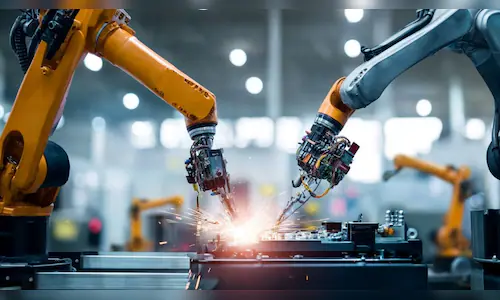
The executive also highlighted the importance of advanced manufacturing technologies in supporting India’s semiconductor ambitions. He noted that some neighbouring countries operate more than a million industrial robots across manufacturing facilities, giving them significant advantages in scale and productivity.
“Manufacturing is coming back, semiconductors are coming back, and AI is where we need to execute intelligently,” he said.
To remain competitive, India must encourage greater deployment of robotics, automation systems and emerging technologies such as physical AI, he added.
“We could do the same by attracting more manufacturing companies and developing more robotics and humanoids in India,” Mathew said.
He added that UST is also engaging with companies from the US, Europe and Asia to strengthen India’s semiconductor ecosystem and bring advanced technologies into the country’s growing manufacturing sector.
According to Mathew, the long-term success of India’s semiconductor ambitions will depend not only on fabrication and packaging facilities but also on the strength of the wider manufacturing ecosystem that supports them.