

According to Iran’s Tasnim news agency, Iranian officials called the assertion “pure falsehood” and denied that any messages had been exchanged regarding a ceasefire or efforts to “end tonight’s bombing.”
They said Iran is “currently delivering a decisive response to the US attacks.”
Trump had told US media outlets that he held direct talks with Iranian officials who asked him “to stop bombing.” He said recent US military operations could be nearing an end, but added that he “reserves the right to strike again” if necessary.
Strait Closure Claim
The denial came as Iranian state and semi-official media reported a further escalation around the Strait of Hormuz.
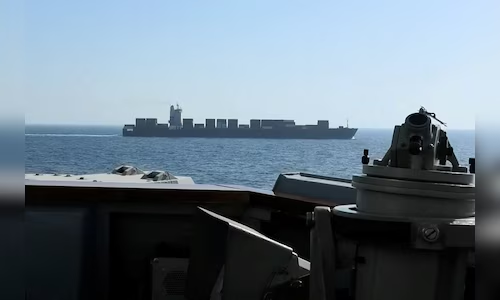
Reuters reported that Iran’s top joint military command announced the closure of the strategic waterway to all vessels, including oil tankers and commercial ships, and warned that any ship attempting to pass through could be targeted.
Tasnim quoted Iran’s Khatam al-Anbiya military command as saying, “Any vessel traffic through the Strait of Hormuz will be targeted,” adding that the route was “completely closed to all types of vessel.”
Iranian media also reported that the Islamic Revolutionary Guard Corps Navy struck two vessels described as “violating ships.” Iranian authorities said, “two ships attempting to illegally pass through the Strait of Hormuz were hit.” These claims have not been independently verified.
Fresh US Action
The developments followed another round of US military action on Wednesday. US Central Command said it launched additional “self-defense strikes” against targets inside Iran in response to what Washington described as Tehran’s “unwarranted and continued aggression.”
https://t.co/06XEfevOgs
— U.S. Central Command (@CENTCOM) June 11, 2026
Iranian media reported explosions near the Strait of Hormuz in Qeshm, Kargan and Sirik.
Trump suggested more attacks could follow, saying, “We hit them hard yesterday. We’re going to hit them again hard today.” He also said, “We were really close to a deal, but they keep tapping us along,” while accusing Iranian negotiators of “playing us for suckers.”
US Defense Secretary Pete Hegseth said Tehran “has an opportunity to make a deal” but warned future strikes would “be strong” and “clear.”
Global Response
The escalation has triggered international concern.
United Nations Secretary-General António Guterres warned against a return to “full war.” Iran’s ambassador to the UN, Amir Saeid Iravani, said “no sustainable deal can be reached through threats, intimidation, or the use of force.”
A diplomat familiar with the negotiations said Qatari mediators were heading to Tehran “to meet with the Iranians in an effort to bridge the remaining gaps.”
Oil prices rose and financial markets weakened amid the renewed tensions. Iran said it had launched attacks on US military installations in Jordan and Bahrain in retaliation for earlier US strikes. Bahrain, Jordan and Kuwait reported intercepting or engaging Iranian aerial threats.
Russia and China called for restraint, while Beijing urged all sides to “stop intensifying the conflict and escalating the situation.”
Iran has also maintained that any settlement must include a ceasefire in Lebanon, where fighting between Israel and Hezbollah has continued despite a truce.
(With input from agencies)