

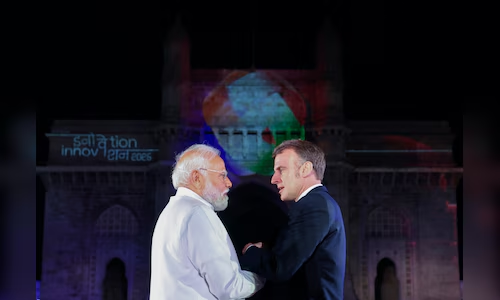
Meeting at Villa Kerylos, the two leaders reviewed progress across a wide range of sectors, including defence, trade, technology, innovation, space and civil nuclear energy. They expressed satisfaction with the growing depth of defence cooperation and agreed to further strengthen collaboration through the co-design, co-development and co-production of defence platforms and advanced technologies.
Foreign Secretary Vikram Misri said the emphasis in defence cooperation remains on indigenisation, including under the Rafale programme.
The leaders also reviewed the longstanding partnership in the space sector and discussed expanding cooperation in human spaceflight, space situational awareness and private-sector participation in space activities.
In civil nuclear energy, Modi and Macron noted that India’s recently enacted SHANTI Act could open up new avenues for collaboration, including in small modular reactors and advanced nuclear technologies. The SHANTI Act is expected to create a new framework for private-sector participation and international collaboration in India’s civil nuclear sector.
Reviewing progress under the Horizon 2047 Roadmap, the two leaders explored ways to deepen cooperation in economic growth, technology, innovation, talent mobility, cultural exchanges and people-to-people ties.
With bilateral trade continuing to grow steadily, India and France agreed to establish a high-level mechanism aimed at doubling trade between the two countries within the next five years. They also called for the early conclusion of the India-European Union Free Trade Agreement to boost trade and investment flows.
The discussions also covered cooperation in small and medium enterprises, aviation and railways. The leaders welcomed the establishment of a Centre of Excellence for Skilling in Aeronautics and Allied Sectors in Kanpur.
Recognising the growing importance of innovation and emerging technologies, both countries adopted the India-France Innovation Roadmap 2030 to provide long-term direction to the partnership. They also agreed to establish a Joint India-France AI Working Group focused on artificial intelligence governance and collaboration.
According to the Ministry of External Affairs (MEA), the joint inauguration of Bharat Innovates in Nice and Prime Minister Modi’s participation in the VivaTech technology conference in Paris further strengthened cooperation in deep-tech, semiconductors, agritech, medtech, renewable energy, defence and space.
The two leaders also welcomed the continued expansion of the Unified Payments Interface (UPI) in France and noted the signing of 19 agreements between institutions from the innovation ecosystems of both countries.
Modi thanked Macron for the operationalisation of visa-free airport transit for Indian nationals in France. Both sides also discussed measures to improve the mobility of students, researchers and skilled professionals, including greater mutual recognition of educational qualifications.
Beyond bilateral issues, the leaders exchanged views on major global developments, including the situations in West Asia and Ukraine, and reaffirmed the importance of the India-France partnership in addressing global challenges.
Separately, Commerce and Industry Minister Piyush Goyal held meetings with global CEOs and industry leaders in France to discuss investment opportunities and strengthen economic partnerships across the India-France and India-Europe corridors.
Among the key outcomes of the visit were the adoption of the India-France Innovation Roadmap 2030, the creation of a Joint AI Working Group, the establishment of a Centre of Digital Sciences, cooperation in railway and high-speed rail development, expanded UPI usage in France, deeper space cooperation between ISRO and CNES, and the launch of new initiatives in healthcare, research and startup incubation.