

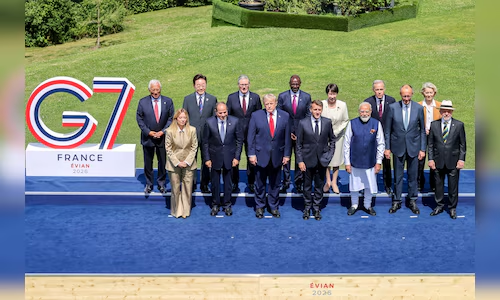
“We welcome the announcement of a deal between the United States and Iran… which provides an historic opportunity to prevent Iran from acquiring any nuclear weapon,” the statement said.
The G7 also reaffirmed that “Iran will never obtain a nuclear weapon” and supported follow-on negotiations involving regional partners and the International Atomic Energy Agency (IAEA).
The leaders also backed a France- and UK-led initiative to help restore commercial shipping through the Strait of Hormuz, stressing that unrestricted transit passage remains “the bedrock of international trade.”
The group said it would accelerate efforts to diversify energy supply routes and build up energy stocks to reduce dependence on the strategic waterway.
On Ukraine
Leaders of the seven economies also pledged to increase deliveries of air defence systems, interceptors, and long-range capabilities to Ukraine, while exploring ways to expand Kyiv’s domestic military production.
“We agree to increase the delivery of air defence capacities, additional systems and interceptors, and long-range capabilities,” the statement said.
The leaders also vowed to step up pressure on Moscow through additional sanctions, including on Russia’s oil and gas sectors, and pledged further support to help Ukraine’s energy system withstand the coming winter.
The statement reiterated support for a “free and open Indo-Pacific”, opposed unilateral attempts to change the status quo in the East and South China Seas and across the Taiwan Strait, and called for disputes to be resolved peacefully through dialogue.
The G7 further expressed concern over North Korea’s nuclear and ballistic missile programmes, urged its complete denuclearisation, and called for coordinated action against Pyongyang’s cybercrime and cryptocurrency theft activities.
Sidestepping economic fallout
Despite endorsing the Iran deal and backing efforts to secure the Strait of Hormuz, G7 leaders largely avoided public debate over the war’s economic fallout, reflecting a desire to avoid friction with Trump, whose cooperation they need on issues ranging from Ukraine and NATO to trade.
Analysts warned that the approach risks undermining the relevance of the G7, which was formed in the wake of the 1973 oil crisis to coordinate responses to global economic shocks.
“US policymaking has been hurting world economic activity,” Marcelo Estevao, chief economist at the Institute of International Finance, told Reuters.
“You have a country with the largest economy undermining what could have been a G7 agenda of collaboration.”
First Published: Jun 17, 2026 2:10 PM IST