

He died Monday from complications of Parkinson’s disease, according to a statement from his wife, Andrea Mitchell, who is also the chief Washington correspondent and chief foreign affairs correspondent for NBC News. She said he passed away at their home.
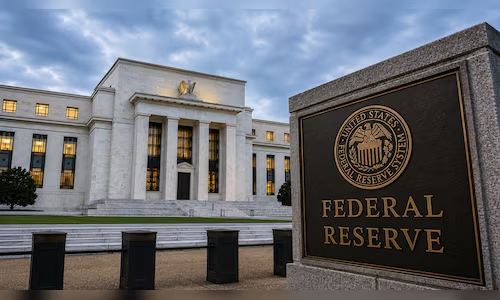
Greenspan’s death marks the end of a career that helped shape modern American capitalism from the final years of the Cold War through the rise of the digital economy. He led the Federal Reserve through five terms as chair, serving under Presidents Ronald Reagan, George H.W. Bush, Bill Clinton and George W. Bush.
Architect of an era of economic expansion
Greenspan presided over one of the longest economic expansions in U.S. history, including the growth period from 1991 to 2001, which coincided with globalization, falling inflation and the rapid rise of the internet economy.
He became one of the most powerful unelected figures in global finance, with markets often reacting sharply to even subtle shifts in his language or policy tone.
During his tenure, the U.S. economy experienced sustained growth and relatively low inflation — a period later described by economists as the “Great Moderation.”
“The Maestro” and the Greenspan era
Greenspan’s influence extended beyond policy into culture and public life. He was widely referred to as “the Maestro,” and his cautious, often opaque communication style gave rise to the term “Fed-speak.”
He gained further prominence after the 1987 stock market crash, known as “Black Monday,” when the Dow Jones Industrial Average fell more than 22% in a single day. His swift intervention to stabilize liquidity helped restore confidence in financial markets and shaped what later became known as the “Greenspan put” — the expectation that the Federal Reserve would step in to support markets during crises.
He also famously warned in 1996 of “irrational exuberance” in financial markets, a phrase that became one of the most cited warnings in modern financial history.
From jazz musician to Washington power player
Born on March 6, 1926, in the Washington Heights neighborhood of New York City, Greenspan showed early talent in mathematics and music. He attended the Juilliard School and played jazz saxophone and clarinet before turning to economics.
He earned his bachelor’s and master’s degrees from New York University and later pursued doctoral work at Columbia University under economist Arthur F. Burns, who would himself become a future Federal Reserve chair.
In the early 1950s, Greenspan worked as an economic consultant and later became president of Townsend-Greenspan & Co., building a reputation as a sharp economic forecaster.
His early political involvement began in the 1960s, including advising Richard Nixon’s presidential campaign. He later served as chair of the Council of Economic Advisers under President Gerald Ford between 1974 and 1977, where he worked on policies aimed at reducing inflation.
Federal Reserve tenure and global influence
Greenspan was nominated by President Ronald Reagan and confirmed as Federal Reserve chair in August 1987. He would go on to serve five consecutive four-year terms, one of the longest tenures in the institution’s history.
He navigated major economic and geopolitical events, including the dotcom bubble, the aftermath of the September 11 attacks, and multiple financial crises.
His policy approach combined confidence in markets with a willingness to intervene during periods of instability — a balance that defined much of his legacy.
He retired from the Federal Reserve on January 31, 2006.
Praise, criticism and the 2008 financial crisis
While Greenspan was widely credited with helping sustain economic growth and stabilizing markets, his legacy came under sharp criticism following the 2007–08 global financial crisis.
Critics argued that his support for financial deregulation and belief in market self-regulation contributed to excessive risk-taking in the financial system, particularly in the housing market.
In 2008 testimony before the U.S. Congress, Greenspan acknowledged flaws in his assumptions, calling the crisis a “once-in-a-century credit tsunami” and admitting that events had exposed weaknesses in his economic worldview.
A later bipartisan inquiry concluded that long-standing deregulation policies — supported in part by Greenspan’s philosophy — had helped create conditions for the financial collapse.
Legacy and lasting influence
After leaving the Fed, Greenspan continued to work as an economic consultant, author and public intellectual. His 2007 memoir, The Age of Turbulence, reflected on his decades in government and his relationships with multiple U.S. presidents.
Despite political differences, he maintained working relationships across administrations and was known for his pragmatic approach to policy.
He received numerous honors, including the Presidential Medal of Freedom in 2005 and an honorary knighthood from Queen Elizabeth II in 2002.
Greenspan remained a towering figure in economic debate — praised by supporters as the central banker who helped guide the U.S. through decades of stability, and criticized by detractors who saw his policies as laying the groundwork for later financial excesses.
Personal life
Greenspan is survived by his wife, Andrea Mitchell. In her statement, she described him as “a giant of a man who helped shape the U.S. economy for decades under presidents of both parties,” adding that he was “always honest in acknowledging his mistakes.”
She also remembered his love of baseball, tennis, golf and jazz — interests that remained with him throughout his life.