
Abdulmumuni Abiola: Nigerians Must Get Involved and Defend Their Votes to Achieve the Desired Change

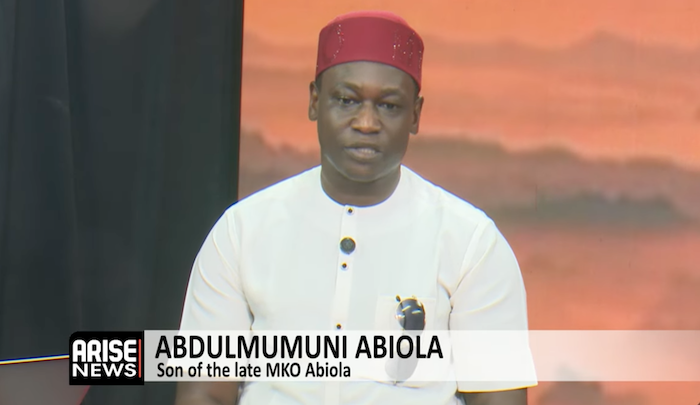
The son of the late Chief Moshood Kashimawo Olawale Abiola (GCFR), also known as M. K. O. Abiola, Abdulmumuni Abiola, has called on Nigerians to become more actively involved in the country’s democratic process, stressing that meaningful change can only be achieved when citizens participate in elections, defend their votes, and hold leaders accountable.
He made the remarks on Thursday in an interview with ARISE NEWS while reflecting on the significance of June 12 and the state of Nigeria’s democracy.
“People are not getting the benefits they expect to get from this democracy. But going into when you expect something to come from an input you’ve made, you have to first of all make that input. I think what we need to do is get engaged, get informed, and use not our words, but our actions. By going, voting, getting our voter’s cards, and defending our votes, this is when you start to get results. So, my advice would be: let’s get engaged, let’s get involved. If you don’t like what you see in the country today, then you should speak up, talk to your neighbors, coordinate, and let’s try to use this energy. Instead of being angry and abstaining from the elections, let’s use this energy toward some kind of action to change our future. I think that’s what we can do,” he said.
Speaking on President Bola Tinubu’s June 12 Democracy Day address, Abdulmumuni said the President’s speech accurately reflected the significance of the historic struggle and acknowledged some of the shortcomings in Nigeria’s democratic journey.
“He did touch on all the points. I don’t think I can actually fault the speech itself. It basically encapsulated what June 12 actually means, and I think he was able to address some of the issues—talking about some of the inadequacies in the democracy that we are in right now. As far as I’m concerned, like I said, he had all the points, so I’m looking for something to fault, but I really can’t fault that speech, actually,” he maintained.
He noted that while many Nigerians compare the current political climate to the period surrounding the annulled June 12, 1993 election, the real concern is that several of the challenges identified more than three decades ago continue to persist despite years of democratic rule.
“We’re talking about 27 years ago. I think what we are facing and what we are seeing now is the fact that some of the issues that were identified in 1993 are still with us today. I think that’s what the issue is. It’s not that people are saying the same things; they’re just saying that after successive democratic governance, we are still basically in the same position we were when we started. So, it’s not necessarily saying that we don’t like the democracy we’re in, but just saying that it has not been a representative one,” he explained.
On the issue of insecurity and the growing calls for state policing, Abdulmumuni cautioned against a hasty implementation of the policy, arguing that while the idea may help address security challenges, adequate safeguards must be put in place to prevent abuse of power.
“I get the idea of state policing. However, we have to be careful. When we want to adopt this, we have to look at the framework around how it’s going to be set up. This might come back to bite us if it’s not done properly. For instance, we should have a committee built from civilians to manage what they do because it’s very easy to abuse such powers,” he advised.
He stressed the need for strong oversight mechanisms, including civilian participation, to ensure accountability, warning that without a proper framework, the same concerns associated with the federal police could simply be replicated at the state level.
“We already see what happens with the federal police today. I don’t want a situation where that crime or criminality is now translated to the states. So, I think there has to be some kind of nuanced way where we can do it in a way that gives us the kind of results we actually intend to get,” he said.
Reflecting on the legacy of June 12, Abdulmumuni said his greatest concern is not that younger generations may forget the significance of the date, but that Nigerians risk repeating past mistakes by failing to learn from history.
“What I’m afraid of is that because we don’t learn from our history, we end up making the same mistakes,” he said.
He maintained that democracy is a continuous journey that requires active citizen participation and argued that the quality of governance ultimately reflects the level of public engagement. According to him, the ideals championed by his late father extended beyond the struggle for democracy to addressing critical issues such as poverty, healthcare, national pride, and economic opportunity.
“Democracy is not a destination; it’s a journey. So, it’s going to keep on changing, and the more we engage with that process, the better it’s going to be. As far as I’m concerned, the democracy we see today is the democracy we made.
“But the issue I’m just trying to say is that when Abiola did what he did, he had a message. So, we’re here talking about heroes of democracy, or we’re trying to name landed properties after other people. But there were some issues my father wanted to address. We’re talking about basic issues: healthcare—the healthcare situation in the country—and even just Nigerian people having some kind of pride in who they are.”
On Nigeria’s growing political divisions, Abdulmumuni said M.K.O. Abiola’s nationwide appeal stemmed from his ability to unite Nigerians around a clear vision for change. He stressed that leaders must engage citizens beyond their political bases, while voters should remain actively involved in holding elected officials accountable.
“Abiola, he was just like a regular Nigerian. The thing that Abiola was able to do was express himself. He was able to convey his message and his vision and sell his vision to the Nigerian people. I think that’s basically what is missing today. Nobody is selling any vision to anybody. People are just talking to their own echo chambers, and we’re having a politics where parties are the ones electing leaders.
“I’m hoping that by 2027, more people will express their own interest in who they would like to lead them. That is part of democracy. You can’t just vote one day and then go to sleep for four years. No, you’re supposed to be there with them. So, it’s a two-way street,” he insisted.
Favour Odima
Follow us on: