

By Ameh George
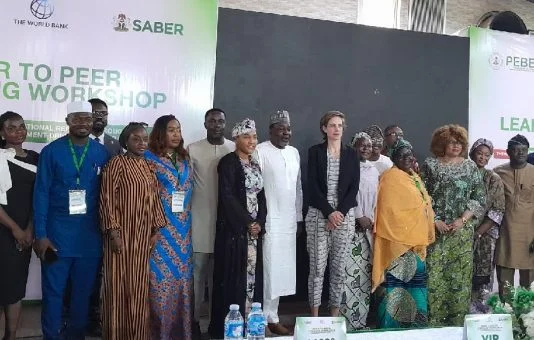
The Presidential Enabling Business Environment Council, PEBEC, in collaboration with the State Action on Business Enabling Reforms, SABER, programme, has convened a two-day peer-to-peer learning workshop in Abuja for Commissioners of Commerce and Heads of Investment Promotion Agencies, IPAs, across Nigeria.
Held from 28 to 29 April, the workshop sought to strengthen collaboration between federal and subnational institutions responsible for fostering a conducive business environment and attracting investment into the country.
Speaking at the event, Director-General of PEBEC, Princess Zahrah Mustapha Audu, underscored the importance of synergy in driving sustainable economic growth. She noted that Nigeria’s development must be locally driven, with states playing a central role in implementing reforms that enhance the ease of doing business.
According to her, the Council’s ongoing engagement with states—including a planned nationwide tour in May—is aimed at bridging performance gaps and promoting the replication of successful models. She emphasised that while competition among states is healthy, collaboration remains essential to achieving the shared goal of attracting investment.
The workshop featured technical sessions and presentations by stakeholders within Nigeria’s investment ecosystem, focusing on practical strategies for investor attraction, retention and expansion. Participants exchanged experiences on institutional frameworks, regulatory reforms, and approaches to navigating bureaucratic processes within Ministries, Departments and Agencies.
In his closing remarks, the Deputy Chief of Staff to the President in the Office of the Vice President, Senator Ibrahim Hadejia, conveyed the goodwill of Vice President Kashim Shettima, Chairman of PEBEC. He reaffirmed the Federal Government’s commitment to strengthening the business environment through coordinated reforms.
Hadejia stressed that Nigeria’s economic transformation would depend largely on the effectiveness of implementation at the state level, where investment decisions are actualised and economic value created. He described the SABER programme as a critical policy instrument designed to incentivise reforms, enhance institutional capacity, and align state systems with global standards.
He further highlighted key priorities discussed during the workshop, including the development of data-driven state investment propositions, improved inter-agency coordination, digitalisation of investor services, and the establishment of robust tracking systems to ensure accountability and performance.
Participants commended the initiative, describing it as impactful and timely. Roslyn Bentu, Head of the Plateau State Investment Promotion Agency, said the workshop provided practical insights that would be integrated into the state’s development strategy, particularly in aligning national and state plans.
Similarly, Dr Mohammed Baba, Director-General of the Katsina State Investment Promotion Agency, noted that the sessions enhanced clarity, transparency and coordination in investment promotion efforts, while addressing critical challenges such as land administration and regulatory bottlenecks.
Stakeholders also reaffirmed their commitment to implementing reforms that will improve investor confidence, reduce transaction costs, and create a more predictable business environment.
The workshop concluded with a renewed resolve among participants to translate deliberations into measurable outcomes, including stronger investment pipelines, improved service delivery, and increased economic opportunities across Nigeria’s states.