

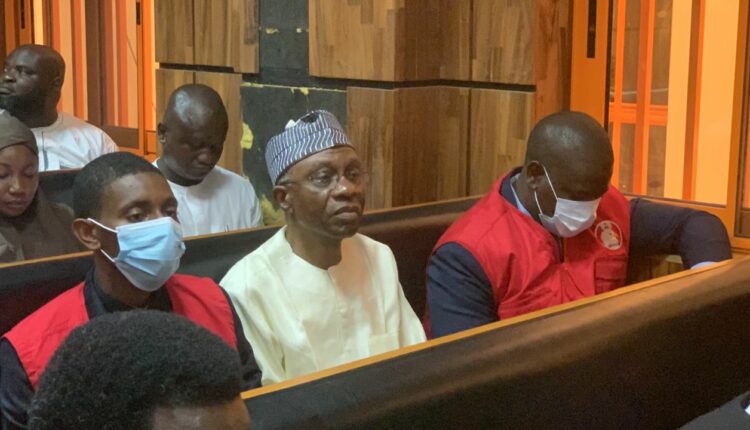
An Ikeja Particular Offences Courtroom has been urged by former Central {Bank} of Nigeria (CBN) Governor, Godwin Emefiele, and his co-defendant, Henry Omoile, to reject an extra-judicial assertion tendered in proof, on the grounds that it was not made voluntarily and was allegedly obtained in breach of statutory safeguards.
The courtroom, presided over by Justice Rahman Oshodi, mounted Could 4, 2026, for ruling on the admissibility of the assertion following the adoption of ultimate written addresses by counsel to each the defence and the prosecution within the trial-within-trial proceedings.
The matter varieties a part of a 19-count cost towards Emefiele bordering on alleged gratification, corrupt calls for, and abuse of workplace in reference to large-scale {financial} transactions.
Omoile, his affiliate, faces a separate three-count cost alleging illegal acceptance of items whereas appearing as an agent in transactions linked to the CBN.
The prosecution alleged that the disputed transactions concerned roughly $4.5 billion and N2.8 billion, which it mentioned constituted breaches of due course of and fiduciary obligations.
The defendants, nonetheless, have persistently challenged the evidential foundation of the fees, insisting that key supplies relied upon by the prosecution are unreliable and unlawfully obtained.
Justice Oshodi had earlier ordered a trial-within-trial to find out the voluntariness of Omoile’s assertion after objections have been raised by the defence.
The courtroom subsequently adjourned for adoption of written addresses after the shut of proof, together with cross-examination of witnesses on how the assertion was obtained.
Adopting the second defendant’s tackle, his counsel, Adeyinka Kotoye, SAN, urged the courtroom to carry that the assertion was not voluntarily made and subsequently inadmissible.
Kotoye argued that the circumstances surrounding the taking of the assertion violated obligatory provisions of Sections 9(3) and (4) of the Administration of Felony Justice Regulation (ACJL) and Sections 17(1) and (2) of the Administration of Felony Justice Act (ACJA), which regulate the process for acquiring statements from suspects.
He contended that the place voluntariness is in dispute, video recording of the interrogation course of is a essential safeguard, including that Supreme Courtroom authorities have persistently recognised digital recording as essentially the most dependable methodology of guaranteeing transparency and compliance with due course of.
Kotoye additional argued that the prosecution failed to offer impartial corroboration of the alleged assertion and raised questions concerning the position of the authorized practitioner mentioned to have been current through the course of, alleging that the lawyer was restricted from successfully performing his obligation.
He additionally submitted that the prosecution misapplied related statutory provisions by limiting their scope to confessional statements alone, whereas they apply to all statements obtained throughout investigation.
He urged the courtroom to resolve all doubts in favour of the defendant and exclude the assertion.
Counsel to Emefiele (first defendant), Olalekan Ojo, SAN, aligned with this place, urging the courtroom to resolve any doubt relating to voluntariness in favour of the defence.
Ojo relied on Part 29(2) of the Proof Act, arguing that any assertion obtained by means of oppression, inducement, or improper means is inadmissible.
He maintained that after voluntariness is challenged, the burden shifts to the prosecution to show that the assertion was freely made.
He submitted that the prosecution did not discharge this burden, noting that the circumstances surrounding the assertion increase critical doubts as to its reliability.
Ojo added that established judicial authorities require courts to confess solely statements confirmed to have been voluntarily made.
He additional faulted the prosecution for not sufficiently difficult allegations raised by the defence, together with claims of inducement, trauma, and insufficient authorized illustration, describing the omissions as materials gaps within the prosecution’s case.
In opposition, the Director of Public Prosecutions (DPP), Federal Ministry of Justice, Rotimi Oyedepo, SAN, urged the courtroom to dismiss the defence objections.
Oyedepo argued that counsel to the primary defendant lacked the authorized standing to problem the admissibility of the second defendant’s assertion after initially declining to object when it was tendered, describing the later problem as an abuse of courtroom course of.
He maintained that the assertion was taken in substantial compliance with the Administration of Felony Justice Act and was made within the presence of the second defendant’s counsel, despite the fact that it was not video-recorded.
The DPP additional argued that the content material of the assertion itself undermines the defence claims of coercion, noting that Omoile expressly refused to implicate Emefiele in any wrongdoing and likewise denied committing the offences alleged towards him.
In response to him, these denials exhibit that the assertion was made independently and never below any type of duress or undue affect.
Oyedepo additionally dismissed allegations of intimidation, stating that the assertion was taken within the presence of a number of people, which made coercion unlikely.
He added that the defendant was duly cautioned and voluntarily signed the cautionary kind earlier than making the assertion.
Following the adoption of written addresses by all events, Justice Oshodi adjourned the matter to Could 4, 2026, for ruling on the admissibility of the disputed assertion.
The courtroom additionally mounted June 26 and June 30, 2026, for continuation of the substantive trial.
Wale Igbintade
Times Nigeria