

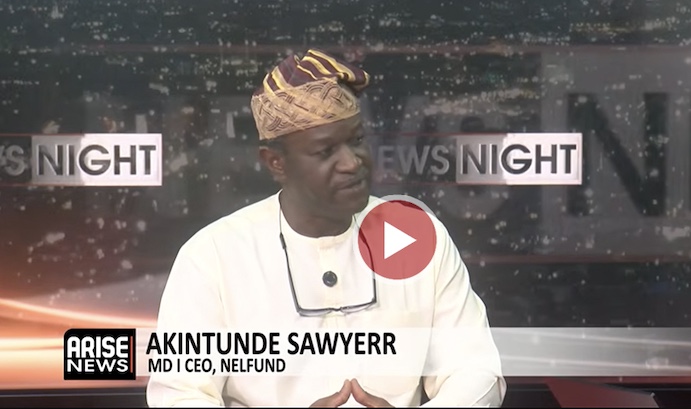
The MD/CEO of The Nigerian Training Mortgage Fund, (NELFUND), Akintunde Sawyerr has mentioned that over 1.3 million Nigerian college students have thus far benefitted from the federal authorities’s pupil mortgage scheme, highlighting the fund’s rising influence on entry to tertiary schooling throughout the nation.
“I believe for the primary time in Nigeria—or definitely the primary time in a really very long time—individuals are beginning to imagine that you may truly profit from authorities insurance policies with out realizing anyone. The system is completely agnostic to who you understand. All you need to do is present the best credentials, apply on-line, and also you don’t want the assistance of anyone to have the ability to entry this. I can let you know in the present day that 1.3 million plus Nigerian college students have benefited with out having to have any handshake with anyone in anyway,” he revealed.
Talking in an interview with ARISE NEWS on Friday, he additionally defined that the difficulty arose from an incomplete add of pupil knowledge moderately than any fault within the mortgage approval course of, stressing that NELFUND depends strictly on verified submissions from establishments earlier than disbursement is made.
It is a following a problem surrounding Ladoke Akintola College of Expertise, (LAUTECH), that emerged after media reviews instructed a major hole between the variety of college students who utilized for help beneath the federal pupil mortgage scheme and those that have been reportedly permitted. Based on the reviews, round 19,000 college students have been mentioned to have utilized, however solely a fraction of that determine was mirrored in approvals, elevating issues amongst stakeholders about attainable delays or exclusions within the course of.
“What has occurred is that after we acquired that report, we instantly contacted LAUTECH and we checked out our methods. In truth, solely 5,237 college students have been permitted. Now, after I say permitted, I imply the college has returned solely 5,237 college students as being eligible for us to pay the loans. Now we have a really strict, very strong system. I’ve a really robust group at NELFUND who comply with the method very intently and take a look at to make sure that no pupil is left behind. Once we went again to LAUTECH in the present day, they confirmed, based mostly on the data that we offered them on the again finish, that actually they’d sadly uncared for to submit the extra 15,000 college students onto our system,” he defined.
He added that the fund had already engaged with LAUTECH to resolve the mismatch and be certain that all eligible college students are correctly captured and accounted for within the system transferring ahead.
“I believe one factor you’ll discover out is earlier than the top of in the present day, they’d have issued a rebuttal, as a result of it’s crucial to us at NELFUND that there’s belief in what we’re doing and that we don’t lose the boldness of scholars. That’s the best factor to lose, given the neglect that they’ve confronted earlier than the appearance of the Bola Tinubu administration,” he mentioned.
Sawyerr emphasised that NELFUND solely releases funds based mostly on verified pupil lists submitted by establishments, not particular person software.
“It is a damaging report, and as I mentioned, earlier than the top of in the present day you will notice a rebuttal from the establishment as a result of we offered them with the info. 5,237 solely have been permitted by the college for us to pay, and that’s the method we’re in.”
Addressing issues about transparency and pupil refunds, the NELFUND MD/CEO defined that such circumstances sometimes come up resulting from timing gaps between software, verification, and disbursement cycles.
“College students apply to us for these loans. We collate the scholars, we confirm them, or we verify to make sure that they’re certainly eligible. We then ship that finalized listing to the college. The varsity checks that the scholars are there—bear in mind they utilized on-line, there’s no interface between us and them. The varsity checks, trying on the data, whether or not the scholars that we’ve despatched to them have utilized and are certainly their college students, they’re nonetheless alive, they’re nonetheless lively, and they’re nonetheless bona fide college students. The varsity then has to ship again to us, electronically, the listing that they affirm. One of many issues that in addition they should do is be certain that the charges are appropriate. Okay. Now, in doing that, some faculties omit some college students, some college students are faraway from the method, however we be certain that we pay what’s permitted. Now, to your query very particularly about how we be certain that the scholars get the simply advantage of this. The truth of it’s that after we began the scheme just a little beneath two years in the past, you have to understand that quite a lot of faculties began their classes at totally different instances. We began this in the midst of a political cycle which doesn’t essentially rhyme with the tutorial session beginning within the lots of of establishments there are throughout this nation.
“So college students utilized virtually blindly, not realizing, you understand, if their session solely had every week to go, they nonetheless utilized. If it had 4 months to go, they nonetheless utilized. Now, basically what then occurred is that when a pupil utilized and so they have a deadline of the week after or two weeks later to both pay a registration payment to sit down an examination or to become involved in tutorial lessons, and the college says ‘Until we see cash, we aren’t going to help you start,’ what then occurs is that the scholars should make the fee. When our fee to the establishment arrives someday after that, we’re now into what we now know as refund territory. The person pupil or their household has paid, NELFUND has paid; the college is holding a double fee,” he defined.
Sawyerr additional defined that whereas establishments are obligated to refund college students in circumstances of double fee, the method continues to be evolving, as this represents a brand new administrative duty for a lot of faculties.
“At that time, the establishment is obliged to return what the coed has paid to the coed. Now, this isn’t one thing that they’ve been doing for the final 10 years, 15 years, let’s say. It’s model new territory for the establishment, in order that they’ve needed to discover and devise methods of doing this shortly. That doesn’t essentially imply that they’re doing something untoward. It merely implies that they’ve to usher in a brand new administrative course of to suit that. We’re not empowered to do something aside from to encourage the establishment to return the funds to the college,” he mentioned.
He famous that NELFUND is working intently with oversight our bodies such because the Impartial Corrupt Practices Fee, (ICPC), and the Nationwide Meeting to trace disbursements and guarantee accountability, whereas additionally supporting establishments in bettering their refund processes to cut back delays and ease the {financial} burden on affected college students.
“However we’ve been working very intently with establishments. We’ve been working intently as a result of they’re with the ICPC; they’re excited by tracing any monies that depart authorities coffers and go to both one other authorities coffer or to a person. So we’ve checked out this very intently, we work very intently with them. The Nationwide Meeting even have oversight capabilities; they’ve additionally been following this. There’s some huge cash that departs from NELFUND, and folks need to know the place it’s going,” he shared.
On whether or not the NELFUND is sustainable, Sawyerr mentioned perceived delays are largely resulting from coordination challenges, including that the system is stabilising as processes enhance.
“I’m glad you used the phrases ‘appears to be’ a backlog—bear in mind I talked concerning the complexity: lots of of establishments, totally different begin instances, 1000’s or tens of millions of scholars making use of at totally different days, totally different expectations. Now we have to crunch all of this and be sure that we’re attempting to provide the best individuals cash on the proper time. However you understand, it could possibly’t all the time be the best time as a result of some individuals apply manner too late. Lots of people didn’t imagine this was actual. Some establishments have not-so-efficient methods or administrative methods of capturing knowledge. So it appears to be late, however in actuality, there’s been quite a lot of studying that’s needed to be gone on by the scholars, by us, by the establishments, in order that we are able to get to a degree of synchrony.”
Explaining the rationale behind the ₦20,000 allowance, Sawyerr mentioned the determine was based mostly on what NELFUND may fairly afford, describing it as a modest help to assist college students cowl primary wants corresponding to knowledge and every day maintenance, alongside aspect their already paid tuition.
“20,000 Naira was the determine we checked out, we checked out what was reasonably priced. We’ve taken the college charges off the desk, and actually, to be trustworthy with you, given the setting that we’re in, this was a token to say, ‘Hey, look, that is one thing over and above your charges that we’ve already taken off the desk.’ You should buy credit score, you are able to do photocopying, you should buy knowledge. So it’s one thing that simply retains them going in order that they don’t go to class with an empty abdomen,” Sawyerr mentioned.
Favour Odima
Times Nigeria