

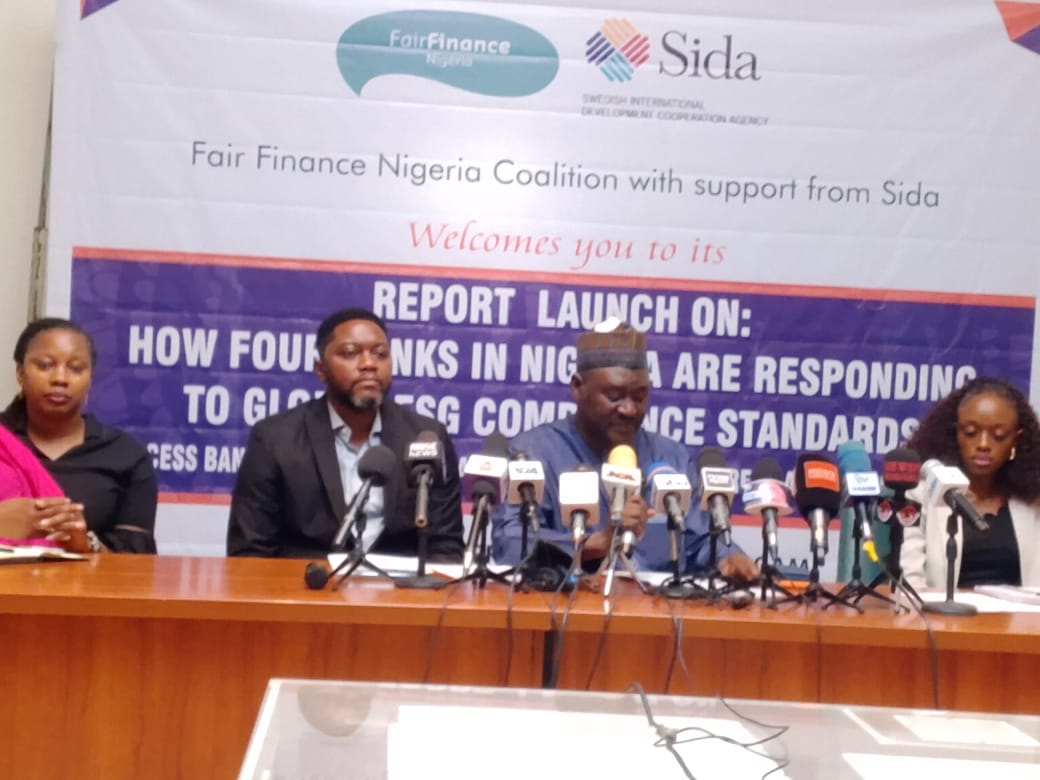

Civil Society Legislative Advocacy Centre (CISLAC) has referred to as for an pressing evaluate of Nigeria’s sustainability framework within the banking sector following the discharge of a brand new coverage evaluation report that exposes important gaps in environmental, social, and governance, ESG, compliance.
The organisation mentioned the findings underscore the necessity for stronger regulatory oversight and extra strong implementation of sustainability requirements throughout {financial} establishments.
Talking on the launch of the report in Abuja, Thursday, Govt Director of CISLAC, Comrade Auwal Ibrahim Musa Rafsanjani, mentioned the findings revealed weak dedication by Nigerian banks to accountable finance regardless of current regulatory necessities.
The report, titled: “How 4 Banks in Nigeria Are Responding to World ESG Compliance Requirements,” assessed Entry {Bank}, Customary Chartered {Bank}, United {Bank} for Africa, and Zenith {Bank} towards greater than 400 international ESG indicators.
Based on Rafsanjani, the banks recorded an total common rating of 1.7 out of 10, indicating that whereas fundamental compliance necessities are met, sustainability ideas weren’t totally built-in into core financing choices.
“The findings are each revealing and regarding. In Nigeria, compliance has not translated into actual dedication,” he mentioned.
The report highlighted important shortcomings in tax transparency, with all 4 banks scoring zero because of lack of disclosure on country-by-country reporting and publicity to tax havens.
It additionally famous poor efficiency in local weather motion, with a mean rating of 0.9, elevating considerations over continued financing of high-emission sectors with out credible transition plans.
Rafsanjani additional pointed to weak commitments to human rights, biodiversity safety, and host group welfare, warning that profit-driven financing continues to overshadow environmental and social issues.
Whereas some progress was recorded in inside insurance policies similar to labour requirements, gender equality, and anti-corruption measures, the report famous that these good points are undermined by gaps in how banks finance exterior initiatives.
Describing the scenario as a systemic problem, Rafsanjani mentioned the Nigerian Sustainability Banking Rules launched in 2012 are outdated and promote “tick-box compliance” relatively than significant accountability.
He referred to as on the Central {Bank} of Nigeria, the Chartered Institute of Bankers of Nigeria, the {Bank} Administrators Affiliation of Nigeria, related committees of the Nationwide Meeting, and banking leaders to convene a multi-stakeholder roundtable to evaluate and replace the ESG framework.
The proposed reforms, he mentioned, ought to align Nigeria’s sustainability requirements with international finest practices and guarantee transparency, accountability, and measurable affect.
Rafsanjani emphasised that the report was supposed as a constructive software to drive reform relatively than criticise, urging banks to maneuver past minimal compliance and undertake real company duty.
“The way forward for finance is sustainable, and establishments that fail to adapt threat long-term instability,” he warned.
He added that Nigeria has the potential to steer sustainable finance efforts in Africa if stakeholders display dedication, collaboration, and accountability.
The report was produced by CISLAC in collaboration with the Honest Finance Nigeria Coalition and companions together with BudgIT, Coverage Alert, CODE, STEPS, and Oxfam.
Rafsanjani concluded by urging stakeholders to deal with the report as a place to begin for transformative change towards a extra inclusive and environmentally accountable banking sector.