

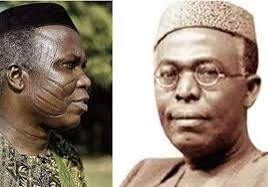
Each era of Nigerian politics likes to think about that its quarrel is unprecedented, that its betrayals are unique, that its intrigue is sporting a crown no earlier intrigue ever touched. However Nigerian politics is an outdated drummer. It adjustments songs, not rhythm. The names change. The costumes enhance. The microphones get higher. But the identical questions hold returning like harmattan mud: What’s opposition for? Is it an ethical pressure, a strategic ready room, or merely a department workplace of the ruling intuition?
To ask that query severely is to stroll again into the haunted chamber of Awolowo and Akintola. What started as a wrestle contained in the Motion Group was not only a disagreement between two good males. It was a collision of political temperaments, ideological route, ambition, and the bigger structure of energy in Nigeria. Awolowo, who moved to the federal centre as opposition chief after 1959, was more and more recognized with a broader ideological challenge. Akintola, in contrast, got here to embody a extra conservative, region-focused and business-oriented present, and his openness to working with the Northern-dominated federal institution deepened the rupture. By mid-1962, Awolowo’s camp had repudiated Akintola; the federal authorities declared a state of emergency within the Western Area and restored him in 1963. The bitterness of that cut up, and the wreckage that adopted, helped poison the First Republic.
That’s the reason the Awolowo-Akintola feud nonetheless issues. It was not gossip in agbada. It was an early Nigerian lesson that opposition can die in two methods. It may be strangled from outdoors by a hostile ruling order. Or, extra dangerously, it will probably decay from inside, when conviction offers option to entry, when technique turns into private survival, when occasion equipment turns into a theatre of ego. The Western disaster was, in that sense, not solely about who ought to lead. It was about whether or not opposition ought to stay an instrument of precept or turn out to be a bargaining chip out there of energy.
Kano and Kaduna then enter the story like twin furnaces of northern political reminiscence. Kano carries the outdated radical grammar of Aminu Kano, NEPU, Sawaba, talakawa politics, the language of emancipation relatively than patronage. Oxford’s entry on Aminu Kano notes his wrestle in opposition to corruption and oppression within the emirate order and his dedication to democratising Northern Nigeria. The PRP’s personal profile, lodged with INEC, explicitly roots itself in NEPU’s legacy and recollects that the PRP had two state governments within the Second Republic: Kaduna and Kano. In different phrases, each states should not unintended footnotes within the story of Nigerian opposition. They’re ancestral terrain.
Then got here 1999 and the Fourth Republic, with the PDP arriving not merely as a celebration however as an unlimited political climate system. Based in 1998 and rapidly changing into dominant, profitable the presidency and legislative majorities in 1999 and retaining nationwide management for years. Opposition existed, sure, nevertheless it was fragmented, regional, underpowered, and sometimes extra symbolic than threatening. That period didn’t abolish opposition. It domesticated it.
The good interruption got here in 2013, when the APC was fashioned by means of the merger of main opposition forces. That merger labored as a result of it answered a Nigerian reality older than any marketing campaign slogan: energy not often yields to scattered grievance. It yields to disciplined coalition. The APC emerged from the merger of ACN, CPC, ANPP, and a part of APGA, and in 2015 Buhari’s victory marked the primary time an incumbent was defeated and the primary inter-party switch of energy in Nigeria’s post-independence historical past. Reuters described it plainly as a historic democratic switch. For a short second, opposition in Nigeria seemed like greater than lamentation. It seemed like a ladder.
However even that victory carried a warning label. The issue with Nigerian opposition is that when it wins, it usually stops being opposition in spirit and turns into merely the subsequent landlord in the identical constructing. An educational evaluate of Nigeria’s democratic journey notes that the APC and PDP share many structural defects, and even cites the broader judgment that little distinguishes the 2 fundamental events as a result of each are fluid elite networks with weak ideology. That prognosis is painful as a result of it explains a lot. In Nigeria, opposition too usually opposes solely till the gates open. After that, the vocabulary adjustments, however the urge for food stays the identical.
That is the place Kano and Kaduna turn out to be particularly revealing from 1999 until now. Kano has repeatedly proven a willingness to defy neat nationwide binaries, and within the 2023 elections it backed Rabiu Kwankwaso of the NNPP within the presidential race whereas additionally electing Abba Kabir Yusuf of the NNPP as governor. Kaduna advised a distinct however equally fascinating story: it voted Atiku Abubakar of the PDP within the presidential contest, but elected APC’s Uba Sani as governor. CDD West Africa described the 2023 elections as unusually fragmented, noting that every one 4 main presidential contenders gained not less than one state and that states like Kano, Lagos, and Rivers cut up amongst three completely different events. So, Kano and Kaduna haven’t been passive spectators within the Nigerian democratic drama. They’ve been laboratories of resistance, fragmentation, coalition, and contradiction.
And now we arrive at present crossroads, the place the phrase “one-party state” is not a tavern exaggeration however a stay political argument. Reuters reported in Could 2025 that the APC endorsed President Tinubu for a second time period whereas the opposition was extensively seen as too divided and weak to mount a severe problem, with high-profile defections strengthening the ruling occasion. AP later reported Tinubu’s denial that Nigeria was being changed into a one-party state whilst a number of governors and federal lawmakers had left opposition events for the APC. By February 2026, main opposition leaders, together with Atiku, Peter Obi, and Amaechi, have been collectively rejecting the brand new Electoral Act, calling it anti-democratic and warning that it may assist set up a one-party order. Tinubu, for his half, has continued to insist that democracy requires room for the minority to talk.
So, is Nigeria now a one-party state? Not formally. Not but. There are nonetheless a number of events, a number of ambitions, a number of resentments, and a number of routes to elite reassembly. However that isn’t the one query that issues. A rustic can keep away from the authorized shell of one-party rule and nonetheless drift into the political tradition of one-party dominance. That drift occurs when the ruling occasion turns into the default shelter for frightened politicians, when defections substitute debate, when opposition events turn out to be warfare zones of inner ego, and when residents start to see events not as platforms of precept however as bus stops for the subsequent highly effective convoy. The hazard is much less a constitutional decree than a democratic evaporation.
For this reason the ghosts of Awolowo and Akintola are nonetheless standing by the roadside, watching us. Their quarrel warned that opposition with out inner self-discipline can collapse into treachery, and that energy on the centre at all times is aware of how you can exploit a divided home. Kano reminds us that opposition can spring from social reminiscence, from the cussed dignity of people that don’t at all times vote as ordered. Kaduna reminds us that politics is never easy, {that a} state can host each institution energy and rebel sentiment in the identical electoral season. And the Fourth Republic reminds us that opposition in Nigeria solely works when it’s greater than noise, greater than wounded ambition, greater than a coalition of briefly unemployed strongmen.
The actual Nigerian hazard, then, will not be that one occasion will conquer the whole nation by brilliance alone. It’s that the opposition will proceed to fail by behavior. If opposition is simply a queue for entry, then the ruling occasion will hold consuming its rivals one defection at a time. If, nevertheless, opposition rediscovers ideology, inner democracy, regional credibility, and the braveness to look completely different from what it condemns, then the outdated republic should still whisper a helpful lesson into the brand new one.
Awolowo and Akintola weren’t simply combating over a celebration. They have been combating over the soul of political different in Nigeria. That battle by no means ended—Could Nigeria win!