

Nigeria is a country bleeding from uncountable cuts; no thanks to Boko Haram terrorists, bandits, kidnappers, and several criminal elements.
From the cries of orphans in Benue, Plateau, Taraba, Kwara states, and other parts of Nigeria, to the charred remains of villages levelled by insurgents, the scars of terrorism are deep and fresh.
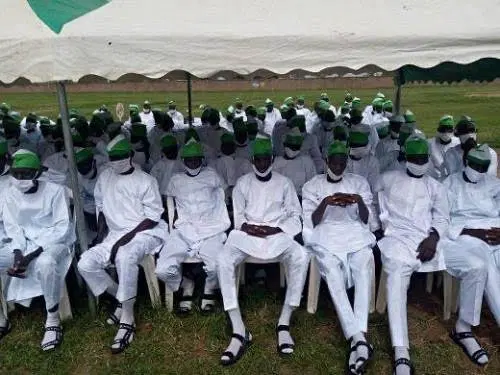
Yet, last week, a heavy silence fell over the country. It was followed by a deafening outrage, especially across social media. The reason? The Nigerian military announced the graduation and reintegration of 744 former terrorists back into society.
After a 24-week training in the de-radicalization program under Operation Safe Corridor in Gombe State, these ex-terrorists who were once the foot soldiers of terror, are now being cleared as fit to dwell in harmony with their victims and society in general.
But then, as they pack their bags to return to the communities they once destroyed, many Nigerians are asking: What’s the meaning of this graduation, and what exactly are we celebrating?
Honestly, the timing of this development couldn’t be worse. As insecurity spikes across the country, the optics of “forgiving” mass murderers feel like a bitter pill to swallow and a slap in the face of our soldiers’ sacrifices.
The fierce debates on this matter have set social media on fire, with citizens questioning the fairness of a system that seems to favour the villain over the victim.
On X (formerly Twitter), a user named Victor captured the mood of many when he wrote, “Not fair at all. Gallant officers sacrificed their lives on the line of duty, only for the enemies they fought against to be reintegrated just because they are ‘repentant.’ This is a mockery of their sacrifice.”
The sentiment is echoed on Facebook, where Baba Babs lamented: “The more we see, the less we understand. These are people who should have been smoked out instanta!”
Indeed, the controversy raises a mind-boggling question about Nigeria’s justice system, particularly about who qualifies for forgiveness? Is it the terrorist who burned down several villages and sent thousands to IDP camps? Or is it the young protester locked up for asking for good governance? What about the youth awaiting trial for years over petty theft or fraud?
By setting 744 ex-terrorists free after just six months of rehabilitation, the government risks sending a message now being interpreted as crime pays, and terror earns you a shortcut to a fresh start. Would you blame anyone habouring such a line of thought?
Sponsored
Seriously, can six months wash away blood?
Can a 24-week program really scrub clean the soul of a man trained to kill? Many Nigerians are skeptical about this program!
Here is an argument by a Facebook user identified as Ur Villagehead. “If these men are truly repentant, why aren’t they being used as assets to dismantle the networks they left behind? Why aren’t they leading soldiers to the hideouts of their former commanders?”
People are nursing a very terrifying possibility that these graduates could become classic “Trojan Horses”; that is, moles and informants who provide the insurgents with the coordinates of our soldiers. They may be wrong, actually.
Another issue at stake is that in a country where millions of honest youths are roaming the streets without jobs, what becomes 744 ex-militants with no livelihood? However, since they were said to have learned diverse skills, hope they would be meaningfully engaged otherwise, if their stomachs become empty at any point, the call to earn a living through violence may sound attractive again.
Many are basically wondering whether this act of forgiveness by the government is truly reintegration or confrontation.
You know, the ceremony or homecoming is perhaps the most disturbing part of this policy. Most of these “repentant” men are being sent back to the very communities they once terrorized. Imagine a widow who watched her husband slaughtered, now having to buy food items at the same village market with her husband’s killer. Imagine that particular man who trended online sometime ago after eight members of his family were burnt beyond recognition in one night attack by tertorists, attending the same village meeting with those that unleashed perpetual trauma on him. That’ll be tough!
So I ask, is the government sure these men will be received with open arms, or are we setting the stage for a cycle of revenge?
While the military views the program as a “complementary approach” to ending terrorism, the Nigerian public sees a ticking time bomb.
There really must be transparency, sincerity, strict monitoring, and a clear plan to provide for these men, otherwise, this “graduation” might just be an exercise that feeds the very monster we are fighting.
As it is, Nigerians can only watch and pray that this act of mercy which some people actually believe is the best way forward, doesn’t return to haunt us in the form of more ambushes and more mass funerals.
SPONSORED