

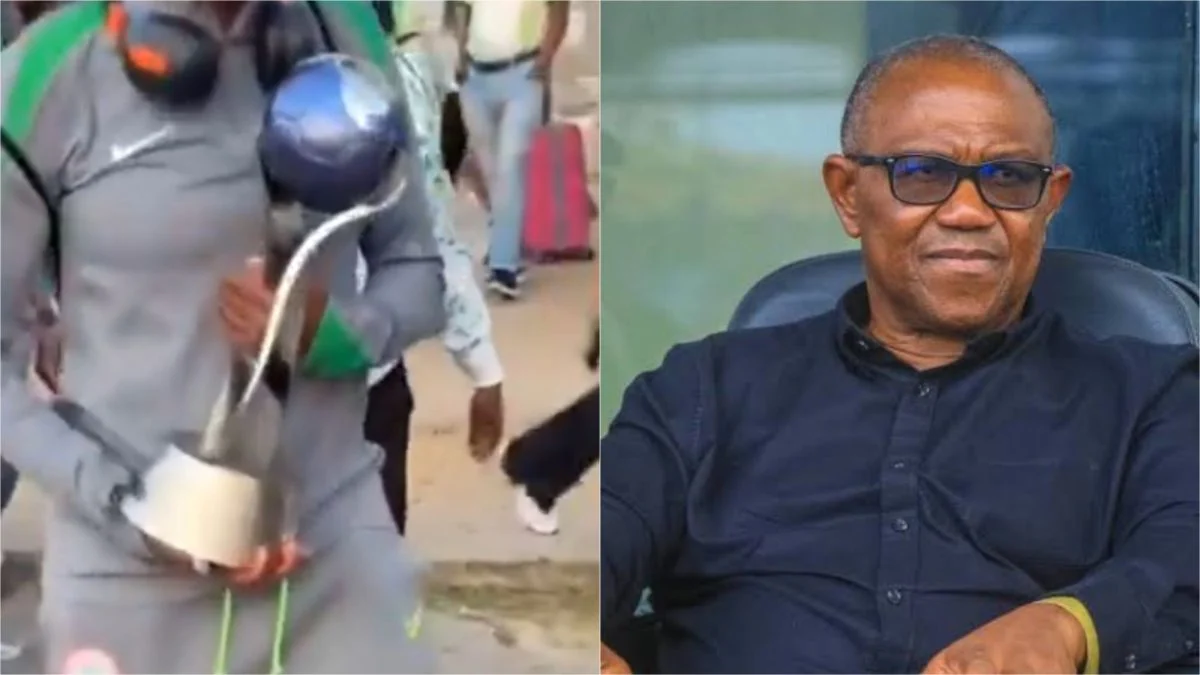
The Presidency has reacted to the controversy surrounding the alleged prevention of former Anambra State Governor and Nigeria Democratic Congress (NDC) presidential candidate, Peter Obi, from meeting Nigeria’s victorious Under-17 women’s football team, the Flamingos, at the airport in Abuja.
The Presidency accused opposition politicians of attempting to politicise national sports teams and institutions, insisting that the country’s athletes represent Nigeria rather than any political party or individual.
Dada Olusegun, Special Assistant to President Bola Tinubu on Social Media, made the remarks in a post on his X account while responding to Obi’s account of the incident.
Obi had alleged that officials of the Nigeria Football Federation (NFF) prevented him from approaching the players despite his intention to congratulate them following their historic victory at the FIFA U-17 Women’s World Cup.
Reacting, Olusegun described the opposition’s alleged attempts to use national sporting events for political purposes as distasteful.
“The constant attempt by the opposition to politicise our national sports teams and institutions is highly distasteful,” he wrote.
He maintained that the Flamingos, like other national athletes, represent the entire country and should not be associated with the political interests of any individual or party.
“Our national athletes, including the Under-17 girls’ team, represent the entire Federal Republic of Nigeria, not any specific political party or individual ambition,” he stated.
The presidential aide further explained that protocol guidelines surrounding national teams were designed to protect young athletes from political exploitation, commercial distractions and unnecessary media attention while carrying out official duties.
“Protocol guidelines around national teams are designed strictly to protect young athletes from political exploitation, commercial distractions, and unnecessary media circuses while on official duty,” he added.
Olusegun accused Obi of presenting what he described as standard security and administrative procedures as political victimisation, arguing that such narratives could undermine the unity that sporting achievements are expected to promote.
“To spin standard security and administrative protocols into a narrative of political victimisation is a disservice to the unity that sports are meant to foster in our country,” he said.
The presidential aide accused him of using unverified information to create a narrative of victimisation.
“Mr Peter Obi, I hope you will reflect on your manipulative way of life and stop weaponising unverified hearsay to build a victim narrative. Let our athletes focus on winning for Nigeria, free from political theatre. Thank you,” Olusegun added.
The reaction followed Obi’s earlier statement in which he narrated how he was allegedly prevented from greeting the players at the Nnamdi Azikiwe International Airport in Abuja on Monday morning.
The former Anambra governor said he arrived at the airport around 7 a.m. to board a flight to Enugu when he noticed the victorious team preparing to leave the airport.
According to him, he instructed his Protocol Officer, Jackie Wayas, to approach the relevant officials and find out whether he could meet the players and congratulate them on their achievement.
However, Obi claimed that he was subsequently informed that NFF officials had objected to the proposed meeting because they feared they could lose their jobs if they allowed him to interact with the team.
He described the incident as unfortunate, suggesting that political divisions were increasingly affecting relationships among Nigerians.
The NDC presidential candidate also recalled a similar experience on March 25, 2025, when he visited Uyo, Akwa Ibom State, for a World Cup qualifying match.
He said that although the governor welcomed him at the VIP stand, some government officials allegedly prevented him from greeting the players after the match for fear of losing their jobs.
“Regrettably, this is not the first time I have been subjected to such treatment,” Obi said.
He expressed concern over what he described as the growing deterioration of national unity, insisting that political differences should not prevent Nigerians from interacting with one another.
“The new Nigeria we aspire to build must have no room for hostility, intimidation, or discrimination, regardless of political affiliation. It must be a Nigeria in which unity, mutual respect, and our shared humanity take precedence over political differences,” he added.
The controversy followed the Flamingos’ historic 2-1 victory over Japan in the final of the FIFA U-17 Women’s World Cup on Saturday, November 7, 2026.
Goals from Awawu Bashiru and Oluebube Umejiaku secured Nigeria’s first-ever title in the competition, making the Flamingos the first African team to win the tournament.
President Tinubu had earlier congratulated the team on their achievement, describing the victory as a landmark moment for Nigeria and African women’s football.
In a statement issued on November 7, 2026, through his Special Adviser on Information and Strategy, Bayo Onanuga, the President praised the players for their determination, discipline and teamwork throughout the competition.
Tinubu also commended Bashiru and Umejiaku for scoring the goals that secured Nigeria’s historic victory and congratulated the coaching crew, the NFF and the National Sports Commission for their contributions.
He further reaffirmed his administration’s commitment to grassroots sports development and creating opportunities for young Nigerians, particularly girls, to pursue their sporting ambitions.