

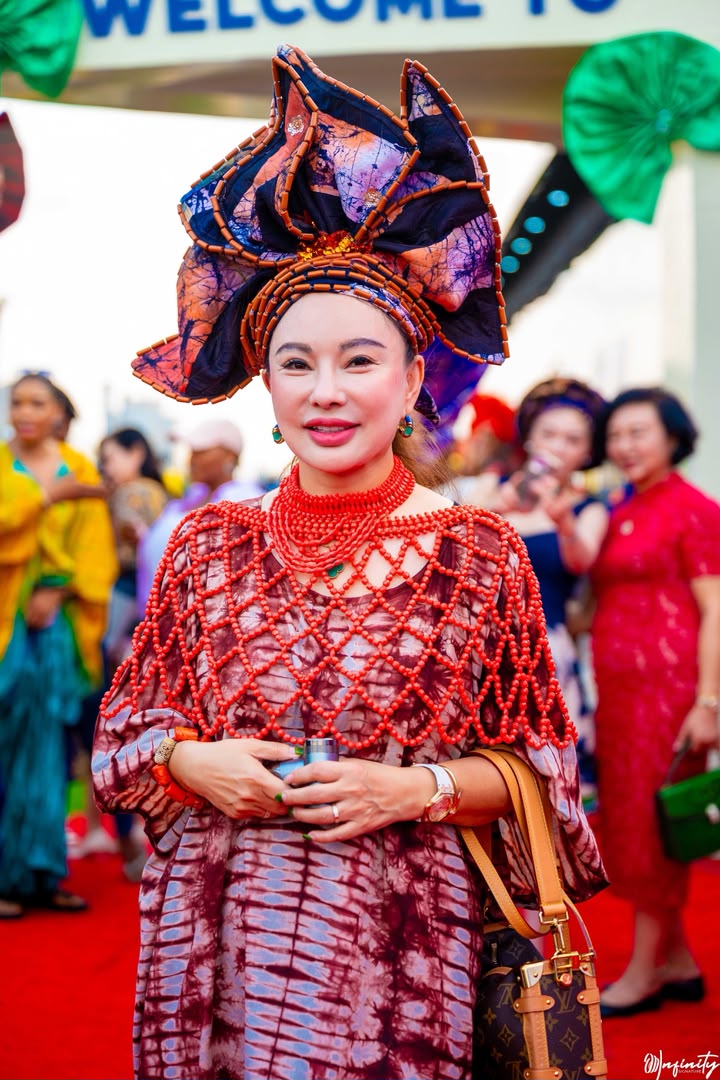
Chinese women and men added an international flavour to the inaugural 2026 Lagos Gele Festival, joining hundreds of participants to celebrate Yoruba culture through traditional headgear and Nigerian fashion.
While the women participated in tying different styles of gele, the men wore traditional Nigerian outfits, reflecting their interest in the country’s fashion and cultural heritage.
The festival held on Sunday in Lekki, attracted Nollywood stars, cultural enthusiasts and other guests, who turned up in gele styles featuring a variety of patterns, designs and vibrant colours.
It also featured a masterclass attended by more than 120 young women and other participants, who learnt and demonstrated various gele-tying techniques, with a cash prize of ₦2m awarded to the participant who created the most outstanding headpiece.
The festival organised by the Lagos State Government, was designed to celebrate the cultural significance of gele among the Yoruba people, promote the preservation of indigenous traditions and showcase the headgear as an enduring symbol of Yoruba identity and expression.
Speaking at the inauguration, the Special Adviser to Governor Babajide Sanwo-Olu on Tourism, Arts and Culture, Idris Aregbe, described the festival as an important platform for showcasing the beauty and cultural richness of Yorubaland.
“Today’s event is a very beautiful event. It’s one of the events that was designed to showcase the beauty, colourful platform that we have in Yoruba lands. You know, Lagos is Yoruba, Yoruba is Lagos,” he said.
Aregbe explained that gele occupies an important place in Yoruba social and cultural life, serving as a form of expression at parties, ceremonies and other social gatherings.
He said the traditional headgear represents a significant aspect of Yoruba identity, adding that the festival provides an opportunity for people to appreciate its cultural importance.
Beyond its cultural significance, Aregbe said the initiative was also designed to create employment opportunities, promote skills development and stimulate economic activities within the creative industry.
“This is something that has to do with culture. This is something that has to do with employment opportunities.
“It also has something to do with economic value as well,” he said.
He further highlighted the training sessions and competitions organised as part of the festival, explaining that they were intended to improve participants’ skills and create opportunities for those involved in gele-making and styling.
“We’ve seen employment opportunity there. We’ve seen trainings. We’ve seen skills.
“We’ve seen competitions within and among those who have tied it and those who are also representing or who are also carrying that elegant gele as well,” he added.
Aregbe expressed satisfaction with the turnout, noting that the festival had provided a platform for showcasing Yoruba traditions and encouraging conversations about the importance of preserving them.
Also speaking at the event, a Chinese participant who has adopted the Nigerian name Olarewaju and is associated with the Confucius Institute, University of Lagos, said his interest in Yoruba culture, particularly gele, inspired him to attend.
Olarewaju said he first learnt about gele through one of his students, whose introduction to the traditional headgear sparked his interest in experiencing it firsthand.
“So, we like culture very much, especially gele. I know of this gele from one of my students. So, today I have this information. Then, I came here to experience the very wonderful festival. Actually, we like it very much,” he said.