

Women
By Anthony Isibor
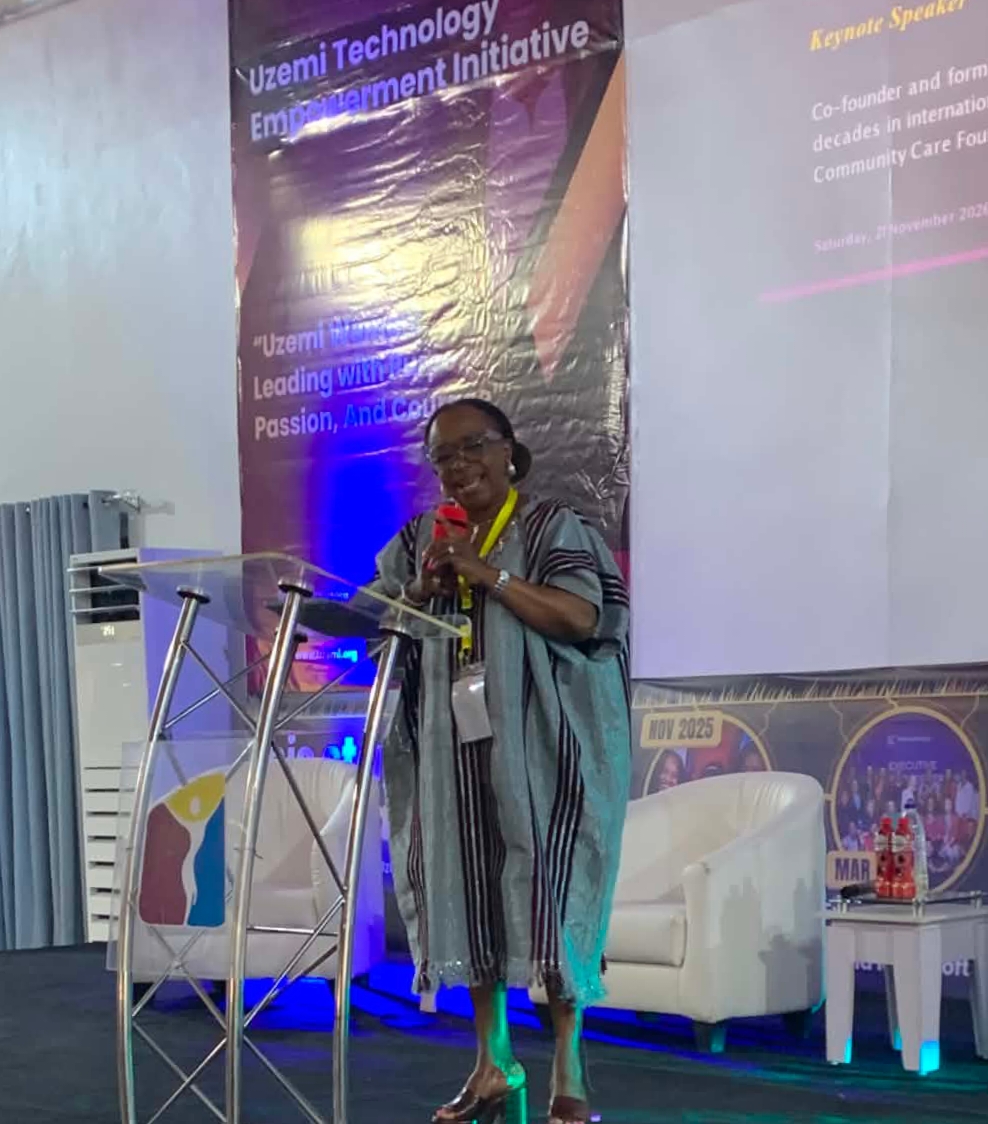
ADEOLA Azeez, co-founder and Chairperson of Women in Management, Business and Public Service, WIMBIZ, has warned that Africa’s artificial intelligence, AI, revolution can widen existing inequalities if women and young people are not given access to digital education, technology and opportunities.
She said that technological advancement alone would not guarantee equal opportunities, stressing that deliberate investment in digital infrastructure, skills development and mentorship was necessary to ensure that more Africans could participate in the emerging digital economy.
Azeez spoke at the fourth Uzemi Leadership Summit, held in Lagos on Saturday, November 21, under the theme, Stewarding Africa’s AI Future, where she delivered the keynote address.
She said the challenge was no longer simply to increase women’s representation in leadership, but to equip them with the skills, confidence and opportunities to influence the future of technology.
Drawing from her experience in the financial industry, where she spent about 15 years working with people across different sectors and institutions, Azeri said talent alone was insufficient without access to opportunities and support networks.
“I’ve encountered remarkable women with intelligence, determination and ambition, but without access and networks of support needed to realise their potential,” she said.
She noted that women often thrived when barriers to their advancement were removed, gaining confidence to become leaders, establish businesses and influence institutions.
According to her, this understanding informed her involvement in establishing WIMBIZ more than two decades ago, with a focus on providing women with access to professional networks, mentoring, development opportunities and platforms to influence decisions.
She described women’s empowerment as an investment in society rather than an act of charity or an attempt to meet representation quotas.
“When women advance, the benefit extends to families, businesses, communities and the entire economy,” she said.
Azeex, who also spoke about her experience in politics, said the barriers women face in seeking political leadership remained a subject that required further attention.
Turning to artificial intelligence, she said the technology was transforming financial services, education, healthcare, agriculture and business, changing how decisions were made, services delivered and skills developed.
However, she cautioned that the benefits of technological advancement would not be evenly distributed without deliberate efforts to address unequal access.
She illustrated this with two young people of similar intelligence and potential, one with access to computers, reliable internet, digital learning resources and mentors, while the other had none of these opportunities.
Although equally capable, she said, their chances of participating in the digital economy would be significantly different.
“For millions of young Africans, the first barrier to participating in the AI revolution is not a lack of talent or ambition. It is a lack of access,” she said.
She challenged policymakers, educators, business owners and other leaders to consider whether they were creating a future in which technology expanded opportunities or became another source of exclusion.
Azeez said Africa’s youthful population could become a major asset only if governments and institutions invested deliberately in education, digital skills and infrastructure.
She cited interventions by the Adiolas Community Care Foundation, through which she said a technology hub had been established at Emmanuel Primary School, Italope, Ijebu-Ode, Ogun State, to give pupils in an underserved public school access to computers and practical digital learning.
She said the initiative was designed to introduce children to technology at an early age, noting that many pupils in underserved communities had little or no opportunity to use computers.
“For us, it was about more than providing equipment; it was about giving children, regardless of their background, the opportunity to develop skills in a digital future,” she said.
She also highlighted the foundation’s CC Tech initiative, organised in partnership with the Uzemi Data Science and Tech Talent initiative, which brought together 40 female students from three universities in Ogun State for technology-related training.
According to her, the programme is designed to help young women understand how technology can be used to solve practical problems and create economic opportunities.
“Our goal is simple: to move women from awareness to capability, and from capability to opportunity,” she said.
Azeez said the next generation of African women should not be limited to using technologies developed by others but should acquire the skills and confidence to create solutions, drive innovation and shape the continent’s digital future.
She also stressed the importance of character and ethical leadership in the deployment of artificial intelligence.
According to her, while AI can generate information quickly, its output could be inaccurate or biased and must therefore be subjected to human scrutiny.
She said technological solutions that improved efficiency could also exclude vulnerable groups if their needs were not considered during development and implementation.
Azeez maintained that technological competence must go hand in hand with integrity, accountability, fairness and sound judgment.
“As we prepare young women for the AI generation, we must help them understand not only what they can do with technology, but what they should do with it,” she said.
She called for women who would question AI-generated results, understand the consequences of their decisions and use their knowledge to solve problems rather than exploit vulnerabilities.
“The true measure of innovation is not simply what technology makes possible, but whether it improves people’s lives,” she said.
Addressing women in leadership positions, Azeri urged them to create opportunities for others, particularly young women still trying to establish themselves.
She recalled a statement attributed to former United States Secretary of State Madeleine Albright, which challenged successful women to support and advance other women.
She said leadership should not be measured only by personal achievements but also by the number of people helped to succeed.
Azeez called on companies to invest in developing young digital talent, educational institutions to strengthen their technology programmes, professional organisations to create mentorship platforms and governments to expand the infrastructure required for digital inclusion.
She also encouraged individuals to contribute through mentoring, supporting students’ education, creating internship opportunities and sharing professional knowledge and resources.
“We may not all be able to establish technological hubs or fund large programmes, but we can each make a difference,” she said.
She urged young girls to remain curious, courageous and willing to experiment with technology, adding that their backgrounds should not determine the limits of their ambitions.
To graduates, she advised continuous learning and adaptability, while encouraging entrepreneurs to explore how technology could help grow their businesses.
She also acknowledged the personal and social challenges women could encounter, including marriage, childcare, divorce and abusive relationships, stressing the need to recognise the different circumstances that could affect their ability to pursue professional and technological opportunities.
She said efforts to prepare women for the future must take account of these realities and provide the support needed for them to remain active and productive.
A.I
Nov. 21, 2026
Tags: Adeola Azeez fourth Uzemi Leadership Summit