

By Maryanne Awuya
A civil society organization – Integrity Advocacy for Development Initiative (IADI) – has called for a comprehensive, evidence-based investigation into alleged contract fraud and procurement violations totaling ₦6.69 billion at the Nigerian Nuclear Regulatory Authority (NNRA).
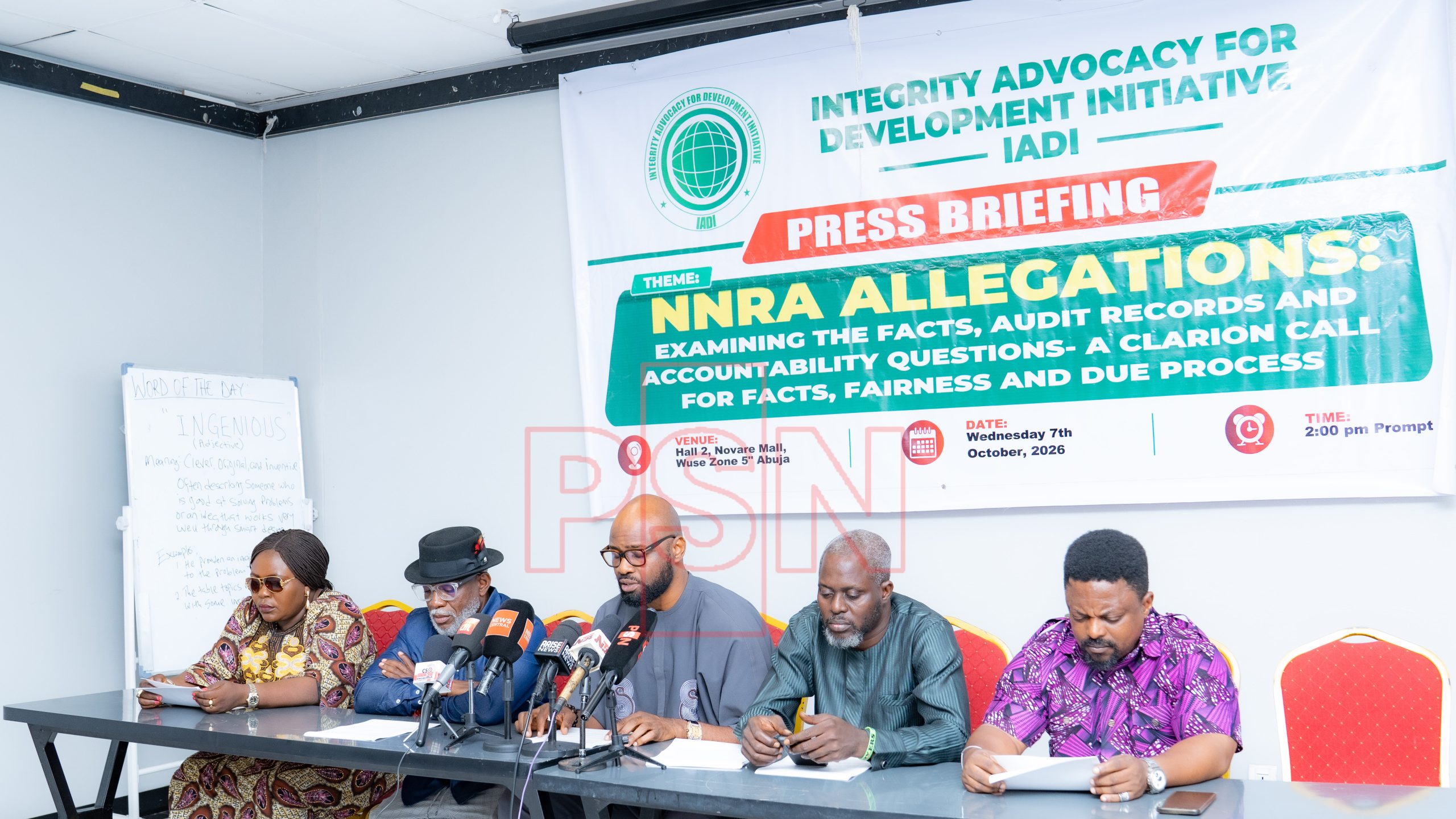
Speaking at a press briefing in Abuja on Wednesday, the group demanded a thorough probe following an October 1 report by Secrets Reporters, which accused the NNRA, under Director-General Dr. Yau Usman Idris, of financial misappropriation and breach of procurement protocols.
The development followed a separate October 5 protest by Global Integrity Watch (GIW) at the NNRA headquarters, where the organisation demanded responses to outstanding audit observations and Freedom of Information requests, alongside changes in the leadership of the Authority.
PerSecondNews correspondent at the briefing reports that IADI Executive Director, Comrade Ofomhi Christopher insisted that allegations involving public funds must be subjected to proper scrutiny, stressing that an audit observation should not automatically be treated as proof of fraud or personal misappropriation.
According to him, the public needs to know the specific audit observations, the periods and transactions involved, the nature and status of the projects or services, the responses provided by the NNRA and whether the issues have been resolved or referred for further investigation.
Christopher also referred to an explanation attributed to the NNRA Director-General concerning the Authority’s 2024 capital budget.
He said the explanation put the total capital budget at about ₦2.7 billion, comprising approximately ₦200 million directly belonging to the Authority and about ₦2.5 billion relating to constituency projects, with an additional ₦200 million regional project bringing the figure referenced to about ₦2.9 billion.
The IADI Executive Director said explanation should not be regarded as the final word, but should instead be tested against appropriation documents, budget releases, procurement records, payment records, project documents and audit reports.
He said where allegations concern unexecuted projects, the specific projects should be identified and physically verified.
Similarly, allegations of inflated contract prices, he said, should be examined through the relevant contracts, bills of quantities, procurement records and applicable price benchmarks.
Christopher also called for examination of procurement and ownership records where questions are raised about contractors, while allegations of diversion or misappropriation should be tested by following the financial trail.
“Audit questions should lead to verification. Verification should lead to findings. And findings should determine the appropriate action,” he said.
The group also addressed the recent GIW protest, acknowledging the right of civil society organisations to organise peaceful assemblies and demand accountability.
However, IADI said civil society advocacy should be conducted responsibly and within the law, particularly when protests are linked to requests for information under the Freedom of Information Act.
Christopher said an unanswered FOI request could justify further steps to obtain the requested information but should not, by itself, be treated as proof that allegations contained in the request are true.
He said the law provides a judicial mechanism for applicants seeking review where access to information has been denied or an application is deemed to have been denied.
The group also urged CSOs organising protests to consider public safety, access to government premises and the safety of protesters, workers and other citizens.
Comrade Dominic Ogakwu, National President of the Civil Society Groups for Good Governance (CSGGG), also cautioned civil society organisations against making allegations without properly establishing the facts.
Ogakwu said civil society had a powerful role in exposing wrongdoing but warned that the same tool could become counterproductive if used without adequate knowledge of the facts.
He urged CSOs to move beyond what he described as sensational claims and focus on citizens’ engagement and evidence-based advocacy.
He said: “Citizens themselves could help identify discrepancies between what is budgeted and what is physically delivered on the ground”.
Taiwo Adeniran, Director of Programmes, Media and Public Relations Officer of the Transparency Advocacy for Development Initiative (TADI), stressed the importance of accuracy in reporting information.
Adeniran warned that even a photograph could be misleading if removed from its proper context or accompanied by an inaccurate caption.
He called on civil society organisations and the media to exercise caution in handling sensitive information, particularly amid the country’s tense political environment.
IADI said it was not seeking to shield the NNRA or any public official from legitimate scrutiny, but insisted that accountability must be based on records, evidence and due process.
The organisation called on relevant audit and oversight authorities to clarify the status of the outstanding observations, responses received from the NNRA and whether the matters had been resolved, sustained or referred for further investigation.
“Investigate the allegations. Verify the records. Examine the audit observations. Inspect the projects and services where necessary. Examine the procurement process. Follow the money. Hear the response. And let the evidence determine the conclusion,” IADI said.
The group maintained that while the public deserves accountability, it also deserves accuracy and fairness, stressing that an allegation or audit observation should not automatically be treated as a finding of personal guilt