

By Omoyeni Ojeifo
Nigeria has saved ₦61.58 billion this year alone through early fertiliser procurement, as the Federal Government targets 1.1 million metric tonnes for the 2026 farming season.
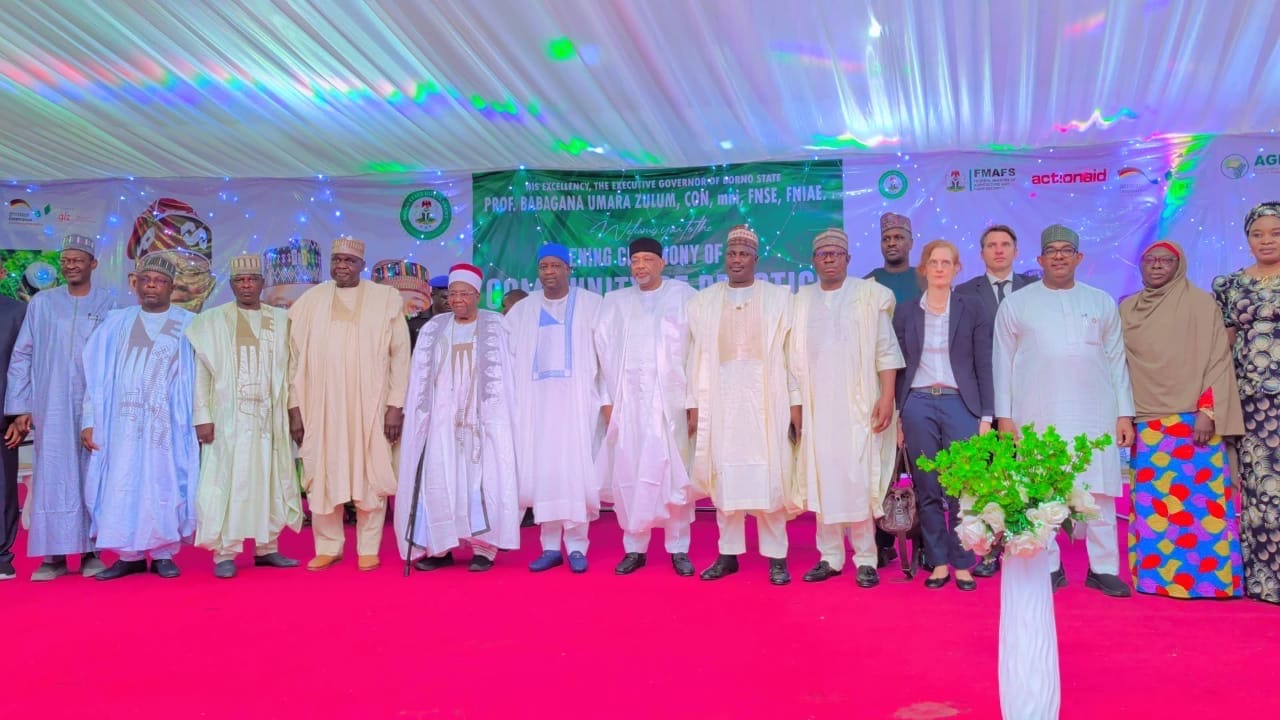
Agriculture Minister Sen. Abubakar Kyari disclosed this at the annual Community of Practice meeting in Maiduguri, Borno State, calling for stronger coordination among governments and development partners.
“Alignment between the Federal State Governments and Partners is indispensable to sustainable food security and resilient livelihoods,” he said.
Kyari also highlighted lower food prices, expanded input delivery and support for smallholder farmers, urging stakeholders to sustain the gains.
“We have seen reductions of up to 50 per cent in the prices of some essential food commodities, alongside expanded input delivery,” he noted.
On fertiliser supply, he explained that early procurement under the Presidential Fertilizer Initiative helped secure the 2026 supply and generated ₦61.58 billion in savings.
“Nigeria remains on course to deliver the 1.1 million metric tonnes fertiliser programme, while the government also pursues mechanisation, irrigation and improved access to quality seeds.
“Our task is to build on those comparative advantages with adaptable technologies, infrastructure and market linkages, rather than expect every State to produce everything.”
Kyari also highlighted the National Agricultural Mechanization Policy and Investment Strategy, including plans for a mega tractor assembly plant.
“Together, they provide the framework for moving from fragmented equipment interventions towards a sustainable mechanization ecosystem,” the minister stressed.
The proposed assembly plant is expected to produce between 2,000 and 4,000 tractors annually, while Special Agro-Industrial Processing Zones will strengthen connections between production, processing and markets.
Also speaking, Borno Governor Prof. Babagana Zulum, represented by Deputy Governor Usman Kadafur, described the meeting as a platform for shared learning and collective agricultural action.
“The Summit is more than a gathering of policymakers, development practitioners, agricultural experts, researchers, farmers, private-sector actors and development partners.”
Zulum urged participants to turn discussions into practical improvements for farmers, businesses and communities.
“It should be a platform where experience becomes knowledge, knowledge becomes action, and action produces measurable improvement in the lives of our people.”
Dr Karin Jansen, Head of Development Cooperation at the German Embassy, stressed stronger cooperation among federal authorities, states and non-state actors.
She highlighted Germany’s support through the AgSys programme, funded by BMZ and implemented by GIZ, to support agricultural policy processes and scale successful approaches.
In his remarks, Minister of State for Agriculture, Sen. Dr Aliyu Sabi Abdullahi, urged states to maximise their individual agricultural strengths.
“A central theme emerging from our interactions is the need to leverage Nigeria’s comparative advantages.”
He also called for stronger coordination among agriculture, health, environment and rural development authorities to address interconnected challenges affecting Nigeria’s agrifood sector.