

Economy, Featured
By Anthony Isibor
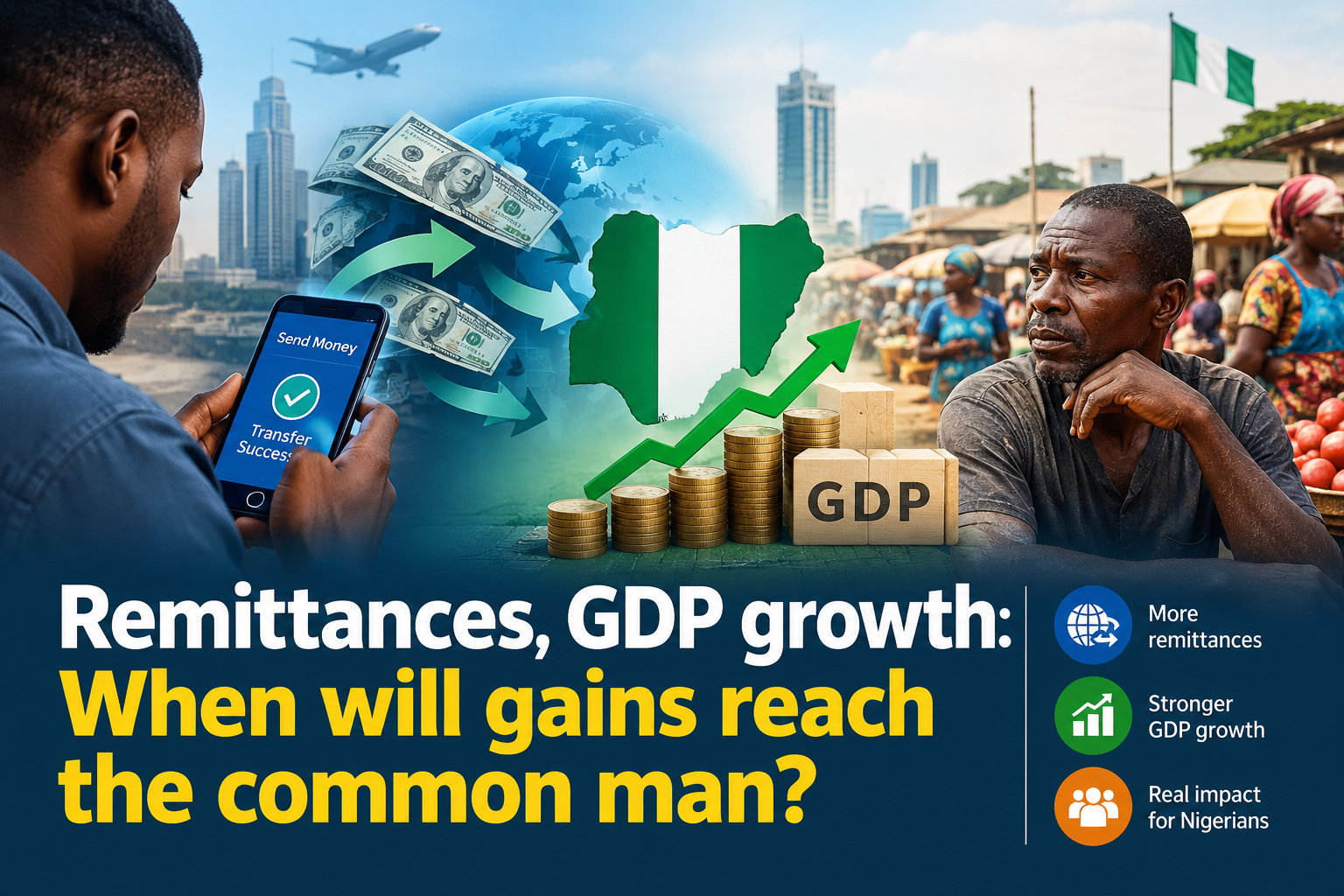
NIGERIA has recorded two achievements that should ordinarily be expected to strengthen confidence in its economy: diaspora remittances through formal channels have surged to a record level, while economic growth accelerated to 4.43 per cent in the second quarter of 2026.
But for millions of Nigerians still struggling with food prices, transport fares, school fees, electricity bills and weak purchasing power, the obvious question is: when will these gains begin to make a meaningful difference to their lives?
The Central Bank of Nigeria, CBN, reported that remittance inflows through International Money Transfer Operators, IMTOs, reached $947 million in July 2026, the highest monthly inflow ever recorded through formal channels and just $53 million short of the CBN’s $1 billion monthly target.
The cumulative formal inflows between January and July stood at $3.8 billion, representing a 50.2 per cent increase over the corresponding period of 2025.
At the same time, the National Bureau of Statistics. NBS, reported that real GDP expanded by 4.43 per cent year-on-year in Q2 2026, up from 4.23 per cent in Q2 2025 and 3.89 per cent in Q1 2026. Growth for the first half of the year stood at 4.16 per cent, compared with 3.68 per cent in the first half of 2025.
On the surface, the combination appears encouraging: more dollars are entering the country, foreign exchange liquidity has improved, the naira has shown greater stability and output is expanding.
But there is a significant gap between macroeconomic improvement and household prosperity.
The CBN attributes the increase in formal remittances to reforms designed to make official channels more attractive to Nigerians abroad.
The measures include greater exchange-rate transparency, changes to the regulatory framework for IMTOs and the introduction of the Non-Resident Bank Verification Number, NRBVN. In March 2026, the CBN also directed IMTOs to route remittance transactions through designated naira settlement accounts with authorised dealer banks.
The CBN Governor Olayemi Cardoso said in July that monthly official remittances had risen from about $200 million to over $600 million following the foreign exchange reforms, while the bank’s objective remained $1 billion a month.
The July figure of $947 million suggests that target is no longer merely aspirational.
The increase is important for Nigeria because remittances provide a source of foreign exchange independent of crude oil. More dollars coming through formal channels can increase liquidity in the foreign exchange market, support reserves and reduce pressure on the naira.
The naira has indeed shown greater stability. CBN data showed the currency closing at about N1,337 to the dollar on August 28, compared with N1,349.99 on August 24.
Reports show that a rise in formal remittances does not necessarily mean that $947 million in entirely new money suddenly entered Nigeria. Part of the increase may represent Nigerians who previously used informal channels switching to regulated channels as the official market became more attractive and transparent.
Similarly, the GDP figure is also positive, but it needs to be read carefully.
According to the NBS, agriculture grew by 4.39 per cent in Q2 2026, compared with 2.82 per cent a year earlier. Services grew by 4.60 per cent, while industry expanded by 3.96 per cent.
”The non-oil economy remains overwhelmingly dominant, accounting for over 95 per cent of real GDP in Q2. The figures therefore indicate that Nigeria is not simply experiencing an oil-driven expansion. But GDP measures economic output, not the amount of money available to each household”.
An economy can grow while households become poorer if population growth, inflation, unemployment and income inequality outpace the benefits of increased output.
This is the point being made by a growing number of economists and business groups. ‘GDP growth is not yet prosperity’
Economist and Chief Executive Officer of Financial Derivatives Company, Bismarck Rewane, said on September 2, 2026, that the 4.43 per cent growth rate was encouraging because it was higher than Nigeria’s estimated population growth rate.
He argued that, technically, output was growing faster than the population and should therefore translate into higher incomes and improved living standards.
But Rewane also stressed that GDP should be understood primarily as increased economic output rather than increased government revenue or an automatic improvement in household income.
Professor Godwin Oyedokun of Lead City University offered a more cautious assessment on September 1 in a story on Daily Post. He said the 4.43 per cent growth showed that the economy was gaining momentum, but warned that GDP growth should not be confused with improved living standards.
His argument is central to the current debate: growth in agriculture does not automatically mean cheaper food, just as growth in services does not necessarily produce enough well-paid jobs.
Oyedokun said the next stage of economic reforms should focus on productivity, manufacturing, quality employment, real wages and lower production and living costs.
NECA Director-General Adewale-Smatt Oyerinde, speaking on September 2, also described the latest GDP performance as encouraging but said it represented gradual rather than full recovery.
He pointed to energy costs, infrastructure, access to affordable credit, weak purchasing power and rising production costs as continuing constraints on businesses.
And on September 4, PENGASSAN chief Olabiyi-Agoro made essentially the same point, saying the improvement in GDP, balance of trade and foreign exchange reserves must translate into food and better living conditions for the ordinary Nigerians.
For Senator Gbenga Daniel, growth must be felt. The former Ogun State governor and Senator representing Ogun East, offered perhaps the clearest political formulation of the issue at the 7th Annual Lecture of Freedom Online in Lagos.
Speaking on the theme, “2027 Elections, Economy, Security and Nigeria’s Future,” Daniel said economic growth could not be assessed solely through the GDP.
The real test, he said, was whether Nigerians could feel the impact of that growth in their daily lives.
He asked whether young Nigerians could find decent jobs, farmers could safely reach their farms, manufacturers could produce competitively and small businesses could survive the cost of electricity, transportation and financing.
“Nigeria cannot have a strong economy without security, and it cannot have lasting security without economic opportunity,” Daniel said.
He argued that insecurity should be regarded as an economic issue because it prevents farmers from cultivating, raises transportation costs, increases business security expenses and discourages investment.
Daniel cited reported figures showing that more than 7,800 people were abducted between July 2025 and June 2026, arguing that every kidnapping that prevents a farmer from reaching his farm or forces a business to close has an economic cost.
He also noted the NBS finding that the non-oil sector accounted for about 95.18 per cent of real GDP in Q2 2026, saying Nigeria’s economic future increasingly lies beyond crude oil.
Why Nigerians may not feel the remittance boom
Remittances are different from GDP because the money normally goes directly to individuals and households. That makes them potentially more powerful at the household level.
A Nigerian in London, Toronto, Houston or Johannesburg who sends money to a parent, sibling or child is effectively transferring purchasing power directly into a Nigerian household.
The money can pay rent, school fees, medical expenses, food bills, farm inputs or capital for a small business.
But the experience of one Nigerian living abroad, who spoke to Realnews on anonymity, illustrates the darker side of the remittance story.
The diaspora contributor said remittances were often not being sent because relatives abroad had suddenly become wealthier, but because families at home had become increasingly dependent on them.
In his account of Uzo-Uwani Local Government Area of Enugu State, insecurity has made farming increasingly difficult, leaving families dependent on money from relatives abroad.
“Unfortunately, most times, we’re not remitting funds by choice. Our relatives, some of them graduates we also sponsored, are impoverished.”
He said farmers in his area were increasingly afraid to go to their farms because of attacks and killings, leaving some communities dependent on remittances for survival.
That account cannot by itself establish the scale of insecurity in Uzo-Uwani, nor should an individual experience be generalised to the entire country. But it raises an important question: are remittances financing economic development, or increasingly financing household survival?
However, the answer can be both.
There is also the inflation problem. And this is where the headline economic improvements collide with everyday reality.
Nigeria’s headline inflation rate fell to 15.43 per cent in July 2026, from 15.91 per cent in June. But food inflation moved in the opposite direction, rising from 17.52 per cent to 20.31 per cent.
More strikingly, month-on-month food inflation jumped to 5.56 per cent in July from 3.75 per cent in June.
In other words, the annual rate of increase in overall prices has slowed, but food prices were still rising rapidly.
This distinction is crucial for ordinary Nigerians because food consumes a disproportionately large share of household income, particularly among poorer families.
The World Bank says food inflation disproportionately affects poor Nigerian households, which can spend up to 70 per cent of their income on food. It also says more than 60 per cent of Nigerians were estimated to be living below the national poverty line in 2025.
The IMF, in its June 9, 2026 Article IV assessment, similarly said that although reforms had improved macroeconomic resilience, conditions remained difficult for many Nigerians. It estimated poverty at 63 per cent and said 27 million Nigerians had faced food insecurity in the fall of 2025.
This explains why a lower inflation rate does not necessarily feel like falling prices.
Inflation falling from 25 per cent to 15 per cent does not mean prices have fallen by 10 percentage points. It means prices are rising more slowly.
A bag of rice that has already become much more expensive does not automatically become cheap because inflation falls.
If more dollars enter through formal channels, the supply of foreign exchange increases. Greater FX liquidity can reduce volatility and make it easier for businesses and individuals to obtain foreign currency.
A more stable naira can, in turn, reduce imported inflation, particularly for an economy heavily dependent on imported machinery, raw materials, pharmaceuticals, food inputs and other goods.
The CBN has linked its reforms to improved exchange-rate stability, while the World Bank has said stronger external balances and remittances are helping Nigeria’s macroeconomic position.
But the transmission from a stronger external position to the household wallet is neither automatic nor immediate.
If the naira stabilises but electricity, transport, rent, food, school fees and healthcare continue rising, the ordinary citizen may still feel little improvement.
There is also a separate political argument that must be distinguished from the economic evidence.
A critic who also spoke to Realnewsmagazine argues that the administration of President Bola Tinubu has manipulated or politicised official economic statistics, particularly the inflation and GDP figures.
He questions how agriculture could be growing while insecurity is preventing farmers from reaching their farms, and how industrial output could expand amid high energy, transportation and raw-material costs.
He also questioned the credibility of the inflation rebasing exercise and argued that investors would be wary of economic statistics they considered unreliable.
These are serious allegations, but they remain allegations.
There is currently no basis to present as established fact the claim that the NBS has fraudulently manufactured the GDP or inflation figures.
There are, however, legitimate debates about statistical methodology and credibility.
The NBS changed the base year for GDP from 2010 to 2019 and rebased the Consumer Price Index to a 2024 base year. The bureau says the changes were designed to make the statistics better reflect the current structure of the Nigerian economy.
The IMF and World Bank have also been involved in Nigeria’s statistical and economic assessment processes, while the NBS says its methodology is based on internationally recognised standards.
At the same time, criticism of the credibility of inflation statistics has not been entirely absent. In January 2026, former Zenith Bank chief economist Marcel Okeke questioned the credibility and comparability of Nigeria’s inflation figures, while investment banker Adetilewa Adebajo called for greater scrutiny of the methodology.
That is a legitimate area for scrutiny, but it is different from proving that the statistics are fraudulent.
There is, ultimately, a way to test whether the current economic improvement is real without relying solely on arguments over GDP.
Look at the transmission mechanisms.
Are real wages rising?
Are businesses hiring?
Is manufacturing capacity increasing?
Are farmers safely returning to their farms?
Are food prices falling in absolute terms?
Are transport costs declining?
Is electricity becoming more reliable and affordable?
Are households able to save more of their incomes?
Are children staying in school because families can afford the fees?
Are Nigerians abroad still sending relatives money because they are building businesses, or because families at home cannot survive without it?
These are the indicators that will determine whether Nigeria’s macroeconomic recovery becomes an economic recovery for households.
Also, the remittance numbers nevertheless deserve recognition.
Moving from roughly $200 million a month in formal inflows to $947 million in July represents a major expansion of a foreign-exchange source that is not dependent on crude oil.
The first seven months’ $3.8 billion is also significant. If the country can sustain that inflow, strengthen the naira, rebuild reserves and channel part of the resulting stability into productive investment, the remittance boom could become more than a statistical achievement.
It could support household consumption, education, healthcare, housing, small businesses and investment.
But there is a danger in celebrating the numbers too early. Experts believe that “a country cannot remit its way out of weak domestic productivity. Nor can GDP growth alone solve poverty”.
And remittances cannot permanently substitute for jobs, functioning farms, reliable electricity, secure communities, competitive industries and rising domestic incomes.
The World Bank made essentially this point in its April 2026 Nigeria Development Update: macroeconomic stability has improved, but household incomes have yet to recover fully and poverty remains high. The next challenge is converting stabilisation into inclusive growth and better livelihoods.
That is perhaps the most accurate description of Nigeria’s economy today.
The engine appears to be starting. The question is whether the power will reach the household. For the Nigerian worker, farmer, trader, student, pensioner and small-business owner, that is the only economic statistic that will ultimately matter.
A.I
Sept. 7, 2026
Tags: Adetilewa Adebajo Adewale-Smatt Oyerinde Bismarck Rewane Marcel Okeke NECA PENGASSAN Professor Godwin Oyedokun Senator Gbenga Daniel