

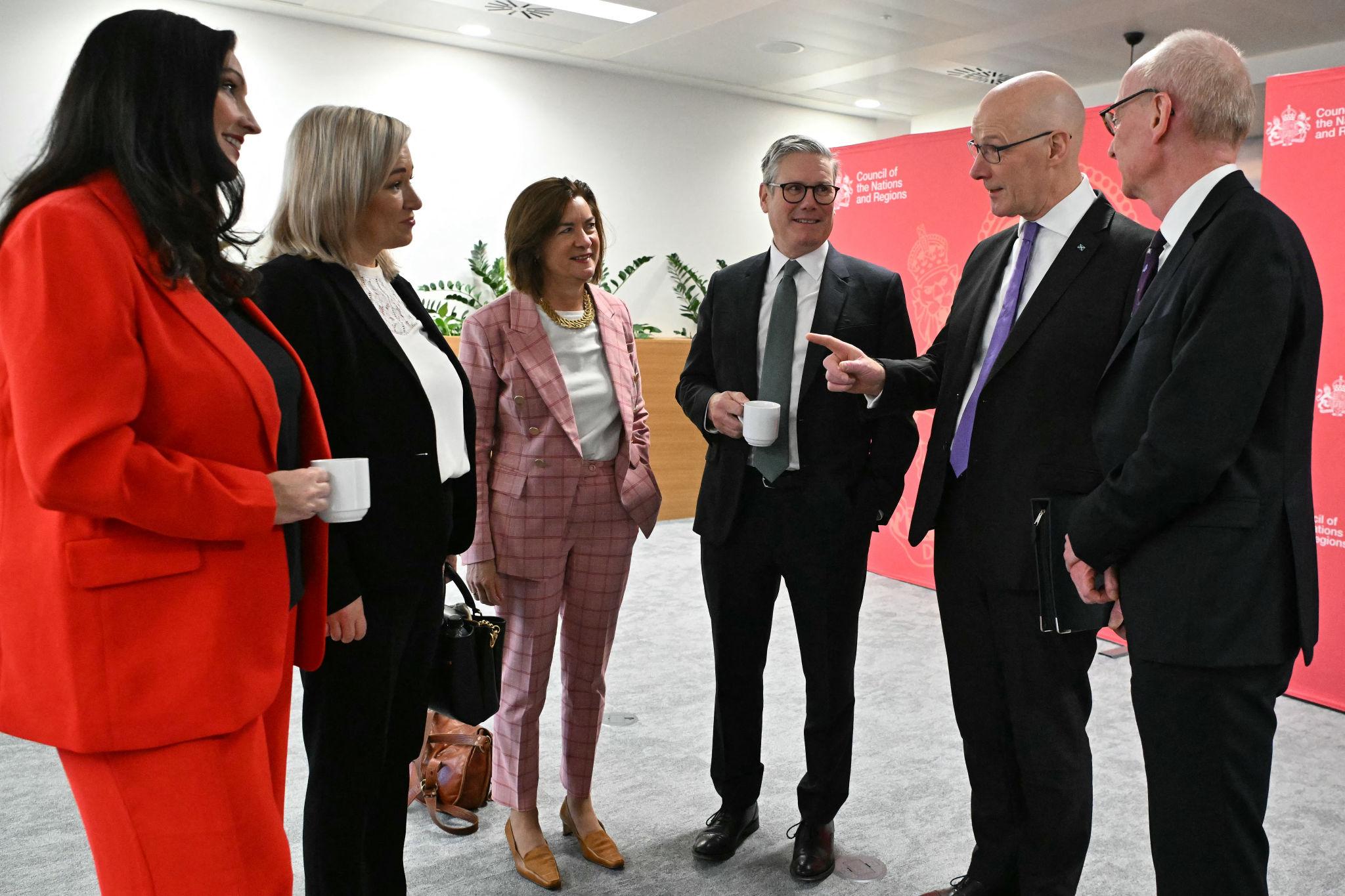
Leaders of three major nationalist parties from Scotland, Wales and Northern Ireland have declared that their nations should have the right to determine whether they remain part of the United Kingdom.
The leaders of the Scottish National Party (SNP), Plaid Cymru and Sinn Féin made the declaration on Monday during a rare meeting in Cardiff, the Welsh capital.
The three parties all support ending their respective nations’ constitutional ties with the UK, although they differ on the timing and process for achieving their goals.
The meeting came days after US President Donald Trump expressed support for a united Ireland, prompting Northern Ireland First Minister Michelle O’Neill to argue that the question of Irish unity remains an active political issue.
Parties Sign Self-Determination Agreement
SNP leader John Swinney, Plaid Cymru leader Rhun ap Iorwerth, and Sinn Féin leader Mary Lou McDonald and deputy leader O’Neill met in their capacities as party leaders.
Swinney and Iorwerth are also first ministers of Scotland and Wales respectively, while O’Neill serves as Northern Ireland’s first minister.
A memorandum of understanding signed by the parties stated that the people of their respective nations should be able to determine their constitutional futures.
“Our nations have the right to self-determination,” the memorandum stated, adding that Westminster should not prevent democratic decisions about the future of the nations.
Swinney said the parties were united around the principle of self-determination.
“For the first time ever, people across these islands have first ministers in Scotland, in Wales and in the North of Ireland who are all committed to independence from the United Kingdom,” the memorandum stated.
The agreement also declared that the parties wanted their nations’ futures to be connected to the European Union.
.
advertisement
Different Routes to Independence
Although the parties share a desire for greater constitutional separation from the UK, their approaches differ significantly.
The SNP is seeking another Scottish independence referendum after voters rejected independence in 2014.
Successive UK governments have opposed holding another referendum without Westminster approval.
Sinn Féin, meanwhile, supports a referendum on Irish reunification, which would determine whether Northern Ireland remains within the UK or becomes part of a united Ireland.
Plaid Cymru supports Welsh independence but has taken a longer-term approach. Iorwerth has previously ruled out pushing for an immediate referendum.
The three parties have also gained significant political influence within their respective devolved institutions.
The SNP and Plaid Cymru are currently the largest independence-supporting parties in the Scottish and Welsh parliaments, while Sinn Féin has been the largest party in Northern Ireland’s assembly since 2022.
The devolved administrations have powers over areas including health, education, housing, transport and the environment, alongside limited taxation responsibilities.
Northern Ireland Unity Debate
The question of Irish unity has remained particularly sensitive because of Northern Ireland’s history of political and sectarian conflict.
The 1998 Good Friday Agreement, which largely brought an end to three decades of conflict, provides for a referendum on Northern Ireland’s constitutional status if the British government’s Northern Ireland secretary believes it is likely that a majority would vote for reunification with the Republic of Ireland.
Sinn Féin leader McDonald recently criticised British Prime Minister Andy Burnham after he said a referendum on Irish unity was “off the table”.
McDonald argued that the prime minister could not remove provisions contained in the Good Friday Agreement.
Burnham subsequently clarified his position in parliament.
On Scotland, Burnham has said another independence vote could take place if there were a “clear consensus” in favour of one north of the border.
However, he reportedly later wrote to Swinney to clarify that a referendum remained “off limits”.
Nationalist Parties Claim Growing Momentum
The three parties described their agreement as evidence of growing support for constitutional change across Scotland, Wales and Northern Ireland.
The memorandum said there could be “no clearer sign” that Westminster’s influence was facing a challenge.
However, the parties still face different political, legal and constitutional hurdles before their independence ambitions could become reality.
The latest agreement nevertheless marks an effort by the nationalist movements to coordinate their positions around the principle of self-determination while maintaining their separate approaches to independence and Irish reunification.