

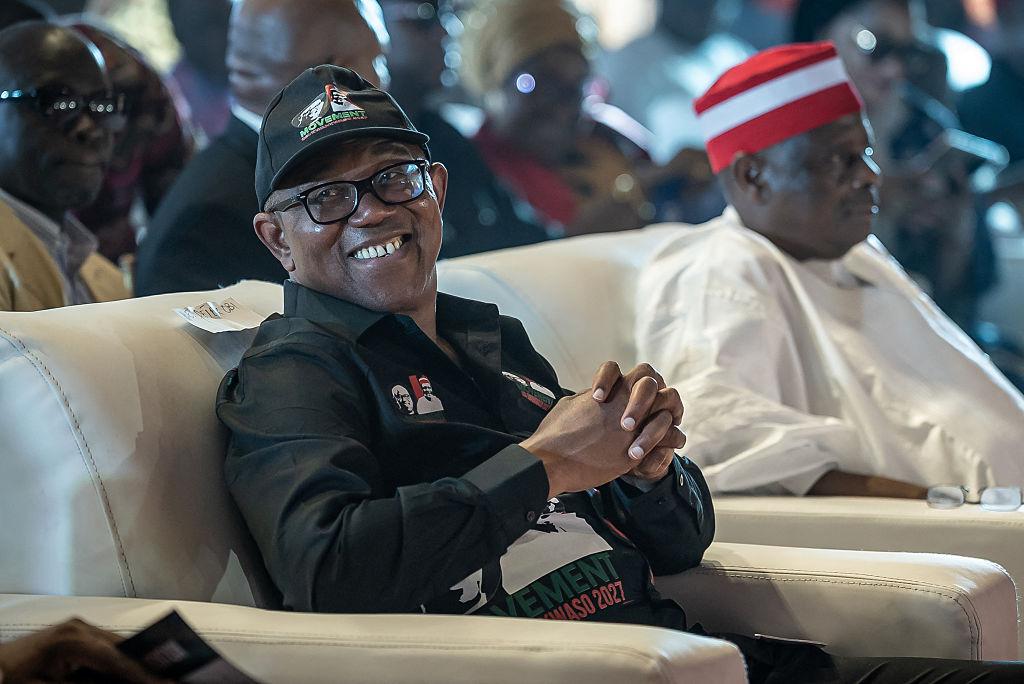
The presidential candidate of the Nigeria Democratic Congress (NDC), Peter Obi, has ruled out treating a possible 2027 opposition alliance as a personal decision between himself and African Democratic Congress (ADC) candidate Atiku Abubakar.
Obi said any arrangement involving the two politicians must now be negotiated by their respective political parties, noting that both men already hold presidential tickets on separate platforms.
The former Anambra State governor made the clarification during an interview with Arise Television on Thursday, where he discussed the 2027 presidential election, opposition cooperation, the economy, national unity, security and governance.
Asked whether he would step aside for Atiku, Obi said the circumstances had changed because the issue now involved two separate political parties.
“Do you know where we are now? Where we are now is that I’m a candidate, my leader Atiku is a candidate of another party,” he said.
According to Obi, discussions about a possible alliance could therefore no longer be reduced to a conversation between two individuals.
He compared the situation to two corporations considering a merger, arguing that the parties would have to determine how their structures could be brought together.
“All those parties have candidates. So, it is a discussion. It is no longer me, as Peter, talking,” Obi said.
His comments come amid continued efforts by opposition politicians to establish a common platform capable of challenging President Bola Tinubu and the ruling All Progressives Congress (APC) in the 2027 presidential election.
Obi, Atiku and other opposition figures were involved in the coalition process that adopted the ADC as its platform in 2025. However, the arrangement did not ultimately produce a joint 2027 presidential ticket for Obi and Atiku.
Obi later emerged as the NDC presidential candidate, while Atiku became the ADC presidential candidate.
.
advertisement
Their separate candidacies have fueled speculation over whether either politician could eventually withdraw in favour of the other as opposition groups seek a single presidential candidate.
Obi’s latest comments suggest that any such decision would have to emerge from broader negotiations among the political parties rather than from a private agreement between him and Atiku.
Obi Denies Rejecting Atiku’s Running-Mate Offer
The NDC candidate was also asked whether he would accept the vice-presidential position if an arrangement with Atiku were proposed.
Obi rejected the suggestion that he had previously been offered the opportunity to become Atiku’s running mate and turned it down.
“I don’t know where that was said. I wasn’t even in a position where that was being offered, and I refused,” he said.
Obi and Atiku previously contested a presidential election together.
In 2019, Obi served as Atiku’s running mate on the platform of the Peoples Democratic Party (PDP).
Their political relationship changed ahead of the 2023 election after Obi left the PDP and became the Labour Party’s presidential candidate, while Atiku remained the PDP candidate.
The 2027 election will therefore represent another presidential contest in which the two former political allies are seeking the country’s highest office from separate opposition platforms.
Obi Says He Would Keep Naira Float
During the interview, Obi also outlined part of his economic position, identifying the floating of the naira as one policy of the Tinubu administration he would retain if elected.
He said he would not necessarily defend the policy itself but would seek to increase productivity so that the currency could become more valuable.
“There’s one – the floating of the Naira. I’m not going to defend it. But I’m going to put productivity to make it more valuable to the people,” Obi said.
The Tinubu administration introduced the naira’s floating exchange-rate framework in June 2023 as part of broader foreign-exchange reforms.
The policy has remained a major point of debate because of the naira’s subsequent depreciation and its effects on inflation, imports, household purchasing power and business costs.
Obi’s position indicates that he would retain the floating framework but seek to strengthen the productive capacity of the Nigerian economy.
The former governor has repeatedly advocated greater emphasis on production, agriculture, exports and investment, arguing that Nigeria needs to reduce its dependence on consumption, imported goods and oil revenue.
The exchange rate and cost of living are expected to remain major issues in the 2027 campaign as Nigerians continue to face pressure from inflation and rising household expenses.
Obi Warns Against Tribal Politics
Obi also urged Nigerians not to allow ethnic considerations to dominate the next presidential election.
The NDC candidate said voters should assess political candidates based on their programmes and what they intend to achieve rather than their ethnic backgrounds.
“Our election should not be driven by tribalism,” he said.
His comments come amid ongoing political discussions about zoning, regional representation and the distribution of presidential support ahead of the 2027 election.
Obi also sought to reassure Nigerians in the North about his political intentions, saying he remained committed to the development of the region.
Addressing attempts to associate him with historical events surrounding the 1966 military coup, Obi pointed out that he was only four years old at the time.
He said the country should focus on overcoming historical divisions and building a more united Nigeria.
“I am committed to the future of the North. I believe the North has so much to offer Nigeria,” Obi said.
He also highlighted agriculture as an area with significant economic potential, particularly in northern Nigeria, arguing that the sector could generate substantial wealth for the country.
“There were regrettable things that happened in our collective history. I was not personally involved in those sad events, but it is time to show love and pursue unity in Nigeria. We must not dwell on the past. We can only build through love,” he said.
His argument forms part of his broader position that Nigeria needs to expand domestic production and reduce its dependence on oil and imported products.
Obi Wants Nigerian President to Spend Holidays at Home
The former Anambra governor also criticised the practice of Nigerian presidents spending their holidays outside the country.
Obi said that, if elected, he would require the president to spend vacation periods in Nigeria and use the opportunity to visit communities facing security and development challenges.
“Nigeria’s President must spend his vacation in Nigeria. We cannot continue with this nonsense,” he said.
He suggested that a president could use such periods to visit states including Zamfara, Borno and Anambra, arguing that the country’s leader should maintain direct contact with Nigerians.
“Nigeria’s President should go to Zamfara, to Borno, to Anambra, to anywhere. As President of Nigeria, I will visit other countries, but I will not take my holidays there,” Obi said.
When asked about the security implications of spending time in states affected by insurgency and banditry, including Borno, Obi maintained that security concerns should not prevent the president from remaining within Nigeria.
He argued that the president should be present in the country and engage directly with communities experiencing serious challenges.
Obi compared the situation with political expectations in other countries, saying leaders could face political consequences if their conduct appeared disconnected from citizens.
He also criticised what he described as brief presidential visits to crisis-hit states, arguing that such visits should involve longer periods of engagement.
“A president who has not slept three nights anywhere in Nigeria,” Obi said, questioning the depth of some presidential engagements with troubled communities.
According to him, a president visiting a state facing serious challenges should spend enough time meeting residents, traditional rulers, government officials and other stakeholders rather than making a short ceremonial appearance.
“He should go to Benue and say, ‘I’m here for the next three days; I want to see these stakeholders in the state,’” Obi stated.
The comments add to the growing policy debate ahead of the 2027 presidential election, with opposition parties expected to continue discussions over possible alliances, candidate selection and strategies for challenging the ruling APC.