
Maroko: The forgotten victims of Lagos’ urban transformation

For many Lagos residents today, Maroko is little more than a name associated with a neighbourhood near Victoria Island.
But 36 years ago, Maroko was a sprawling community of an estimated 300,000 people, with homes, schools, churches, mosques, businesses, workshops, markets and a functioning local economy.
On July 14, 1990, with orders from Col. Raji Rasaki who was then the military administrator of Lagos, soldiers and bulldozers entered.
Within days, much of the community had been flattened.
The residents were given only seven days’ notice to leave, according to Human Rights Watch’s contemporary account. The organisation reported that about 300,000 people were left homeless after the demolition.
The official explanation was urban renewal, environmental concerns and the need to reclaim a low-lying, flood-prone area.
But more than three decades later, Maroko remains one of Lagos’ most controversial cases of forced displacement.
The question is not simply why Maroko was demolished.
It is what happened to the people who lived there — and why the land that was once portrayed as unsuitable for habitation subsequently became part of one of Lagos’ most valuable property corridors.
A thriving community before the bulldozers
Historical research challenges the simplistic description of Maroko as merely a “slum”.
A submission concerning the case to the African Commission on Human and Peoples’ Rights described Maroko as a fully functioning town with businesses, schools, churches, mosques, a police station, cottage industries and an active civil society. Residents included traders, mechanics, carpenters, welders, tailors and other workers.
Its location was crucial.
Maroko was adjacent to Victoria Island and close to Ikoyi, giving low-income workers access to employment in some of Lagos’ most important commercial districts.
Academic research also traces the community’s history to earlier displacement associated with the expansion of Victoria Island.
READ ALSO; Lekki residents protest illegal access code, street gates, seek Sanwo-Olu’s intervention
In other words, Maroko was itself partly a product of Lagos’ earlier urban transformation.
Seven days to disappear
By 1990, Maroko’s population had reportedly grown to about 300,000.
Then came the eviction order. Residents were reportedly given seven days to leave.
Human Rights Watch described the demolition as a denial of due process, noting that the courts were unable to stop the operation before it took place. It also reported that former residents were moved into makeshift camps lacking adequate water, sanitation, lighting and other basic services.
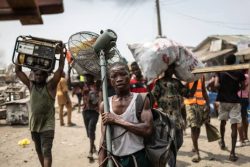
The operation transformed the community almost overnight. Homes were demolished. Businesses disappeared. Schools were destroyed. Families were separated.
Livelihoods built over decades were lost.
For residents, it was not merely a housing crisis. It was the destruction of an entire social and economic system. Was it really only about urban renewal?
This is where the Maroko story becomes more complicated.
The Lagos authorities cited environmental and planning concerns. Maroko was low-lying and prone to flooding, while the government said the area needed reclamation and infrastructure.
But researchers have also examined the relationship between the demolition, land values and powerful interests around the Lekki corridor.
A 2021 study of Lagos, Kolkata and Mexico City notes that the Lekki peninsula was being planned for development from the early 1980s and that both the government and the Oniru family were pushing for the clearance of Maroko. The study says the settlement was eventually razed in 1990 without notice or compensation.
A 2025 study of urban displacement in Lagos, based partly on interviews with Maroko evictees and government and civil-society officials, found that the history of the community’s displacement was intertwined with government authorities, land-owning interests and powerful actors in the city’s urban governance.
The study, however, should not be read as proof that the government’s stated environmental concerns were fabricated. Rather, it illustrates the competing interests surrounding the land.
Perhaps the most troubling question for former residents is what happened after the demolition.
The land was reclaimed and redeveloped.
Maroko’s former territory became part of the Victoria Island Extension and Oniru areas — locations that subsequently experienced significant investment and rising land values.
READ ALSO; ENDSARS: Bogeyman “in white attire” from Maroko police station, his victim cry for panel’s attention
This transformation has fuelled the long-running suspicion among former residents that land value, rather than environmental concerns alone, was central to their displacement.
A University of Liverpool analysis of the Maroko case in 2025 noted that sites cleared through forced eviction can subsequently become elite enclaves and argued that Maroko offers important lessons about the intersection of urban planning, land speculation and class dynamics.
What happened to the 300,000?
This is arguably the most neglected part of the Maroko story. The demolition was immediate, but resettlement was not.
Research by University of Ibadan scholar Tunde Agbola and A.M. Jinadu found that most people displaced from Maroko were worse housed after relocation than they had been before the eviction. Their study examined housing quality, overcrowding, rent, basic services and residents’ satisfaction with their new environment.
The 1990 eviction affected about 41,776 property owners, according to subsequent academic research. Yet only 2,933 were eventually resettled, with 1,766 moved to Ilasan and others to different estates.
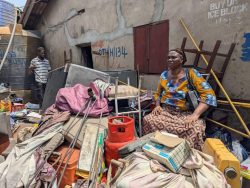
That disparity remains central to the controversy.
How could a community of roughly 300,000 people be demolished, while only a fraction of its property owners received formal resettlement?
Ilasan: the second displacement
For many Maroko evictees, Ilasan was supposed to represent a new beginning. Instead, it became another chapter in the struggle.
Research published in 2025 found that the Ilasan estate occupied by Maroko evictees had remained poorly serviced and in deteriorating condition, even as the surrounding Lekki area was transformed by major government infrastructure and private investment.
The irony was difficult to miss.
The people removed from land that later became highly valuable were relocated to an estate that, according to researchers, remained inadequately developed.
Professor Tunde Agbola and Jinadu’s earlier research reached a similar conclusion: most of the evictees were worse housed after relocation.
That finding gives the Maroko debate an important expert dimension. The issue was not simply whether the government had a right to redevelop land.
It was whether redevelopment actually improved the lives of those who paid the social price for it.
Experts: Lagos cannot repeat Maroko
Researchers at the University of Lagos have described the Maroko case as a question of the “right to the city”.
A 2019 study by Taibat Lawanson, David Odekunle and I.O. Albert found that more than 25 years after the eviction, many Maroko evictees had still not been adequately compensated and continued to suffer the consequences of the 1990 displacement.
The researchers advocated more inclusive approaches, including in-situ upgrading and reforms to land policies.
READ ALSO; Taskforce raids criminal hideouts in Victoria Island, arrests 49 suspects in pre-dawn operation
More recent research by University of Liverpool urban-management scholar Lindsay Sawyer argues that the people most vulnerable to displacement are often those whose housing and economic needs were never incorporated into formal urban planning.
She said research into evictions over the past century showed that cleared sites frequently became new enclaves for wealthier groups.
The message from these researchers is clear: urban redevelopment without meaningful participation, compensation and resettlement can reproduce poverty rather than eliminate it.
Thirty-six years later, the dispute continues
In March 2025, The Guardian reported that Maroko evictees living in Ilasan were again protesting proposed relocation and compensation arrangements.
The residents reportedly questioned an offer of about N11.3 million, arguing that it was inadequate to secure comparable accommodation or land in the area. They also complained that some residents had not been properly consulted.
The development brought the 1990 controversy back into public view.
For the evictees, Maroko is not history. It remains a question of property, compensation, identity and justice.
The uncomfortable legacy
Maroko presents Lagos with a difficult contradiction. The government argued that redevelopment was necessary. The land was subsequently transformed. The surrounding area became one of the city’s most valuable real estate zones.
But many of the people who occupied the land before the transformation say they were left behind.
That is why Maroko remains more than an old demolition story. It is a case study in how cities grow — and who pays when they do.
The community disappeared physically in 1990.
But its legacy remains embedded in Lagos’ housing politics, land disputes and debates over forced eviction.
As Lagos continues to expand and redevelop waterfront and low-income communities, the central lesson from Maroko remains difficult to ignore:
A city may replace buildings, reclaim land and create new neighbourhoods, but development cannot be judged only by the value of what is built. It must also account for the people displaced to make that transformation possible.
Thirty-six years after the bulldozers came, Maroko’s buildings are gone. Its people, however, have not forgotten where they came from.