

Nobody who has watched Nigerian agriculture for a decade believes the journey from emergency relief to real industry is neat. It is messy. Governments learn, unlearn, and sometimes start again. Policy papers pile up. Banks still treat the farm as a gamble. Tomatoes still rot on the road between Kano and Lagos.
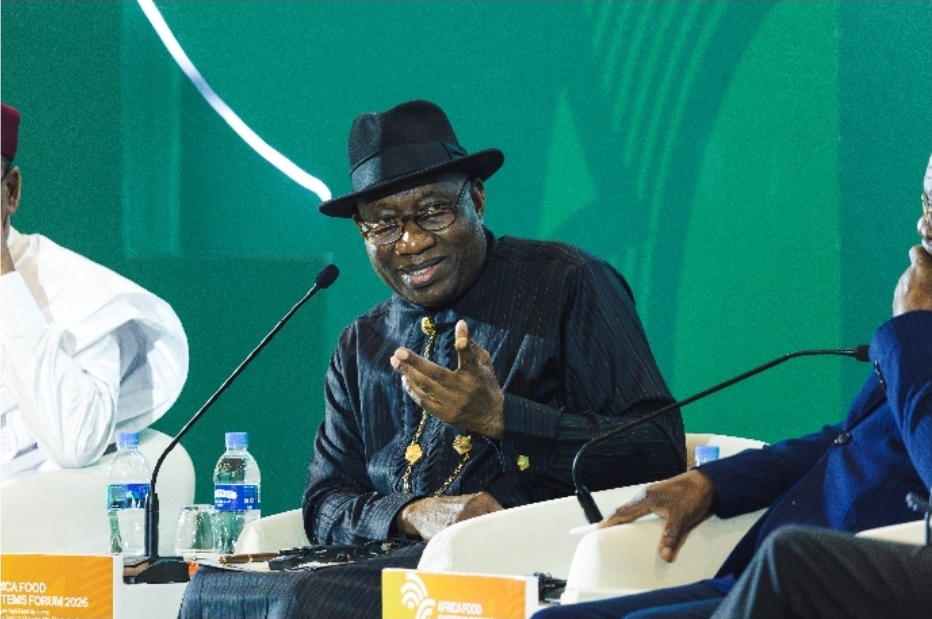
That unfinished story was on the table this week in Kigali, at the Africa Food Systems Forum, where former President Goodluck Jonathan sat with other retired African leaders on the Council of the Wise and spoke to a hall full of young people who want agriculture to pay like a profession, not a last resort.
Jonathan went back to the beginning of his attempt to modernise the sector. The e-wallet, rolled out under the Agricultural Transformation Agenda, did something simple and politically dangerous: it put fertiliser and seed subsidies on farmers’ phones instead of leaving them in the hands of the usual middlemen. The old patronage machine hated it. Farmers who had never seen a bag of genuine fertiliser suddenly got one.
Coupled with the Central Bank’s risk-sharing work through NIRSAL, the scheme made it slightly less suicidal for commercial banks to lend. Doctors, lawyers and engineers who once would not have touched a farm started asking questions about land and off-takers.
That was the foundation. It was never the whole house.
On the margins of the same Kigali meeting, AGRA’s Nigeria country director, Dr Rufus Idris, put the current problem more bluntly. Giving a farmer seed and fertiliser is no longer the hard part. The midstream is. Processing plants that actually work. Buyers who show up with money when the harvest comes. Storage that does not turn maize into mould. Banks that can look at agriculture as an asset class instead of a charity case.
That is the shift AGRA says it is now making with the Federal Ministry of Agriculture and Food Security and with state governments: less obsession with input distribution, more work on the parts of the chain where Nigeria haemorrhages value. The Nigeria Postharvest Systems Transformation Programme — NiPHaST — sits at the centre of that bet. Officials have put the annual waste at about ₦3.5 trillion. The programme is being sold as a multi-billion-dollar push to cut that loss and build processing and aggregation businesses that young people and women can actually own, not just labour in.
Idris framed it as Nigeria trying to live up to the Kampala CAADP Declaration: build state capacity that lasts beyond one person, set up delivery units that can be held to account, and use blended finance so private money does not have to carry all the risk alone.
Jonathan’s point to the young crowd in Kigali was less technical and more political. Phones and credit lines can move a system. They cannot hold it together. That takes institutions that remember what worked, and public-private deals that survive election cycles.
Nigeria has done the first act — the digital subsidy, the farmer registers and the attempt to break the fertilizer cartel. The second act is harder: factories, cold rooms, warehouse receipts, and banks that do not vanish at the first delayed rainfall. If that piece holds, the e-wallet will look like what it was meant to be: not a clever project, but the first brick in a market that can feed the country and still make money.