

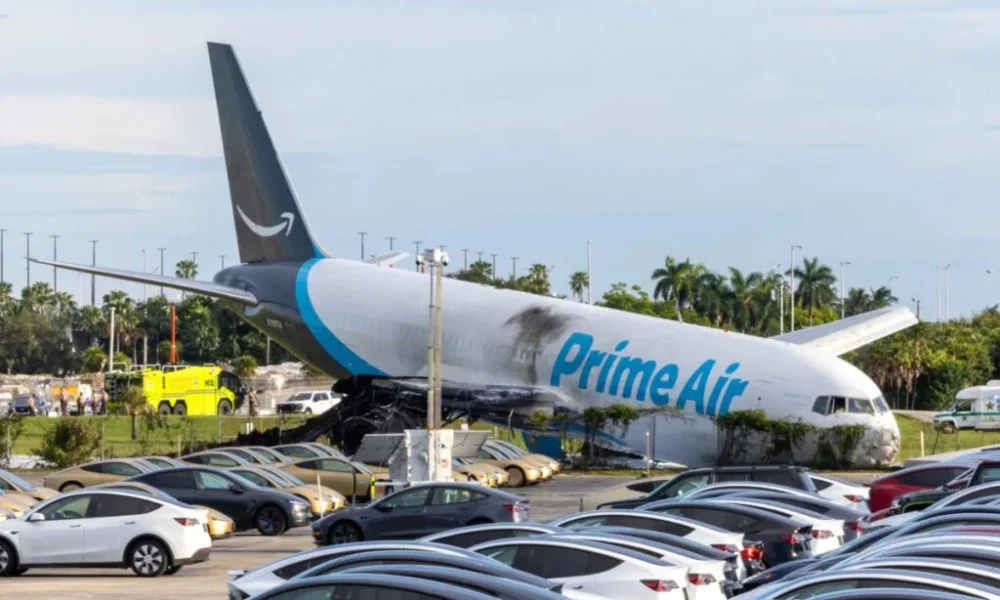
At least five people have been killed and five others injured after an Amazon Prime Air cargo aircraft operated by 21 Air overran a runway at Miami International Airport in the United States and crashed into vehicles before bursting into flames.
The Boeing 767-300 freighter, operating as 21 Air Flight 7598, was landing shortly before 2pm local time on Sunday after a flight from Luis Muñoz Marín International Airport in San Juan, Puerto Rico.
The aircraft failed to stop within the usable portion of the runway, crossed a perimeter road and struck several vehicles before coming to rest near a parking area, where it caught fire.
Miami-Dade authorities said five people died while five others were injured, with three of the injured reportedly in critical condition. The identities of the deceased had not been released as of Monday morning.
Authorities were also investigating whether all the fatalities occurred aboard the aircraft or among people on the ground.
More than 60 Miami-Dade Fire Rescue units and about 200 emergency personnel responded to the scene. Firefighters battled the blaze and dealt with a fuel leak while rescue teams worked to free people trapped inside the aircraft and vehicles.
Preliminary flight-tracking data indicated that the aircraft was travelling at about 112 knots, or approximately 129 miles per hour, when it left the usable runway.
READ ALSO; Five killed as Indian Air Force cargo plane crashes in Assam
Flightradar24 identified the aircraft as a 32-year-old Boeing 767-33A(ER)(BDSF), registration N1997A. The plane was originally built as a passenger aircraft before being converted into a freighter.
The flight lasted about two hours and 11 minutes, with the aircraft touching down at approximately 1:53pm local time.
The National Transportation Safety Board (NTSB) has deployed investigators to Miami to determine why the aircraft failed to stop. Investigators are expected to examine the approach, touchdown point, speed, braking performance, runway conditions, weather and crew actions.
Thunderstorms and strong winds were reported around the airport when the accident occurred. Flightradar24 recorded winds of about 17 knots, gusting to 26 knots, alongside thunderstorms and cumulonimbus clouds.
However, authorities have not blamed weather for the crash. Investigators will determine whether wind shifts, runway conditions or other factors affected the aircraft’s landing performance.
Attention is also likely to focus on runway safety infrastructure because the aircraft crossed the runway end, travelled across a nearby road and struck vehicles. Reports indicate that Miami International Airport does not have some runway arresting systems recommended by the FAA for certain airports.
However, investigators have yet to establish whether the absence of such a system contributed to the deaths.
The crash has also drawn comparisons with the 2019 Atlas Air Flight 3591 disaster, another Boeing 767 freighter operating for Amazon Prime Air. That aircraft crashed into Trinity Bay near Houston, Texas, killing all three people aboard.
The two accidents involved different airlines and circumstances. The 2019 NTSB investigation found that the aircraft experienced an in-flight loss of control following an airspeed indication problem.
Amazon does not operate the aircraft as a conventional airline. Its air-cargo network relies on carriers such as 21 Air to operate flights.
Sunday’s crash temporarily disrupted operations at Miami International Airport, with more than 160 flights reportedly cancelled and about 325 delayed. Two of the airport’s four runways had reopened by Sunday evening.
Investigators will now reconstruct the aircraft’s final approach using flight data, cockpit recordings and air-traffic-control communications to establish what caused the runway overrun.