

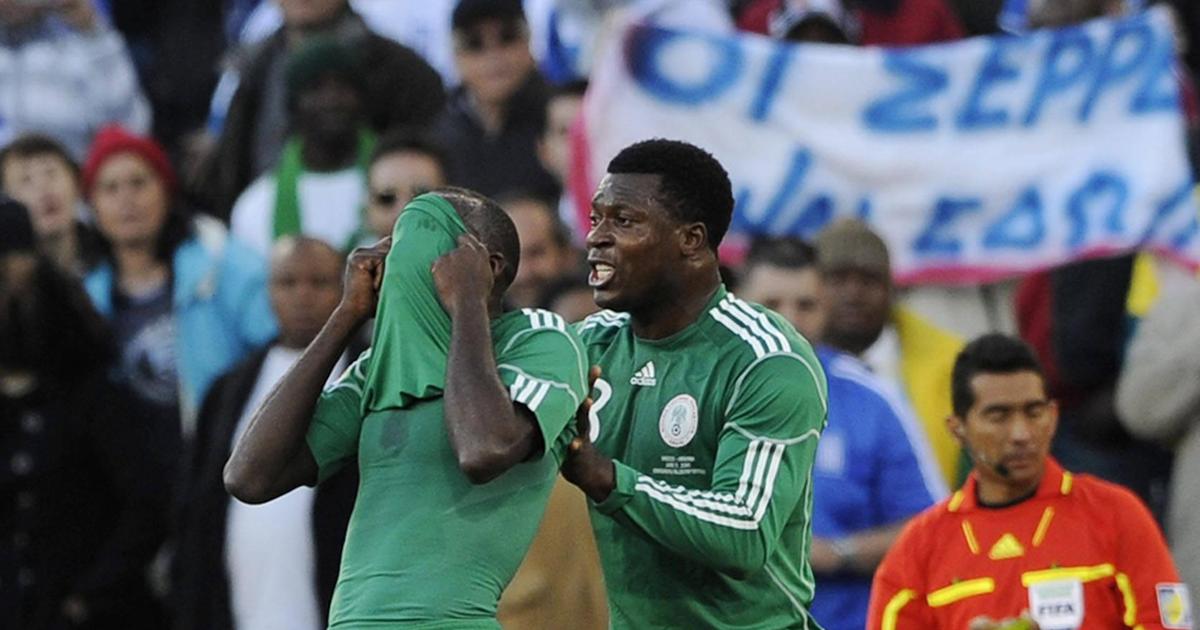
Sani Kaita has admitted that even the Video Assistant Referee (VAR) might have failed to save him from one of the most infamous moments in Nigeria’s World Cup history.
The former Super Eagles midfielder has reflected on his 2010 dismissal against Greece, accepting that his own actions left little room for a different verdict.
Kaita accepts responsibility for Greece red card
Kaita was shown a straight red card in the 33rd minute of Nigeria’s second group-stage match at the 2010 FIFA World Cup in South Africa after kicking Greece’s Vasileios Torosidis in an incident off the pitch.
The dismissal reduced Nigeria to 10 men while the Super Eagles were leading, and Greece eventually capitalised on the numerical advantage to complete a 2-1 comeback through goals from Dimitris Salpingidis and Vasilis Torosidis.
The moment became one of the defining images of Nigeria’s campaign, with Kaita becoming the first Nigerian player to receive a red card in a World Cup match.
More than a decade later, the former midfielder believes modern technology would probably have reached the same conclusion.
“I may say no to be honest with you because intent is what really counts when it comes to appreciating football from the referees point of view,” Kaita told AySuga.
‘I have already moved on’ – Kaita
Kaita, who has since moved on from the controversy, believes the incident was ultimately part of his football journey and accepts that his intentions were wrong.
“So, the intent from myself wasn’t good at all. I don’t think it will change anything even with VAR. I believe it was just something that was meant to happen. I have already moved on,” he added.
The 40-year-old represented the Super Eagles between 2005 and 2010, earning 22 international caps without scoring.
While the Greece defeat remains a painful memory for Nigerian football fans, Kaita appears to have made peace with his role in it. And, VAR or no VAR, he knows there was little he could say in his own defence.