

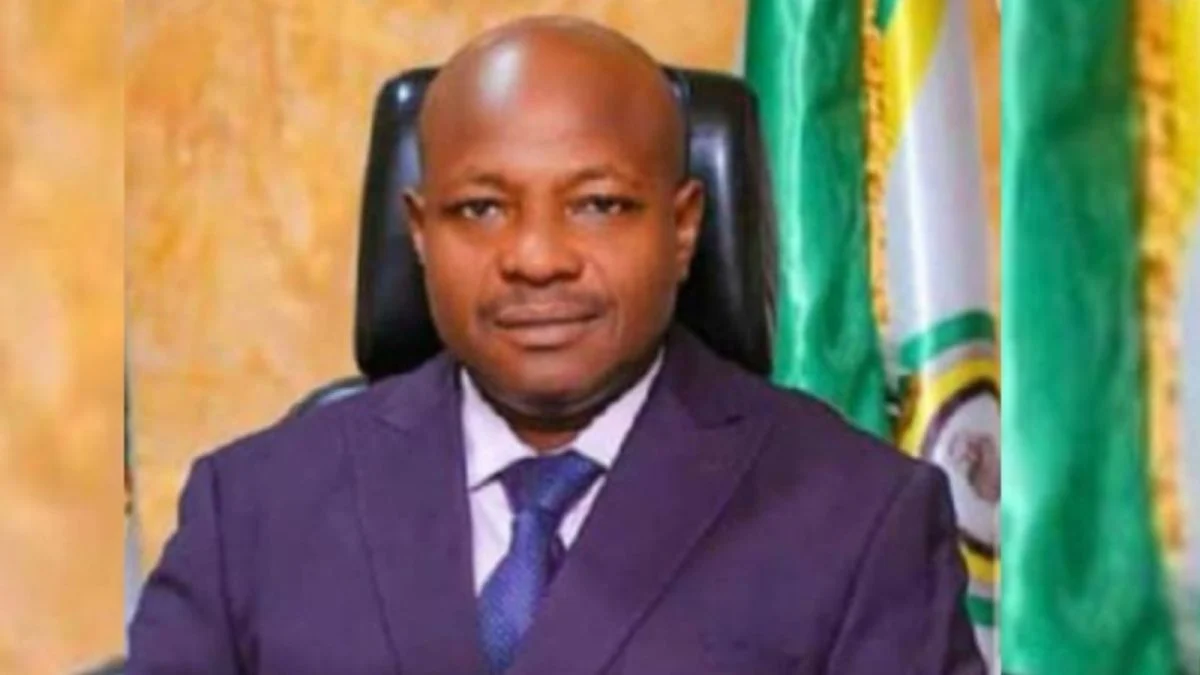
The Director-General of the Department of State Services (DSS), Oluwatosin Ajayi, has identified the factors helping terrorism and insurgency to thrive in Nigeria.
Ajayi said criminal groups have taken advantage of places where government presence is limited, turning such locations into safe havens for kidnapping, terrorism and other violent crimes.
The DSS boss made the remarks in a wide-ranging interview made available to POLITICS NIGERIA, as he marked two years in office and the 40th anniversary of the domestic intelligence agency.
Ajayi, who has spent 36 years in the Service, said Nigeria’s security challenges cannot be properly addressed by looking at them through ethnic or religious lenses.
He stressed that criminality should be treated as criminality, regardless of the identity of those involved.
“There should not be ethnic colouration to crime. We cannot criminalise a race or paint a whole ethnic group with one brush,” he said.
According to him, Nigeria has experienced different forms of criminality in various parts of the country over the years. He cited the kidnapping crisis in the South-East and South-South between 2003 and 2007, the activities of notorious armed robbers and the emergence of groups such as Maitatsine and Kalakato.
He said the nature of insecurity has changed over time, with criminal networks increasingly taking advantage of local grievances and difficult terrain.
Ajayi specifically linked some of the violence in Benue and Plateau states to longstanding disputes over access to land and resources between farming communities and Fulani neighbours.
He said the situation became more complicated after local criminal groups and terrorists affiliated with international organisations became involved.
“The problems in Benue and Plateau are age-long. It started as a dispute over access to land resources between native farmers, most of whom are Christians, and their Fulani neighbours, the majority of whom incidentally are Muslims,” Ajayi said.
“Over time, local criminal groups, including terrorists who pledged allegiance to international terrorist organisations, got involved, mainly to further their sinister agenda.”
The DSS chief also pointed to what he described as a loss of values and the decline of governance in remote areas as a major part of the problem.
He explained that communities that once had some form of government presence and local security structures are now left vulnerable.
“What has changed is the loss of our values,” he said.
Ajayi recalled that in earlier years, government structures extended into rural areas through institutions such as native authorities and forest guards.
He said the gradual disappearance of such structures created spaces where criminals could operate with less resistance.
“At that time, some form of governance was extended to those remote areas: native authorities, the Regional Forest Guard Law of 1956, then the State Controlled Land Use Act and Forests Act of 1978,” he said.
“However, today there is no presence of governance in those places, leaving them as ungoverned spaces for criminals to keep victims of kidnapping.”
The DSS boss said the revival of forest guards is therefore important because security agencies operating at the federal level may not always have the local knowledge needed to respond quickly to threats in difficult terrain.
He also mentioned the government’s push for state police and stronger community-based security arrangements as part of the broader response to Nigeria’s security challenges.
According to him, the country’s geographical realities make a single security approach inadequate.
He cited the Lake Chad area, the Sahel region and the creeks of the Niger Delta as examples of difficult environments that require security personnel to understand the local terrain.
Ajayi said intelligence remains critical, but intelligence alone cannot automatically prevent every attack.
He acknowledged that terrorist attacks and kidnappings still occur despite the work of security agencies.
“I want to anchor on the fact that we recognise that attacks are still happening, which tends to diminish our efforts,” he said.
“For instance, somebody whose child was kidnapped doesn’t care if you prevented 200 attacks. For that person, you haven’t achieved anything. Premised on that, I acknowledge we need to do more.”
He added that no intelligence agency anywhere in the world can completely eliminate crime.
The DSS director-general said the objective should instead be to reduce criminal activities to the barest minimum while improving the capacity of security agencies to respond to threats.
He also highlighted the importance of addressing the conditions that allow extremist groups and criminal organisations to recruit and operate.
According to Ajayi, one of the principles guiding his administration at the DSS is the reduction of grievances within society.
He explained that the Service considers people its most important intelligence asset because members of the public provide information that technology alone cannot replace.
“Human intelligence is more valuable than any technology because people can provide context, answer questions, and be engaged repeatedly in ways machines cannot,” he said.
“When people trust you, they are more willing to work with you.”
Ajayi said this thinking informed some of the reforms introduced under his leadership, including compensation for people affected by operational mistakes and efforts to improve relations between the DSS and communities.
He said the Service had paid more than N300 million in compensation in various cases involving people who were wrongfully arrested, detained or affected during operations.
One of the cases involved a Jos businessman who was mistakenly shot during an operation. Ajayi said a court had awarded him N10 million in 2016, but the compensation was not paid at the time.
After becoming DSS director-general, Ajayi said he ordered a review of cases involving operational mistakes.
He said the victim later received an additional N10 million and medical assistance after an assessment showed that his condition had worsened.
The DSS chief said the objective was not only to comply with court orders but also to help victims rebuild their lives.
He also disclosed that the agency had released and supported other people who were found to have been wrongly detained after investigations.
The approach, according to Ajayi, is connected to the agency’s wider effort to build public confidence and encourage Nigerians to provide intelligence.
He said people who feel abandoned or unfairly treated may be reluctant to share information with security agencies, even when such information could help prevent attacks.
The DSS chief therefore described the reduction of social grievances as an important part of counterterrorism.
He said this also explains the agency’s attention to vulnerable groups, including people raised in orphanages.
Ajayi said some people who grew up in orphanages had previously been recruited into the DSS and performed well.
He explained that the initiative was not based on viewing orphans as security threats but on ensuring that vulnerable Nigerians were not forgotten.
The DSS boss also defended the agency’s growing focus on legal processes and human rights.
He said his administration had directed officers not to use arrest as a response to civil disputes.
According to him, where disagreements arise, the DSS can approach the courts rather than resort to force.
He said the same principle applies to the media, insisting that journalists should not be treated as criminals simply because of reports that the Service considers inaccurate.
Ajayi said the DSS now prefers corrections, dialogue and legal action where necessary.
His comments come at a time when the Federal Government is pushing for stronger community-based responses to insecurity, including discussions around state police and forest guards.
The DSS chief said such measures could help address gaps created by difficult terrain and limited government presence in remote communities.
He maintained that the fight against terrorism requires more than military operations.
For Ajayi, effective security must combine intelligence, law enforcement, community cooperation, justice and efforts to reduce the grievances that criminals can exploit.
He also urged Nigerians to avoid ethnicising insecurity, saying criminals exist across different ethnic and religious groups.
“Politics has not ruined Nigeria. It is only bad politicians in pursuit of their ambitions who threaten the stability of Nigeria,” he said.
Ajayi further called for collective action against terrorism and urged Nigerians to support the “United Against Terror” campaign.
He said terrorists benefit when their activities receive widespread publicity and suggested that greater unity among citizens would make it harder for political actors or criminal groups to exploit insecurity for their own interests.
The DSS director-general acknowledged that much remains to be done despite the agency’s intelligence operations and recent reforms.
He said the continued occurrence of attacks means security agencies must keep improving their methods.