

Top executives of California’s two biggest utilities warned they would take action to protect their shareholders if Sacramento lawmakers fail to pass legislation limiting their companies’ liabilities for wildfires sparked by their equipment.
“If the legislature does not act, or if they act and don’t actually solve the problem, then we’re going to have to take action,” said Patti Poppe, chief executive of Pacific Gas & Electric, on a July 23 call with Wall Street analysts.
Poppe did not specify what her company would do, but made it clear any action would protect shareholders’ money. Previously, she told Wall Street analysts that if lawmakers failed to pass legislation to protect the utilities, PG&E would use its cash to buy back the company’s shares, according to a report by the bank Jeffries.
That could raise the company’s stock price and benefit shareholders, while reducing money available for the utility’s California programs.
The comments from Poppe and Pedro Pizarro, chief executive of Edison International, came just before the state Legislature returned from summer break Monday to begin the last four weeks of its session.
Gov. Gavin Newsom and legislators have been working behind closed doors to address the state’s escalating cost of wildfires, including those caused by the utilities, The Times reported last month. The big electric companies have told their investors they are talking to Newsom and lawmakers about a bill package that would protect shareholders from paying for utility-sparked fires.
On Tuesday, government fire officials released their investigation into last year’s devastating Eaton fire, blaming Edison’s century-old transmission line, which the utility kept in place even though it had not carried power since 1971.
Last week, Edison’s Pizarro echoed some of Poppe’s statements. He told Wall Street analysts on a conference call that he too was prepared to make financial changes if the legislature does not pass a comprehensive bill that cuts the utilities’ financial wildfire risk before the legislative session ends Aug. 31.
Any legislation that passes without a protective framework for utilities, Pizarro said, would “influence how we prioritize and deploy future capital.”
Pizarro declined analysts’ requests to say where the company would cut back, other than saying it would continue spending aimed at keeping its grid safe and reliable.
“We’re going to evaluate the totality of the package that comes to us and figure out our response that goes along with it,” Pizarro said.
Pizarro also told analysts that without legislation supporting the utilities, Edison’s credit rating could be downgraded. If that happens, he said, it could raise bills for electric customers since the utility may have to pay a higher interest rate for new borrowings.
“That could be a significant cost impact through the cost of debt that gets passed through to SCE customers if we don’t have a framework in the next four weeks that is credit supportive for our utility,” Pizarro told the analysts.
Newsom and lawmakers are drawing up legislation based on recommendations in an April study that the governor ordered last year.
The final report didn’t focus on utilities’ responsibility for sparking at least seven of the 20 most destructive wildfires in state history. It suggested ways to reduce the cost of wildfire liabilities, including by capping fees of attorneys representing victims and reducing payments to survivors for non-economic damages like pain and suffering.
The report also suggested that utilities should no longer reimburse property insurers for damages of fires sparked by electrical equipment. Insurers say this would increase premiums for homeowners.
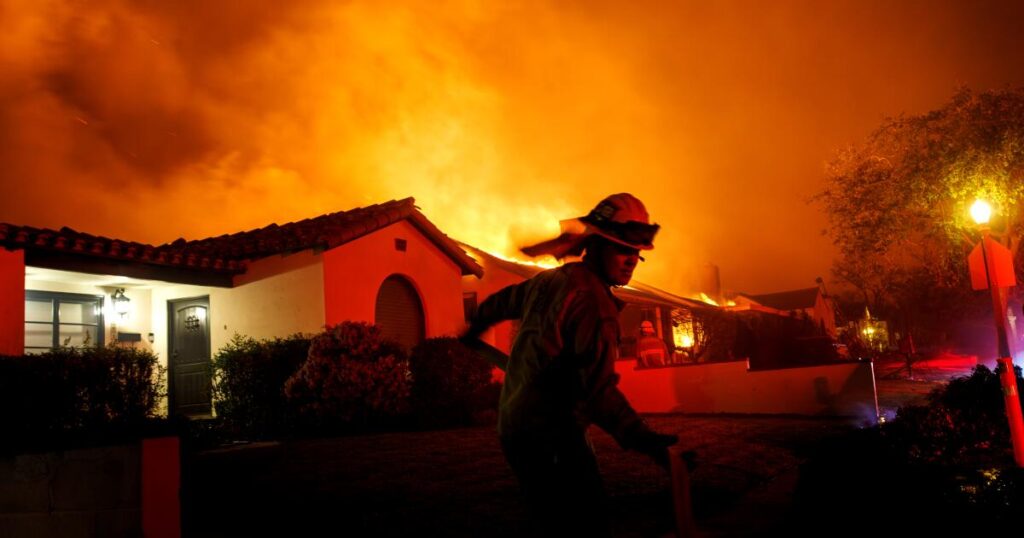
Edison is now facing thousands of lawsuits from the victims of the Eaton fire, which roared through Altadena, destroying more than 9,000 homes and other structures and killing 19 people. The lawsuits claim it was negligent for the fire, which Edison denies.
The utility created a program to pay for victims’ damages if they agree to give up their right to sue.
Edison has so far paid more than $1 billion to victims. Experts say the fire’s costs could exceed the $21-billion state wildfire fund that Newsom and lawmakers created in 2019 to protect Edison, PG&E and San Diego Gas & Electric.
If that happens, Edison customers must pay for the rest under legislation that Newsom and lawmakers introduced in the final days of last year’s legislative session.
Because of utility protections in legislation that Newsom and lawmakers passed in 2019 and last year, Edison has said it expects its shareholders to pay little for the Eaton fire. The utility says it believes it will be reimbursed for its damage payments to victims by the state wildfire fund and through customer bills, according to the company’s financial disclosures.
A coalition of wildfire survivors, consumer advocates and other groups wrote a letter to Newsom last month, asking him for legislation that keeps utilities accountable for the fires they cause.
The coalition pointed out that despite billions of dollars in damages from the Eaton fire, Edison’s profits soared last year by more than 200% — from $1.3 billion in 2024 to $4.5 billion.
The company’s board also rewarded Edison executives with higher salaries and bonuses. Pizarro received $16.6 million in cash, stock and other compensation, up 20% from 2024.
“For-profit companies that repeatedly cause catastrophic harm must be held accountable, not protected and enriched,” wrote Joy Chen, executive director of Every Fire Survivors Network, who is leading the coalition, in the letter to Newsom.
The letter warned that without reform of current state laws protecting utilities, disasters like the Eaton fire could happen again.
“Altadena is not the first community to endure this cycle, and it will not be the last,” the letter said.