

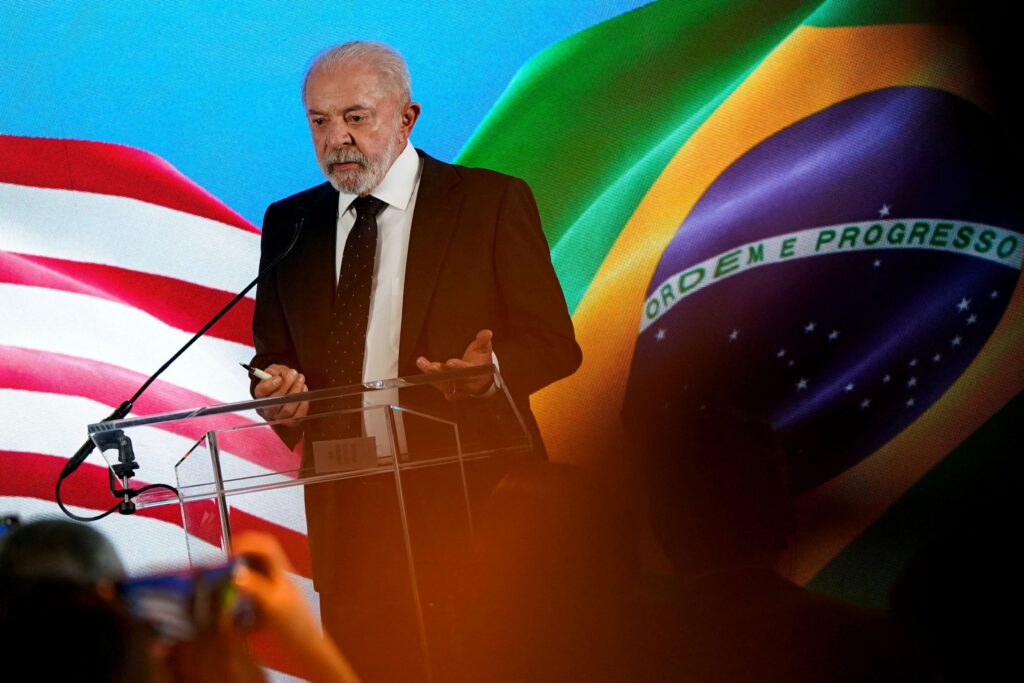
The Trump administration revoked the visa of Brazil’s ambassador to Washington, the latest flash point in a deepening dispute between the United States and Latin America’s biggest and richest country.
A senior State Department official told reporters in a background briefing that it was a “reciprocal” action because Brazil has not approved President Donald Trump’s nominee as ambassador to Brasília — former Florida House speaker Daniel Perez.
The government of President Luiz Inácio Lula da Silva has “given signals that they will probably delay until after” elections there in October, the official said, speaking on the condition of anonymity under rules set by the department.
Stressing the importance of the U.S.-Brazil relationship, the official said, “We regret the situation that we’re in.” But, the official said, “we’ve been very clear that reciprocity is the name of the game.”
In response, the Brazilian president’s office said in a statement that U.S. justifications for its action were false, noting that under international diplomatic agreements the receiving government must be formally notified and consent to a new ambassador, yet Trump announced his choice before doing so. Perez was approved in a Senate hearing last month, but the full Senate has not yet voted on his nomination.
The Vienna Convention on Diplomatic Relations “establishes no time limit” for the receiving government approval, the Brazilian statement said. “The U.S. request remains under review.”
Last month, Brazil denied visas to two senior State Department diplomats the administration planned to dispatch on a mission to cast doubt on the fairness and integrity of the country’s electoral system, Brazilian officials said at the time.
Lula, as the leftist president is known, is running for a fourth term against Flávio Bolsonaro, the son of former president Jair Bolsonaro.
The senior Bolsonaro, a close Trump ally on the political right, was convicted of trying to overturn the results of the last election, which he lost to Lula. Trump has compared Jair Bolsonaro’s treatment to what he calls his own political and legal “abuse,” and he met with his son at the White House in May.
“The two U.S. government officials who were denied entry visas to Brazil,” the Brazilian statement said, “had planned to visit the country to cast doubt on the integrity of Brazil’s electoral system, in an unacceptable attempt to interfere in the country’s political process.“
The statement noted that the Trump administration also had sanctioned and revoked the visas of Brazilian court and senior government officials “based on the unfounded allegation that former president Bolsonaro is subjected to political persecution.” It called Tuesday’s action “a deliberate escalation of hostile measures … driven by ideological motives that are incompatible with a bilateral partnership that has always been guided by mutual respect.”
Trump has also imposed significant tariffs on Brazil, despite a U.S. trade surplus.
A second State Department official, who was not authorized to discuss the situation, questioned what he called the U.S. “confrontational approach,” adding that “each time Brasília portrays itself as standing up to Trump, Lula’s standing in the polls only improves.”
Ambassador Maria Luiza Ribeiro Viotti is the first woman to lead Brazil’s embassy in the United States. A career diplomat, she has served as the country’s ambassador to the United Nations and to Germany.
The senior State Department official who briefed reporters said that her visa would be restored if the Brazilian government agreed to the new U.S. ambassador.