

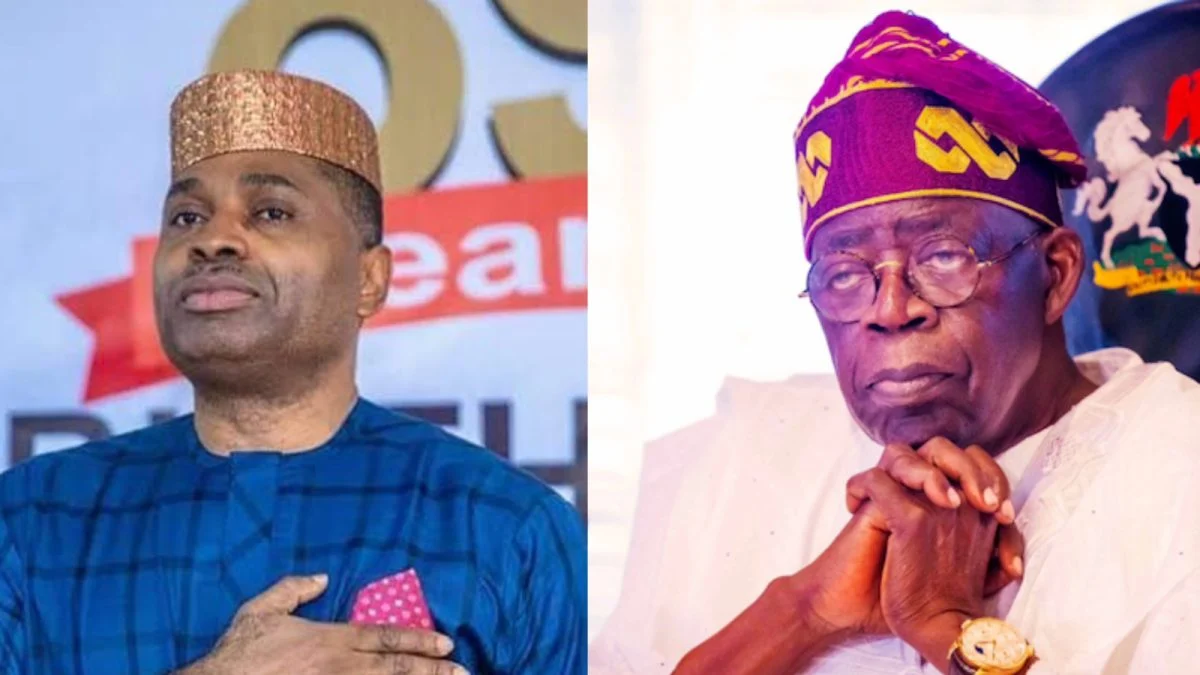
The spokesperson for the 2027 presidential campaign of former Vice-President Atiku Abubakar, Kenneth Okonkwo, has hit back at President Bola Tinubu over his criticism of Atiku’s proposal to restore petrol subsidy.
Okonkwo said Atiku was not advocating a return to the subsidy regime that previously plagued Nigeria with corruption and opaque fuel importation practices.
He made the clarification on Channels Television’s Sunday Politics, days after Atiku, speaking in Hausa during an interview with an African Democratic Congress (ADC) media group, said he would restore petrol subsidy if elected president in 2027.
Atiku, ADC presidential candidate, had also accused the Tinubu administration of failing to account for the funds saved following the removal of petrol subsidy.
The former vice-president’s position triggered reactions, particularly on social media, with critics pointing to his reported 2023 campaign promise to remove the subsidy if elected.
Tinubu subsequently faulted the proposal, describing it as evidence of “serious ignorance of governance and economy” and recalling the financial difficulties faced by some states before he assumed office.
However, Okonkwo rejected the president’s assessment, saying Atiku’s proposal was designed to reduce the cost of petrol for Nigerians rather than revive the old subsidy arrangement.
“The whole idea of the Atiku plan is affordability of fuel to the ordinary Nigerian,” Okonkwo said.
He described Tinubu’s criticism as a misunderstanding of the proposal, arguing that Atiku’s plan, which he identified as the Atiku Fuel Affordability Plan (AFAP), was fundamentally different from the former subsidy regime.
According to him, the previous system became associated with corruption because Nigeria depended heavily on imported petrol and allegedly paid inflated amounts for fuel that was either not imported or was imported in smaller quantities than claimed.
Okonkwo said the situation was worsened by the absence of functional domestic refineries, adding that Atiku’s proposed approach would leverage the return of local refining capacity.
He explained that under the proposed plan, crude oil would be made available to domestic refineries at a fair price, enabling them to produce petrol at a lower cost for consumers.
“This is what Atiku is saying. And I’m going into the Atiku plan, which we call Atiku fuel affordability plan (AFAP),” he said.
Okonkwo argued that the revival of local refining had changed the circumstances under which petrol subsidy previously operated, stressing that Atiku was not proposing a system based on fuel imports and opaque subsidy payments.
He further accused the Tinubu administration of failing to ensure sufficient crude oil supply to local refineries, particularly the Dangote Refinery, which he said had contributed to high production costs.
According to him, the resulting increase in production costs was being passed on to consumers through higher petrol prices.
“I once said that even if Dangote Refinery came into existence, they will not give us fuel at a cheap rate in Tinubu’s regime,” Okonkwo said.
He maintained that the current fuel crisis was driven largely by production costs rather than excessive demand.
“What we are suffering today is not demand-pull inflation. It’s cost-of-production-induced inflation,” he said.
Okonkwo also criticised Tinubu over the controversy surrounding the alleged Presidential Foreign Intervention Promotion Council (PFIPC), using the issue to question the president’s understanding of agencies operating under his administration.
He argued that Atiku’s proposal should be assessed on its potential to make petrol affordable rather than being equated with the subsidy system that existed before the current era.