

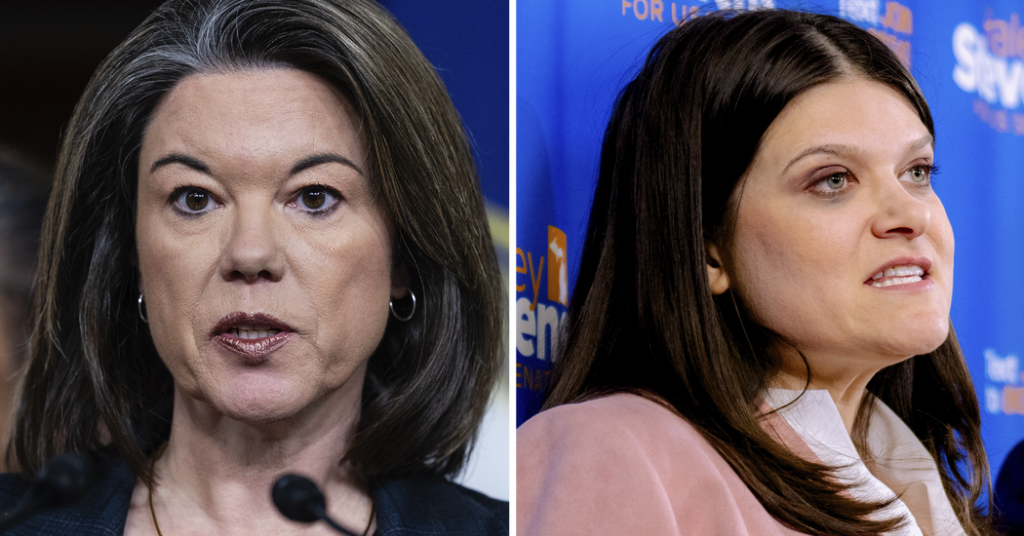
In President Trump’s first midterm elections in 2018, Representatives Haley Stevens of Michigan and Angie Craig of Minnesota turned red House districts blue, vaulting themselves into a cohort of pragmatic moderates who wanted to go to Washington in an era of chaos and get things done.
Those Democratic majority-makers — many of whom were women who connected with voters in suburbs and exurbs — were celebrated in their party as models for winning tough races.
But that experience hasn’t given either Stevens or Craig an easy path to the Senate in 2026.
This week, Stevens narrowly lost her battle with the left-wing outsider Dr. Abdul El-Sayed. Next up, on Tuesday, Craig will try to prevail in a competitive primary against Minnesota’s progressive lieutenant governor, Peggy Flanagan.
The two races are very different, of course, and their outcomes may well diverge. But some Democrats believe the hurdles the two moderates have faced this summer reflect a bigger shift in the party as its voters wrestle with the question of what makes a winner in the second Trump era.
“Some part of the Democratic base is changing its theory of success,” former Representative Conor Lamb, a Pennsylvania Democrat, told me. He flipped a House seat in 2018 before losing a Senate primary in 2022 to John Fetterman.
“In 2018, the theory of success was: Elect good people who want to be good public servants and try to make our institutions work again,” Lamb said. Now, he added: “They’re changing it to, ‘We want people who fight. We want people who will never back down.’ They’re uncompromising.”
‘Many more options’ for restless Democratic voters
Plenty of those Democrats who helped win a House majority in 2018 have gone onto higher office.
Just ask Gov. Abigail Spanberger of Virginia and Gov. Mikie Sherrill of New Jersey, who offered their party fresh leadership in last year’s elections. And in 2024, Senators Elissa Slotkin of Michigan and Andy Kim of New Jersey prevailed even as Republicans made gains across the map. (All four of them have endorsed Craig.)
But it hasn’t been smooth sailing for everyone, especially as outsider and progressive candidates have picked up steam. Former Representative Colin Allred flipped a Texas congressional district in 2018 and handily won the state’s Democratic primary for Senate in 2024 before losing to Senator Ted Cruz. His attempt to capture the nomination for this fall’s Senate race, though, sputtered last year as James Talarico captured the party’s hearts and minds in the state.
This year is different “in the sense that you have many more options,” said Faiz Shakir, the executive director of More Perfect Union, a left-leaning media nonprofit group, and an adviser to Senator Bernie Sanders of Vermont. At the same time, he said, the popularity of the Democratic brand has nose-dived, pushing voters to look beyond candidates they perceive as representing the status quo.
When I asked Craig this afternoon if she thought the Democratic electorate had changed since she was first elected in 2018, she seized on the opportunity to distance herself from the national brand.
“Certainly the Democratic electorate is pissed off, and I don’t blame them,” she said. “I’m pissed off, too. I was so upset when Donald Trump came back into the White House, upset with Democratic leadership and the way that this party is operating.”
A close, unpredictable race
Independent polling in the Minnesota Senate primary is scant, but it shows a close contest between Craig and Flanagan, an unabashed liberal who has the support of the retiring incumbent, Senator Tina Smith, as well as of progressive stalwarts like Sanders and Senator Elizabeth Warren of Massachusetts.
Flanagan has derided Craig for accepting corporate donations during the campaign and says she’ll push back harder against the Trump administration — a pledge that is familiar for Democratic candidates but could carry more power in Minnesota after the deadly immigration crackdown there this year.
Supporters of Craig say the race has little in common with the brawl between Stevens and El-Sayed. Stevens faced a true outsider in El-Sayed, who has never held elected office; Flanagan, the sitting lieutenant governor, has served for years in a Democratic administration that has been rocked by a major fraud scandal. Craig has been quicker than Stevens to challenge Democrats in Washington, including when she called for President Joe Biden to drop out of the presidential race before he stepped aside in 2024.
And Craig says she has shown her mettle as a fighter — just one who also wants to get things done. She pointed out that she easily won her district in 2024, when Democrats had a bad night across the board, and warned that Minnesota, which has a narrowly divided State House, can be swingier that it seems.
“At the end of the day,” Craig told me, “we can’t do anything to pass progressive policies in our country unless we win elections.”