

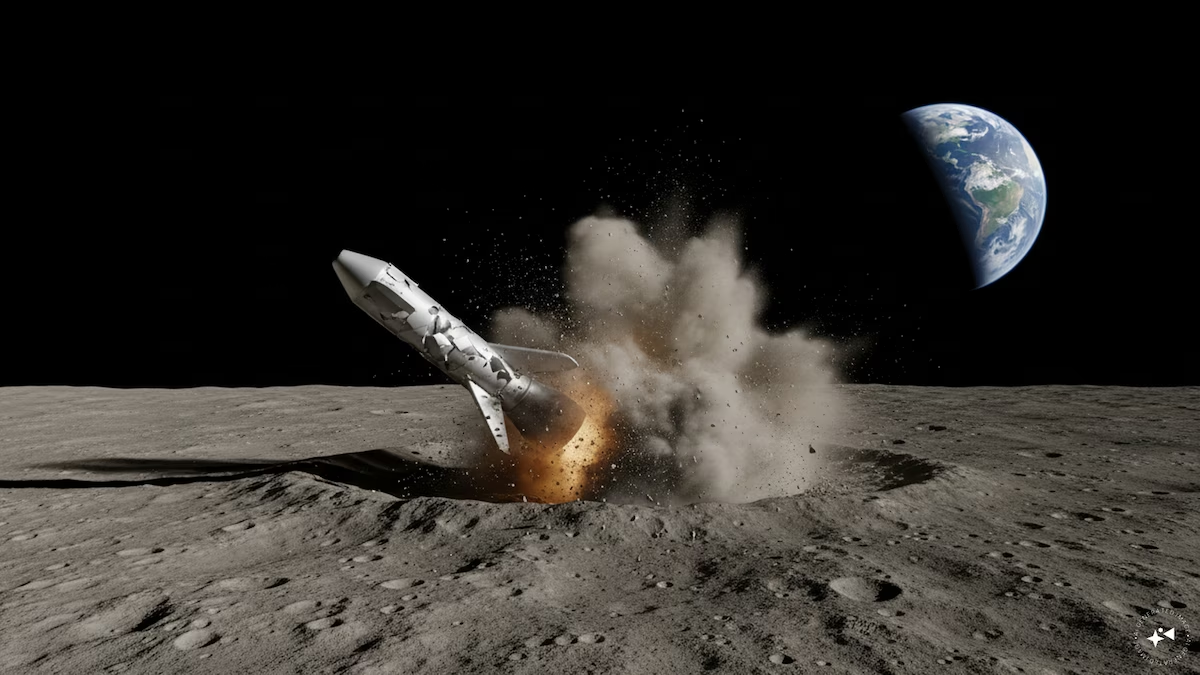
The object, comparable in size to a school bus, is the second stage of a Falcon 9 rocket used to launch Firefly Aerospace’s lunar lander in January 2025.
It is set to slam into the Moon at about 6:35 am GMT (12:05 pm IST), reaching the surface at a speed of around 5,400mph (8,690km/h). The crash is expected to send dust soaring above the lunar landscape. Although sunlight could illuminate the plume, it is unlikely to be visible from Earth without powerful instruments.
NASA believes the collision will gouge out a crater measuring approximately 60ft (18 metres) in diameter and 12ft (four metres) in depth, with debris being hurled across the surrounding terrain.
Impact site and why the collision will happen
The SpaceX rocket stage is expected to hit near Einstein Crater on the Moon’s western limb, a region that is difficult to observe directly from Earth.
Normally, the second stage of a Falcon 9 rocket re-enters Earth’s atmosphere and burns up after completing its mission. However, because this mission required extra thrust than missions closer to Earth, the rocket’s second stage stayed in orbit, floating aimlessly among thousands of other bits of space trash that active satellites must avoid.
It was only earlier this year that astronomers confirmed the rocket upper stage was on an orbital trajectory toward the Moon. Having exhausted its fuel, the rocket stage could no longer be controlled.
According to Julianna Scheiman, SpaceX’s Director of NASA Science and Dragon Programs, a combination of solar activity and gravitational forces gradually altered its orbit, ultimately sending it onto a collision course with the lunar surface.
On April 29, astronomer Bill Gray accurately predicted the rocket stage’s impact date, time and location, forecasting that it would strike near the Moon’s Einstein Crater on its far western lunar horizon.
Not the first object to hit the Moon
The Moon has witnessed many human-made impacts over the past several decades. The first was in 1959, when the Soviet Union’s Luna 2 spacecraft planned a crash landing onto the lunar surface.
Since then, nearly 70 spacecraft and spent rocket stages have either landed or crashed on the Moon, according to TIME. During the Apollo missions in the 1960s and 1970s, the empty third stages of Saturn V rockets were deliberately crashed into the Moon to trigger small moonquakes that could be recorded by seismographs left by earlier missions.
More recently, a Chinese rocket stage struck the Moon in 2022, while several lunar landers, including Russia’s Luna-25 (2023) and India’s Chandrayaan-2 (2019), crashed during landing attempts.
Why scientists are interested
Although accidental, the impact is expected to provide scientists with a rare opportunity to study an artificial collision on the Moon. Because the rocket’s size, mass and speed are well known, researchers can compare the resulting crater with computer models to better understand how impacts shape the Moon’s surface.
“What happens when an object crashes into the moon? We know it makes a crater, and of course it does eject material, but we don’t really understand that process in great detail,” Dr. Paul Wiegert, a professor of astronomy and physics at the Western University in London, Ontario, said.
NASA’s Lunar Reconnaissance Orbiter (LRO), which has been orbiting the Moon since 2009, is expected to capture images of the impact site after the collision and compare them with photographs taken before the event. Scientists hope the observations will help measure the newly formed crater and study the debris thrown up by the impact, providing new insights into artificial lunar impacts and their implications for future exploration.
While the impact flash itself is expected to last only a fraction of a second and will likely be difficult to detect from Earth. “If you imagine the moon is a clock, it’ll sort of roughly hit where the 10 would be,” according to Wiegert.