

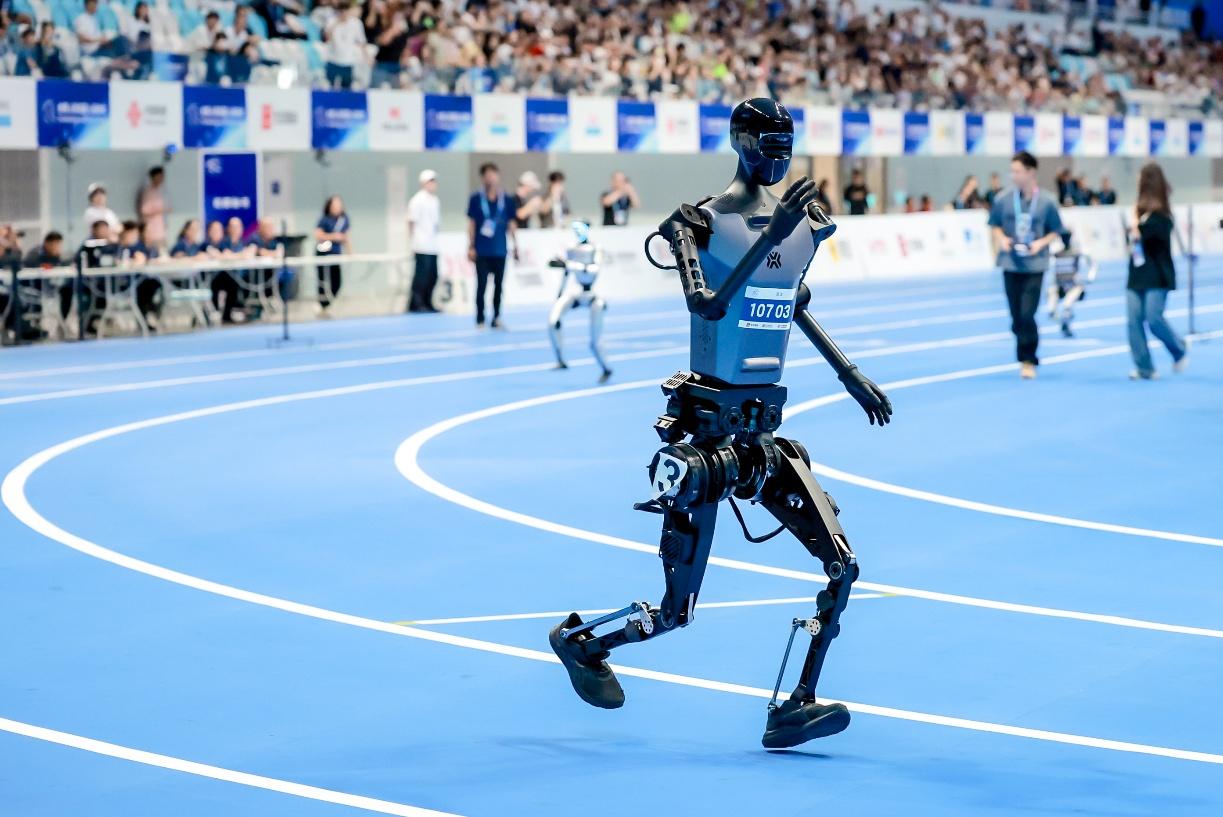
A Chinese humanoid robot has reportedly surpassed Usain Bolt’s 100-metre world record at the World Robot Games in Beijing, highlighting the rapid progress of China’s robotics industry.
The humanoid, known as Tiangong Ultra, completed the 100-metre sprint in 9.39 seconds, according to Chinese state broadcaster CCTV.
That time is faster than Bolt’s recognised world record of 9.58 seconds, set by the Jamaican sprint legend in Berlin in 2009.
Tiangong Ultra sets another record
The same humanoid model later claimed another notable mark in the 400-metre event.
Tiangong Ultra initially completed the race in 38.16 seconds, with the time later revised to 38.15 seconds, according to the report.
The robot was developed by a government-backed research centre in Beijing.
Footage and accounts from the competition showed the machines displaying both impressive speed and obvious limitations. Some robots failed to start their races, while others struggled to remain upright or moved around the track at little more than walking pace.
One robot reportedly lost its balance during a boxing event and ended up against the ropes before human operators removed it.
Spectators impressed by robot competition
The unusual performances attracted hundreds of spectators, including families and children, who watched humanoids compete in athletics, football, boxing and martial arts.
Some of the robots’ failures proved as entertaining for the crowd as their successful performances, with spectators laughing and applauding when machines stumbled or struggled to complete events.
The competition also prompted questions about how far humanoid technology has progressed beyond controlled sporting demonstrations.
A 72-year-old Beijing spectator, Hou Yali, said she would prefer to see robots tested against humans and in practical activities such as household work.
She argued that speed competitions alone do not demonstrate whether machines can perform more complex tasks or assist people with everyday responsibilities.
For now, the Beijing event has provided another public demonstration of China’s investment in humanoid robotics, while also showing that the technology remains a work in progress.