

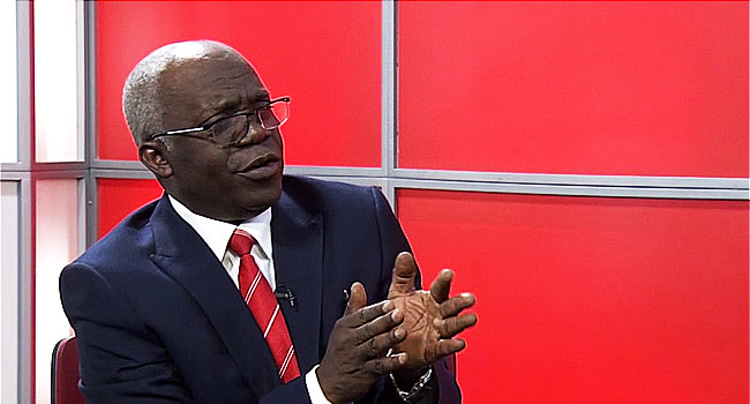
Human rights lawyer and Senior Advocate of Nigeria (SAN), Femi Falana, has said the Economic and Financial Crimes Commission (EFCC) acted within its statutory powers by placing restrictions on the Osun State Government’s account, stressing that the commission must obtain a court order within 72 hours.
Falana, who spoke during an appearance on Politics Today, a programme on Channels Television, explained that the EFCC is legally permitted to impose a Post No Debit (PND) restriction on government accounts, provided it complies with the timeframe set by law.
According to him, the legal authority of the EFCC to take such action has already been affirmed by the courts.
He cited a 2022 judgment of the Court of Appeal in a case involving the Benue State government, noting that the ruling established that the commission could impose a PND restriction for up to 72 hours pending an application to court.
“Well, as far as the law is concerned, the EFCC has not acted illegally. As a matter of fact, that came out in the statement of the President: ‘I’m not questioning your mandate and the exercise of your power. However, I’m embarrassed,’” Falana said.
He maintained that the EFCC has the authority to restrict access to the accounts of the federal, state and local governments, subject to compliance with relevant legal provisions.
“Under the law, the EFCC has the power to freeze the account of the Federal Government or of any state or local government in Nigeria,” he said.
Falana recalled that the Federal High Court in Benue had in 2019 ruled against the EFCC in a case concerning the freezing of the state government’s account and awarded N50 million in damages against the commission.
He said the EFCC appealed the decision, which led to a judgment by the Court of Appeal in September 2022 that overturned the earlier ruling and affirmed the commission’s powers, provided it approaches the court within 72 hours.
“That remains the law in Nigeria today,” he said.
The SAN also referenced a 2024 judgment of the Supreme Court of Nigeria arising from a suit filed by the Kogi State government and others challenging the authority of anti-corruption agencies to investigate state accounts.
According to Falana, the apex court examined relevant constitutional and statutory provisions and affirmed the powers of agencies including the EFCC, the Independent Corrupt Practices and Other Related Offences Commission (ICPC), and the Nigeria Financial Intelligence Unit (NFIU) to probe accounts at all levels of government.
“In 2024, the Kogi State Government, joined by many state governments, challenged the investigation—probing of state accounts by EFCC, ICPC or NFIU. And in a historic judgment, the Supreme Court examined all the relevant laws and came to the conclusion that these agencies have the power to probe the accounts of any organisation, either at the federal, state or local government level. That remains the law in Nigeria,” he said.
Falana added that any attempt to change the current legal framework must be pursued through the National Assembly of Nigeria.
“If Nigerians—those who are concerned—want the law changed, they can go to the National Assembly. But for now, as of today, EFCC has the power to freeze the account of any state and, in not more than 72 hours, has to go to court,” he said.