

Nigeria’s real Gross Domestic Product (GDP) grew by 4.43% year-on-year in the second quarter of 2026, rising from 4.23% recorded in the corresponding period of 2025.
The growth was supported by stronger performances in the agriculture and services sectors, which expanded by 4.39% and 4.60%, respectively, while industrial growth slowed to 3.96% from 7.46% recorded in the same period of 2025.
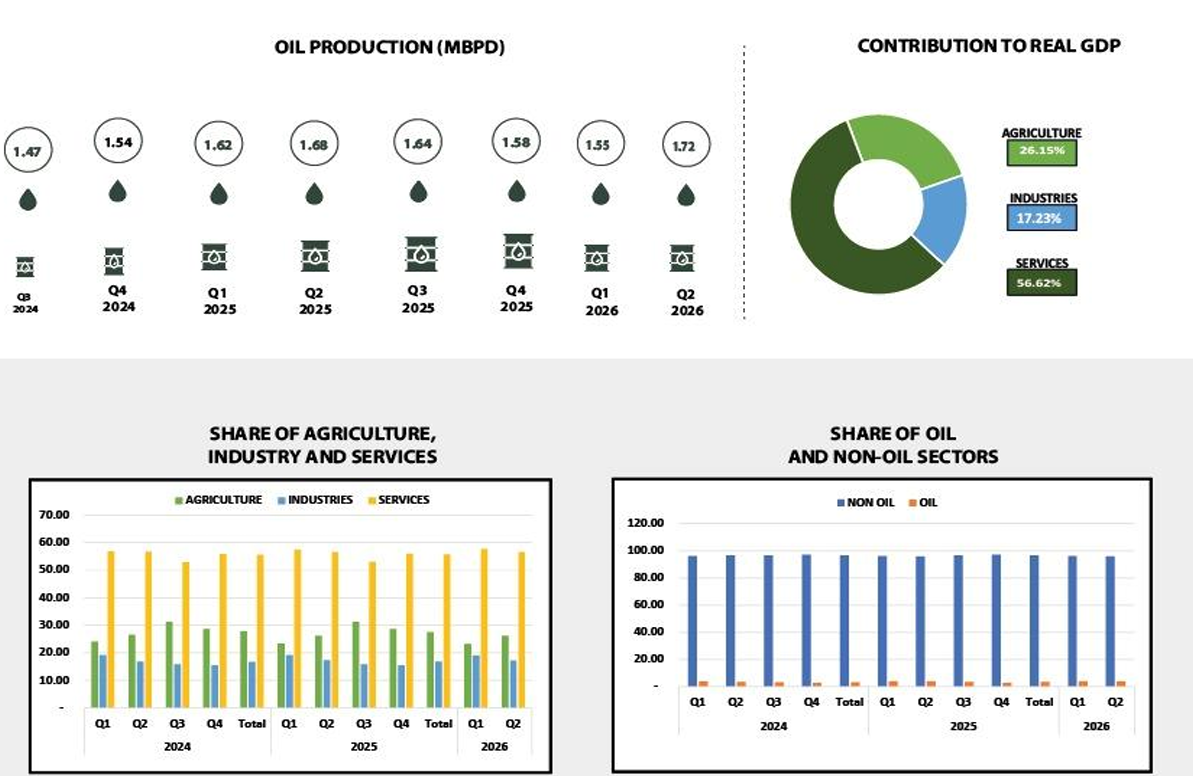
According to a report released on Monday by the National Bureau of Statistics (NBS), average daily oil production stood at 1.72 million barrels per day (mbpd) in Q2 2026, compared with 1.68 mbpd in Q2 2025 and 1.55 mbpd in the first quarter of 2026.
The oil sector recorded 7.31% real growth year-on-year, representing a decline of 13.15 percentage points from the 20.46% recorded in Q2 2025, but an increase of 4.74 percentage points from the 2.57% growth recorded in Q1 2026.
Despite the increase in oil production, the sector contributed only 4.16% to total real GDP, while the non-oil sector accounted for 95.84%. The non-oil sector also grew by 4.31% in real terms, up from 3.64% recorded in Q2 2025.
The NBS report showed that the services sector remained the largest contributor to Nigeria’s economic output, accounting for 56.62% of aggregate real GDP in Q2 2026, slightly higher than the 56.53% recorded in the corresponding quarter of 2025.
Within the broader economy, Trade, Crop Production, Real Estate, and Telecommunications and Information Services were the leading contributors to real GDP, accounting for 17.93%, 17.66%, 12.71% and 9.72%, respectively.
Meanwhile, nominal GDP stood at ₦119.29 trillion in Q2 2026, compared with ₦100.73 trillion recorded in Q2 2025, representing an 18.43% year-on-year increase.
The mining and quarrying sector also recorded significant nominal growth of 66.49% year-on-year. Coal mining increased by 99.37%, while metal ore mining rose by 89.08%, although crude petroleum and natural gas remained the dominant activity in the sector, accounting for 95.37% of its weight.
The agriculture sector recorded 4.39% real growth, improving by 1.57 percentage points from the 2.82% recorded in Q2 2025 and contributing 26.15% of real GDP. Crop production remained the dominant component of the sector, accounting for 59.35% of its nominal value.
The education sector also recorded a sharp increase in nominal growth, rising to 43.98% year-on-year in Q2 2026 from 3.85% in the corresponding quarter of 2025. This represented an increase of 40.14 percentage points year-on-year and 42.91 percentage points compared with the 1.07% recorded in Q1 2026.