


The childhood home of Neil A. Armstrong, the astronaut who commanded NASA’s Apollo 11 mission on his way to becoming the first man to walk on the moon, is for sale in Wapakoneta, Ohio.
The single-family home, built in 1908, was purchased by the Armstrong family in 1944. As a flying-obsessed boy, Neil, the oldest of three siblings, launched model airplanes made out of balsa wood from his second-story bedroom window.
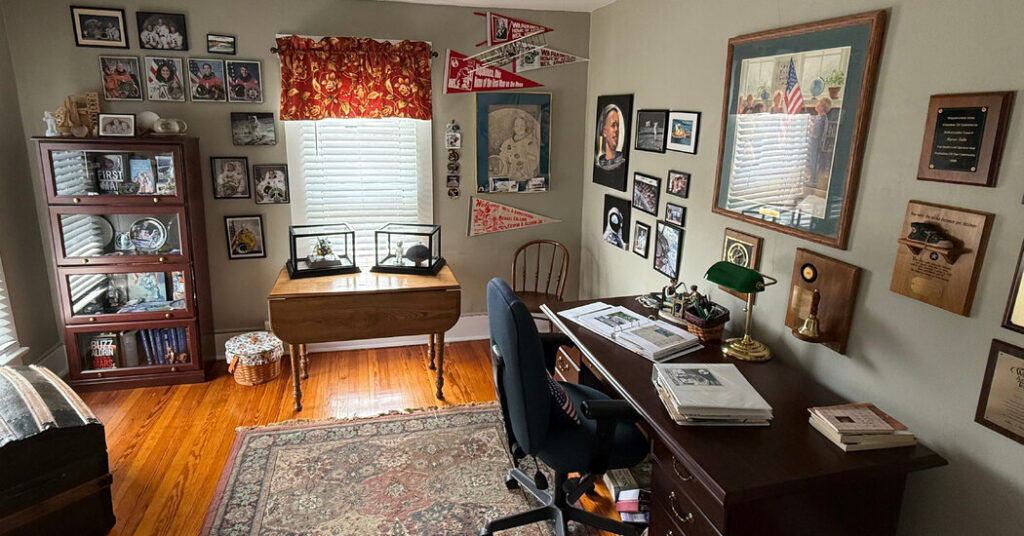
That bedroom now features a collection of items related to the astronaut found by or given to Karen Mikesell, an 82-year-old retired history teacher, who has owned the home since 1988.
Paintings, photos and memorabilia from the 50th anniversary of the moon landing cover the bedroom’s walls.
“I witnessed firsthand the Apollo program,” Mrs. Mikesell said, explaining the need to preserve this part of history.
A historical marker stands outside the home, which has three bedrooms and two bathrooms and is a little over 1,500 square feet. It was listed in July as a “once-in-a-lifetime opportunity” for $430,000.
“When you walk in it feels different,” the listing agent, Beverly Rex-Cook of Ron Spencer Real Estate, said. “It’s immaculate, but you’re walking back into time.” (No offers, yet, she said.)
When Mrs. Mikesell bought the home, its history was obscured. The listing then said nothing about Neil Armstrong, but “when I found out it was, it was exciting,” she said. “It reminded me of the home I grew up in. It was an old house and I loved it.”
She added a sign to the front yard and called the property Eagles Landing. The historical marker designating the property as Armstrong’s childhood home was placed in the front yard in 2018.
The home was a pilgrimage destination of sorts for astronauts, Mrs. Mikesell said, hosting visits over the years from the likes of Buzz Aldrin, Gregory H. Johnson, Suni Williams and Donald A. Thomas.
Mr. Armstrong was born in 1930 in Wapakoneta and had a pilot’s license by the time he was 15. The Armstrong family moved around and settled back in Wapakoneta, where Mr. Armstrong finished high school. “It’s my town and I’m very pleased that it is,” he said in a 1971 interview. After his moon mission, the town raised money to build the Armstrong Air & Space Museum.
Armstrong studied aeronautical engineering at Purdue University, earning a bachelor’s degree in aeronautical engineering, and served as a fighter pilot in the Navy, where he flew 78 combat missions.
He became the first American civilian astronaut to fly in space. He was the backup commander for Apollo 8 in 1968, the first flight to circumnavigate the Moon, and then, in 1969, took the first step in a “giant leap for mankind.”