

By Ihuoma Inyama
Nearly three decades after the death of legendary rapper Tupac Shakur, the long-running mystery surrounding his murder has finally reached the courtroom, with the trial of the man accused of orchestrating the fatal shooting now underway in Las Vegas.
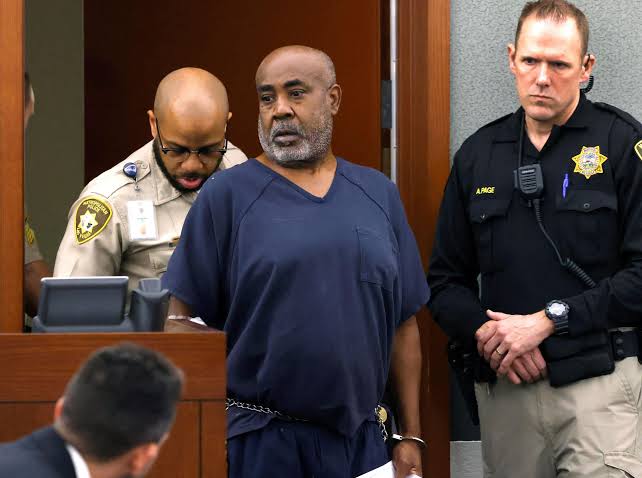
Duane “Keffe D” Davis, a former gang member who has been charged with the murder, has pleaded not guilty. His trial marks a major development in a case that has remained one of the most closely watched unsolved mysteries in hip-hop history.
Tupac was shot several times on the night of September 7, 1996, while riding in a BMW with Death Row Records co-founder Marion “Suge” Knight after attending a Mike Tyson boxing match at the MGM Grand in Las Vegas. The rapper was taken to hospital but died six days later at the age of 25.
For years, investigators struggled to make an arrest, despite the case attracting intense public attention and generating countless theories about who was responsible.
Why Keffe D Is on Trial
Prosecutors allege that Davis was involved in planning the shooting and supplied the gun used in the attack.
Davis has acknowledged being present in the vehicle from which the shots were fired, but his defence has challenged the prosecution’s interpretation of his role and the evidence connecting him directly to the killing.
A major part of the case centres on statements Davis made over the years, including material published in his 2019 memoir, Compton Street Legend.
READ ALSO; Tupac Shakur’s Mother Afeni Shakur Davis Dies at 69
Prosecutors are expected to argue that Davis’s own words provide important evidence about what happened before and after the shooting.
A Murder That Changed Hip-Hop
Tupac’s death became far bigger than a criminal investigation.
At the time of his death, he was one of the biggest names in music, known for songs that explored poverty, violence, racism, relationships and life in America.
His murder also came during one of the most turbulent periods in hip-hop, when tensions between the East Coast and West Coast rap scenes were dominating popular culture.
Just months later, fellow rap superstar The Notorious B.I.G. was also killed in Los Angeles.
The two deaths intensified the perception that the rivalry between the two sides of the music industry had become deadly, although the precise connections between the killings have remained the subject of debate for decades.
Why the Trial Matters
The case has attracted enormous attention because it could finally provide a courtroom account of what happened on the night Tupac was killed.
For fans who have spent years debating possible suspects and motives, the proceedings could offer answers to questions that have remained unanswered since 1996.
However, the trial will ultimately focus on whether prosecutors can prove their allegations against Davis beyond a reasonable doubt.
Nearly 30 years after Tupac’s death, the courtroom is now the latest stage in a case that has survived generations of conspiracy theories, conflicting accounts and unanswered questions.
For one of hip-hop’s most influential figures, the search for justice has taken almost as long as the career he never got the chance to finish.