

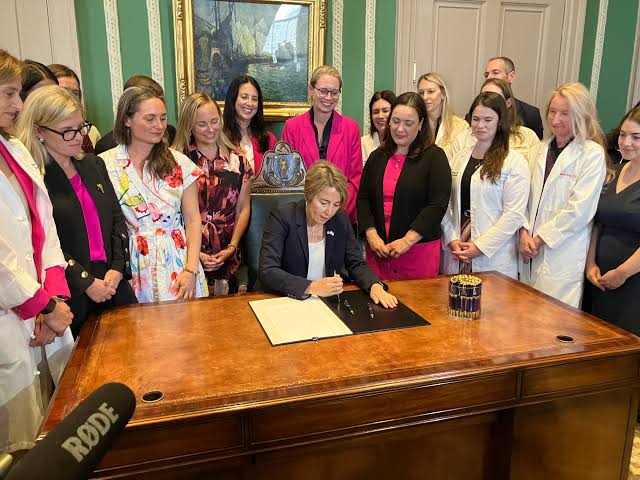
By Princess Ose Aluede
Massachusetts Governor Maura Healey has signed legislation removing the state’s previous statutory restrictions governing abortions after 24 weeks of pregnancy, triggering renewed controversy over how far abortion rights should extend and what legal safeguards should remain in place for pregnancies at an advanced stage.
The legislation has drawn strong criticism from abortion opponents, who argue that eliminating a clear statutory threshold could weaken protections for unborn children and give physicians broader discretion to terminate pregnancies much later in gestation.
Critics say the change raises serious ethical and legal questions because pregnancies beyond 24 weeks are considered significantly advanced, with the unborn child potentially capable of surviving outside the womb with intensive medical care.
Opponents have consequently used the phrase “abortion up to birth” to describe what they see as the potential consequence of removing the previous restriction.
However, the legislation does not expressly establish abortion on demand throughout pregnancy. Rather, it provides physicians with greater discretion in determining whether an abortion can be performed after 24 weeks under circumstances covered by the law.
Supporters of the measure argue that the change is necessary to protect doctors and patients facing severe and complicated pregnancies. They contend that rigid statutory limits can create uncertainty for physicians dealing with serious fetal conditions or circumstances in which continuing a pregnancy could pose significant risks to the patient.
READ ALSO; Woman, nurse remanded over alleged N16.17m fake pregnancy, abortion fraud in Lagos
But opponents maintain that medical emergencies can be addressed without eliminating clear legal boundaries on late-term abortions. They argue that the legislation places too much reliance on individual medical judgment and could make it more difficult to establish a consistent legal standard for abortions performed at advanced stages of pregnancy.
The controversy has also intensified because of the broader political and cultural divide over abortion in the United States. While abortion-rights advocates view the Massachusetts legislation as an effort to protect access to reproductive healthcare and safeguard doctors from legal uncertainty, abortion opponents see it as another step toward reducing restrictions on late-term abortion.
The debate has particularly focused on whether existing medical exceptions should be strengthened rather than removing explicit gestational limits.
Opponents contend that the state should maintain clear protections for unborn children while ensuring that doctors can intervene when genuinely necessary to save a pregnant patient’s life or address severe medical complications.
The Massachusetts law therefore represents more than a change to the state’s abortion regulations. It has become part of the wider American argument over reproductive rights, fetal protection, medical ethics and the extent to which governments should regulate abortion at advanced stages of pregnancy.
As the debate continues, opponents are expected to press for greater clarity over the circumstances under which abortions can be performed after 24 weeks, arguing that the absence of an explicit statutory restriction could create a legal framework they consider too permissive.