

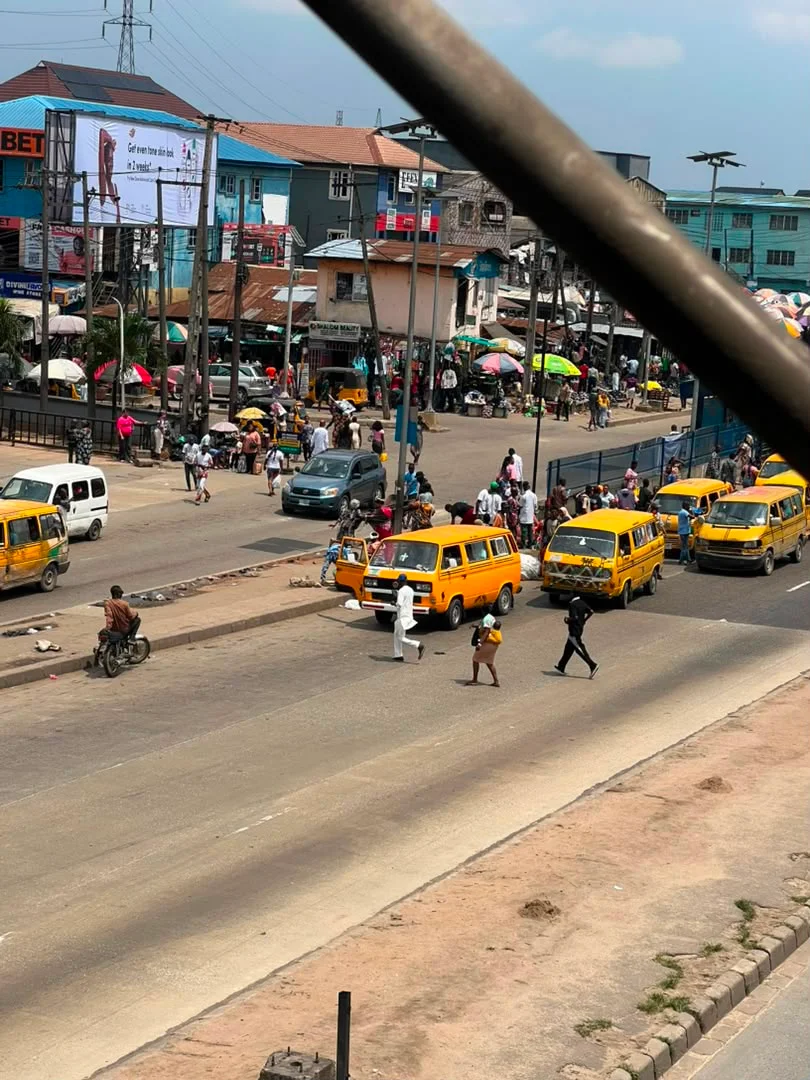
Despite millions of naira spent in constructing pedestrian bridges across Lagos metropolis to tackle recurring deaths on highways, residents continue to risk their lives by crossing highways rather than using these overpasses provided by the Lagos State Government.
The high-risk behaviour that residents, including the elderly and schoolchildren, engage in despite being fully aware of the consequences continued even after the Lagos State Environmental Sanitation Corps (LAGESC), popularly called KAI, deployed officials to strategic bridges to enforce the law against crossing highways.
The deployment, a double-edged decision which prioritise Lagosians’ safety and reduced recurring deaths, was not mainly to enforce the law on road users, but also to persuade residents to use the facilities.
Before this, the government had carried out campaigns across the state, in communities and schools, to educate residents on the need to adopt these safety measures.
However, many residents remain reluctant to use the bridges, citing a range of reasons for not taking advantage of the government-provided safety infrastructure.
A visit by The Guild correspondents to pedestrian bridges across Lagos, particularly in Oshodi, Mangoro, Ojota, Idumota, Apongbon, Cele, Ilasa, Iyana Ipaja and Amuwo Odofin showed a mixed picture.
During these visits, it was discovered that while some bridges were partially used, others appeared largely deserted, with pedestrians dashing across major roads and expressways, unmindful of traffic, to reach other parts of the road.
After several minutes of interviewing the elderly, schoolchildren, pregnant women, traders and workers, it was revealed that their reasons for avoiding the bridges vary, but largely centre on convenience, security concerns, physical difficulty, poor maintenance and the activities of traders and beggars around the facilities.
Some of those interviewed said phone snatching was common on the bridges, particularly at night and in the early hours of the morning, while beggars often occupied the facilities during the day, seeking alms from pedestrians.
At Cele, residents said robbery remains a concern as KAI officials do not work at night or early hours in the morning to prevent robbers from dispossessing commuters of their belongings.
They added that the police station, whose jurisdiction is to patrol the axis, seldom does that, leaving the commuters’ fate in their own hands.
“Around 5 o’clock, that is when they always rob commuters. Sometimes the police patrol in the evening or afternoon, like 2, 3 police officers. There is a police station by that side,” said Zainab, whose shop is close to the Cele bridge.
Another pedestrian, Ajayi, said fear of robbery and phone theft makes him reluctant to use some bridges.
“Incidents of robbery and phone theft always occur on and around the bridge. So I am always reluctant to use it, particularly when travelling alone or during quieter periods of the day,” he said.
At Amuwo Odofin, Hycent Idahor said he leaves home very early in the morning and fears being attacked by hoodlums who use parts of the infrastructure as shelter.
“I think the government should do something about these people crowding the bridge, because it is a pity that the purpose is gradually being defeated.
“Many times, people lose their belongings while using the bridge, handsets, cash. Some who even try to face these hoodlums have gotten injured and spent money on hospital bills,” he added.
Beyond security, the physical condition and use of some pedestrian bridges have also become a source of concern.
At Ilasa, The Guild observed that the pedestrian bridge had become a trading spot, with different goods displayed along the bridge and buyers moving through the facility.
Similar complaints were raised around Idumota, Apongbon and Ojota, where traders and beggars were observed occupying large portions of pedestrian walkways, a development that made it uneasy for pedestrians to move easily on the facility.

“What is the government doing about those who display their wares on the bridges?” Mary, a resident who spoke with correspondent, asked.
For some residents, the decision to cross the highway rather than use the pedestrian bridges was centered on convenience.
At Ojota, more pedestrians were observed ignoring the bridge and crossing the expressway directly, despite the obvious dangers.
At Ikeja Along, however, a larger number of commuters used the pedestrian bridge, a development attributed to the Federal Government’s decision to cordon off all access to cross the rail track, which reduced deaths recorded around the transport facility.
Some residents told The Guild that climbing the bridges adds to their walking distance and delays their journeys, particularly when they are rushing to work or trying to catch a bus.
A commuter at Iyana Ipaja, Seun Aina, said he sometimes uses the bridge but occasionally crosses the road to save time when resuming for work.
At the Cele Bus stop along the Apapa-Oshodi expressway, a pedestrian, who did not want his name in public, explained that some commuters consider crossing the road easier than using the bridge.
“Sometimes, some people find it easy. An easier way than to climb up. Some complain about their legs, that they can’t climb. But some people like me master crossing the road,” he said.“I am an old woman who is experiencing body pains. Do you expect me to climb bridges? Crossing is faster, and I don’t have to strain my legs,” an elderly woman, Iya Mubarak, who lives in the Shogunle area of Oshodi, said.
The neglect of the facilities is not limited to the senior citizens alone who complained over their inability to climb; even young Lagosians, including Sam, a trader around Cele bus stop along the Apapa-Oshodi expressway, who claimed to struggle in climbing bridges.
“Actually, my belief, and that of many Lagosians, is that it is easier to cross the road than to climb the pedestrian bridge. For example, there are some people who feel very weak when climbing the bridge. Like I’ve seen a situation of someone climbing the bridge and pausing. Was like I’m tired o.. oti remi o… After that again, the person requests a hand before she completed the movement,” he said.
Another resident, who identified himself as Goodluck, lamented that the hygiene standard on the bridge often discourages him from using the facility despite its benefits.
“Sections of the bridge have become dumping points for refuse, while parts of its steel structure appeared to have been vandalised. I am scared of using it,” he said.“That aside, the bridge also serves as a sleeping area for some homeless persons and touts, all the while traders have extended their stalls onto portions of the walkway, reducing the available space for pedestrians,” he added.
A commuter, Franklin Simon, added that poor lighting and unhygienic conditions around the bridges often made it easy for robbers to dispossess residents of their property.
“I know of many bridges with no light. It is dangerous to walk in that kind of area. What if robbers attack and maybe, at the end, throw someone off the bridge? It is about the safety of the people. Maybe if they can provide adequate measures on safety, people can begin to use the bridges,” he said.
For some residents, the problem is neither convenience nor security but a personal difficulty with using elevated structures.
A Ketu market trader, Yunisa Quadri, told The Guild that he often avoids pedestrian bridges because he suffers from acrophobia, the fear of heights.He said looking down at vehicles while using the bridge causes him significant fear and that he feels more comfortable crossing the road.Among younger residents, lack of awareness about the purpose of the bridges also emerged as a factor.
A student of a popular private school in Magoro axis of Lagos, Emmanuel, said he had not understood that the pedestrian bridges were meant for commuters’ regular use.
“I thought the only time to use it is when going to school or coming back home. I did not know that the ones in our communities are for usage,” he said.
However, Sam, the Cele resident and trader, raised allegations about the manner in which some KAI officers enforce compliance.
“Countless, like uncountable. Like I can’t even count them to be sincere with you. Police station is here, but security is poor.
“When it comes to KAI, yes. KAI is always at the junction. If you are a well-known person, they will let you go. But if you are a novice, they are going to arrest you in a violent way, which is very bad.”
He further alleged that some officers demand money from people caught crossing the road, although such claims could not be independently verified by The Guild.
Despite the different explanations offered by residents, the danger of crossing busy highways remains evident.
At Idumota and Apongbon, The Guild observed traders, commuters, and even some traffic officials crossing the expressway instead of using the pedestrian bridges, weaving through moving vehicles.
Responding to the concerns raised by residents, the KAI said its efforts have led to increased compliance, with more residents now using pedestrian bridges across the state.
The agency also said it was taking steps to address some of the challenges identified by residents, particularly the activities of traders and beggars who occupy portions of the bridges and obstruct pedestrians.
According to the agency’s Public Relations Officer, Ajayi Lukman, efforts are ongoing to arrest and remove traders, beggars and other persons whose activities interfere with the proper use of the facilities.
He said KAI has also strengthened surveillance around the bridges, with officers being deployed on different occasions to ensure that criminals do not take advantage of the facilities to attack commuters.
The PRO said enforcement operations are being intensified to ensure that residents comply with the directive to use the pedestrian bridges.
He reaffirmed the agency’s commitment to protecting the lives and safety of Lagos residents, stressing that the objective of the enforcement is not merely to arrest violators but to encourage safer behaviour and reduce the risk of pedestrian fatalities on the highways.
With the concerns of residents on one hand and the government’s enforcement efforts on the other, the challenge now lies in ensuring that the bridges are not only available but remain safe, accessible and conducive enough for residents to use them.
For many Lagosians still choosing to cross busy highways, however, the question remains whether stronger enforcement, improved security and better maintenance will be enough to change a habit that has persisted despite the obvious risks.